
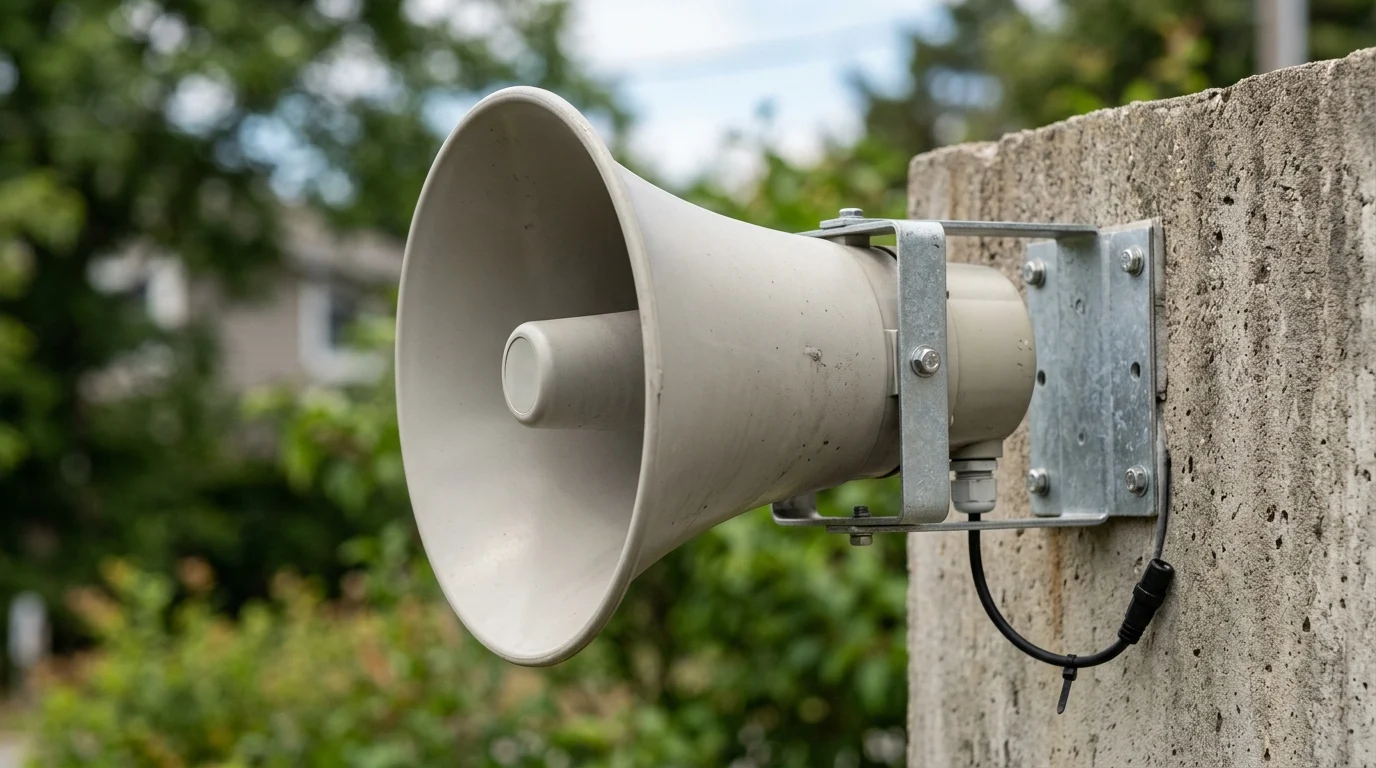
Why Outdoor Horn Speakers Matter
Industrial environments present severe acoustic challenges, characterized by vast open spaces and high ambient noise. As facilities upgrade their infrastructure to meet 2026 operational standards, the outdoor horn speaker remains an indispensable component of Public Address (PA) and General Alarm (PAGA) systems. Unlike standard commercial audio components, industrial horn speakers are engineered to penetrate background noise levels that frequently exceed 85 dB(A) in sectors like manufacturing, petrochemicals, and logistics.
The fundamental architecture of these transducers prioritizes extreme durability and acoustic efficiency. By converting electrical energy into concentrated acoustic energy, these systems ensure that critical life-safety announcements and daily operational broadcasts are delivered with absolute clarity across expansive industrial footprints.
Improving audibility and coverage
The primary acoustic advantage of the horn speaker lies in its impedance-matching design. By utilizing a flaring waveguide, the speaker efficiently couples the high pressure generated by the compression driver to the lower pressure of the open air. This physical amplification allows a standard 30-watt horn speaker to achieve Sound Pressure Levels (SPL) exceeding 120 dB at 1 meter.
Consequently, a single unit can maintain critical voice intelligibility over distances of 50 to 150 meters. This focused projection overcomes the inverse square law of sound attenuation far more effectively than direct-radiating cone speakers, significantly reducing the total hardware and amplifier power required to cover a multi-acre facility.
Supporting modern industrial PA systems
Modern industrial PA systems are rapidly transitioning from legacy analog architectures to fully networked IP/SIP frameworks. By 2026, the integration of Power over Ethernet (PoE+) outdoor horn speakers will be standard practice for new facility builds and major retrofits. These IP-enabled horns connect directly to the facility’s Local Area Network (LAN), allowing for decentralized zoning, remote health monitoring, and seamless integration with existing VoIP infrastructure.
Networked horn speakers can achieve audio delivery with latency well under 20 milliseconds, ensuring synchronized broadcasting across vast industrial campuses. This digital integration eliminates the echo effect common in older analog daisy-chains and allows system administrators to adjust DSP (Digital Signal Processing) parameters on a per-speaker basis, optimizing audibility for specific micro-environments within the plant.
Key Specifications for Outdoor Horn Speakers

Specifying the correct outdoor horn speaker requires a rigorous evaluation of acoustic output capabilities, environmental resilience, and electrical integration. A mismatch in any of these parameters can lead to critical communication failures during emergency events or premature hardware deterioration.
SPL, sensitivity, and dispersion angle
The fundamental performance metrics of a horn speaker are its Sound Pressure Level (SPL), sensitivity, and dispersion angle. Sensitivity, typically measured at 1 watt at 1 meter (1W/1m), often ranges from 105 dB to 110 dB for industrial horns, indicating extreme electro-acoustic efficiency.
Dispersion angles dictate the coverage footprint; a narrow dispersion (e.g., 60° horizontal by 40° vertical) focuses acoustic energy for long-throw applications, while a wider dispersion (e.g., 120° x 90°) sacrifices maximum distance for broader close-range coverage. Acoustic engineers must calculate the required SPL at the listener’s ear, factoring in the inverse square law, which dictates a 6 dB drop in sound pressure for every doubling of distance from the source.
IP rating, UV resistance, and corrosion protection
For outdoor deployments, environmental specifications are just as critical as acoustic performance. Industrial horn speakers must carry an Ingress Protection (IP) rating of at least IP66, and preferably IP67, to withstand heavy rain, high-pressure washdowns, and total dust ingress.
Furthermore, housings must resist ultraviolet (UV) degradation and chemical corrosion. High-impact UV-stabilized ABS plastic is standard for general outdoor use, while marine-grade aluminum or specialized glass-reinforced polyester (GRP) is mandatory for highly corrosive offshore or petrochemical environments. Operating temperature tolerances typically must span from -40°C to +70°C to ensure continuous reliability across extreme global climates.
Transformer line systems for large sites
Large-scale industrial sites rely on high-voltage constant-voltage distributed audio systems, predominantly 70V or 100V transformer line systems. These systems mitigate the severe voltage drop and power loss that occur over long cable runs. Horn speakers equipped with multi-tap step-down transformers allow installers to adjust the wattage drawn by each speaker (e.g., selecting between 5W, 10W, 15W, and 30W taps) to balance the amplifier load and tailor the volume for specific zones.
| Amplifier Output | Cable Gauge (AWG) | Max Distance (100V, 100W Load) | Max Distance (100V, 30W Load) |
|---|---|---|---|
| 100V | 18 AWG (0.82 mm²) | ~450 meters | ~1,500 meters |
| 100V | 16 AWG (1.31 mm²) | ~700 meters | ~2,300 meters |
| 100V | 14 AWG (2.08 mm²) | ~1,100 meters | ~3,600 meters |
Selecting the correct tap setting in conjunction with the appropriate cable gauge ensures that the furthest outdoor horn speaker in the circuit receives adequate voltage to reach its rated SPL without overloading the central amplification matrix.
Outdoor Horn Speakers vs Other PA Speakers
While the outdoor horn speaker is a staple of industrial audio, it is not the only transducer available for public address. Comparing horn speakers with cabinet, column, and ceiling speakers highlights the specific acoustic and physical trade-offs inherent in industrial system design.
Coverage pattern comparison
Coverage patterns vary drastically between speaker types. Cabinet speakers utilize direct-radiating cones that produce a relatively wide, hemispherical dispersion, making them suitable for localized, low-ceiling areas. Column speakers employ an array of small drivers to create a wide horizontal but tightly controlled vertical dispersion, minimizing floor and ceiling reflections in highly reverberant indoor spaces.
Conversely, horn speakers utilize their mechanical waveguide to tightly control both horizontal and vertical dispersion. This creates a highly directional beam of acoustic energy that penetrates long distances without scattering, minimizing unwanted acoustic spill into adjacent zones or neighboring residential areas.
Where horn speakers perform best
Horn speakers excel in environments characterized by extreme ambient noise and expansive physical footprints. Refineries, rail yards, open-pit mines, and seaport terminals routinely generate background noise levels between 90 dB and 110 dB.
In these settings, cabinet and column speakers lack the acoustic efficiency and concentrated throw to overpower the ambient din. The horn speaker’s ability to focus acoustic energy ensures that critical safety announcements cut through heavy industrial machinery noise and reach personnel working in vast, unprotected outdoor zones.
Sound quality, appearance, and beam control trade-offs
The primary trade-off when selecting a horn speaker involves frequency response and aesthetic profile. Because horn drivers are optimized for maximum efficiency in the human vocal range, their frequency response is typically restricted to a narrow band, often between 300 Hz and 8 kHz.
This makes them highly effective for speech intelligibility but entirely unsuitable for full-range background music, which requires the 80 Hz to 20 kHz range provided by two-way cabinet speakers. Additionally, the prominent, utilitarian appearance of large horn flares may conflict with architectural aesthetics, though in heavy industry, durability and beam control supersede visual discretion.
| Speaker Type | Typical Sensitivity (1W/1m) | Frequency Response | Environmental Durability | Ideal Industrial Application |
|---|---|---|---|---|
| Horn Speaker | 105 dB – 110 dB | 300 Hz – 8 kHz | Excellent (IP66/67, GRP) | Vast outdoor yards, high-noise areas |
| Cabinet Speaker | 88 dB – 92 dB | 80 Hz – 20 kHz | Moderate (IP54/IP65) | Indoor control rooms, offices |
| Column Array | 90 dB – 95 dB | 150 Hz – 15 kHz | High (IP55/IP66) | Reverberant indoor halls, platforms |
Compliance, Installation, and Commissioning
Deploying an industrial PA system is a highly regulated engineering discipline. To meet 2026 life-safety standards, the installation and commissioning of outdoor horn speakers must adhere to strict compliance frameworks governing design, redundancy, and measurable acoustic performance.
Zoning and system design
Effective zoning is the foundation of industrial PA system design. Facilities must be acoustically mapped and divided into distinct zones based on ambient noise profiles and operational functions. A common installation error is over-populating an outdoor area with horn speakers pointing in opposing directions, which creates severe multi-path acoustic echoes.
Proper design aligns speakers in a single direction, utilizing digital delay processors to synchronize the arrival time of the sound wave from supplementary speakers further down the line. Delay is typically calculated at approximately 3 milliseconds per meter of distance between speaker poles, ensuring that listeners perceive a single, cohesive audio broadcast rather than a chaotic echo.
Safety, fire alarm, and voice evacuation requirements
When an outdoor horn speaker network doubles as a Voice Alarm (VA) or Voice Evacuation system, it must comply with stringent life-safety standards such as EN 54-24 in Europe or UL 1480 in North America. These standards mandate fire-resistant terminal blocks, thermal fuses, and rigorous testing for continuous operation under extreme heat.
Furthermore, the amplifier network must feature continuous line monitoring. This is achieved by injecting an inaudible 20 kHz pilot tone or measuring the impedance of the 100V line in real-time to instantly report ground faults, short circuits, or severed cables to the central control matrix, guaranteeing system readiness during an emergency.
Commissioning steps for intelligibility
The final phase of deployment is acoustic commissioning, which validates the system’s performance against life-safety requirements. Subjective listening tests are no longer sufficient under modern regulatory frameworks.
Engineers must utilize specialized acoustic analyzers to measure the Speech Transmission Index (STI) or STIPA (Speech Transmission Index for Public Address). The STI scale ranges from 0.0 to 1.0. For emergency voice evacuation systems, international standards generally mandate a minimum STI score of 0.50 in all coverage areas, ensuring that voice instructions are clearly intelligible above the facility’s baseline ambient noise.
How to Specify and Source Outdoor Horn Speakers
Procuring outdoor horn speakers for a major industrial upgrade requires a strategic approach that looks beyond the initial unit price. Facilities managers and systems integrators must adopt a Total Cost of Ownership (TCO) methodology to ensure long-term reliability and compliance.
Balancing lifecycle cost and performance
Balancing lifecycle cost and performance is crucial in harsh industrial environments. While a standard commercial-grade ABS horn speaker might cost $50, a hazardous-area, marine-grade GRP horn can easily exceed $300 to $500 per unit.
However, opting for the cheaper unit in a corrosive environment inevitably leads to rapid failure. The true cost of replacement includes not just the hardware, but the operational downtime, scaffolding erection, and specialized labor required to replace a speaker mounted 10 meters high on an active chemical processing plant. Such an intervention can easily cost upwards of $1,000 per incident, making the higher initial CAPEX of industrial-grade units significantly more economical over a 10-year operational lifecycle.
Building a buyer decision matrix
To streamline procurement, engineering teams should construct a comprehensive buyer decision matrix. Key weighting factors should include acoustic performance (SPL and STI capability), environmental certification (IP rating, ATEX/IECEx for explosive atmospheres), and vendor ecosystem compatibility.
Supply chain logistics also play a critical role in the matrix. Highly specialized explosion-proof horn speakers often carry lead times of 8 to 12 weeks, which must be factored into the project’s critical path. Warranty terms, typically ranging from 1 to 5 years, and the availability of replacement driver diaphragms should also be heavily weighted to ensure ongoing maintainability.
Final specification guidance
Finalizing the specification requires translating the acoustic modeling and environmental requirements into a rigid Request for Proposal (RFP). The specification document must explicitly state the minimum acceptable sensitivity (e.g., >105 dB 1W/1m), the required IP rating, the exact transformer tap configurations, and any necessary third-party certifications.
By establishing strict Minimum Order Quantities (MOQs) aligned with phased installation schedules, and enforcing rigorous Factory Acceptance Testing (FAT) criteria, buyers can confidently source outdoor horn speakers that will meet the uncompromising demands of industrial PA systems through 2026 and beyond.
Key Takeaways
- Select outdoor horn speakers with sensitivity around 105–110 dB at 1W/1m to maintain intelligible paging in high-noise industrial areas.
- Use 30-watt industrial horn speakers capable of exceeding 120 dB at 1 meter when alarms must cut through ambient noise above 85 dB(A).
- Plan speaker placement for practical voice coverage of about 50 to 150 meters per unit, then verify results with an acoustic survey.
- Choose narrow dispersion such as 60° x 40° for long-throw coverage and wider dispersion such as 120° x 90° for broad close-range zones.
- Prioritize IP/SIP and PoE+ horn speakers for 2026 upgrades to enable decentralized zoning, remote health monitoring, VoIP integration, and synchronized broadcasts.
Frequently Asked Questions
Why are outdoor horn speakers important in industrial PA systems?
Outdoor horn speakers project clear voice alarms and paging across noisy, open industrial areas. Their high efficiency helps overcome ambient noise above 85 dB(A), making them critical for safety announcements, evacuation alerts, and routine operations.
What SPL should an industrial outdoor horn speaker provide?
Many industrial horn speakers deliver sensitivity around 105–110 dB at 1W/1m, while a 30-watt model can exceed 120 dB at 1 meter. The right SPL depends on site noise, distance, and required voice intelligibility.
How far can an outdoor horn speaker cover?
Depending on power, mounting height, dispersion angle, and site noise, one industrial horn speaker may support intelligible voice coverage across roughly 50 to 150 meters. A site acoustic survey is recommended for accurate placement.
Are IP or PoE horn speakers better for 2026 PA upgrades?
For new builds and retrofits, IP/SIP and PoE+ horn speakers offer easier zoning, remote monitoring, VoIP integration, and lower-latency synchronized announcements compared with many legacy analog daisy-chain systems.
What dispersion angle should I choose for an outdoor horn speaker?
Use narrow dispersion, such as 60° x 40°, for long-throw coverage along roads, yards, or process areas. Use wider dispersion, such as 120° x 90°, when broad close-range coverage is more important than distance.

Post time: Jun-24-2026