
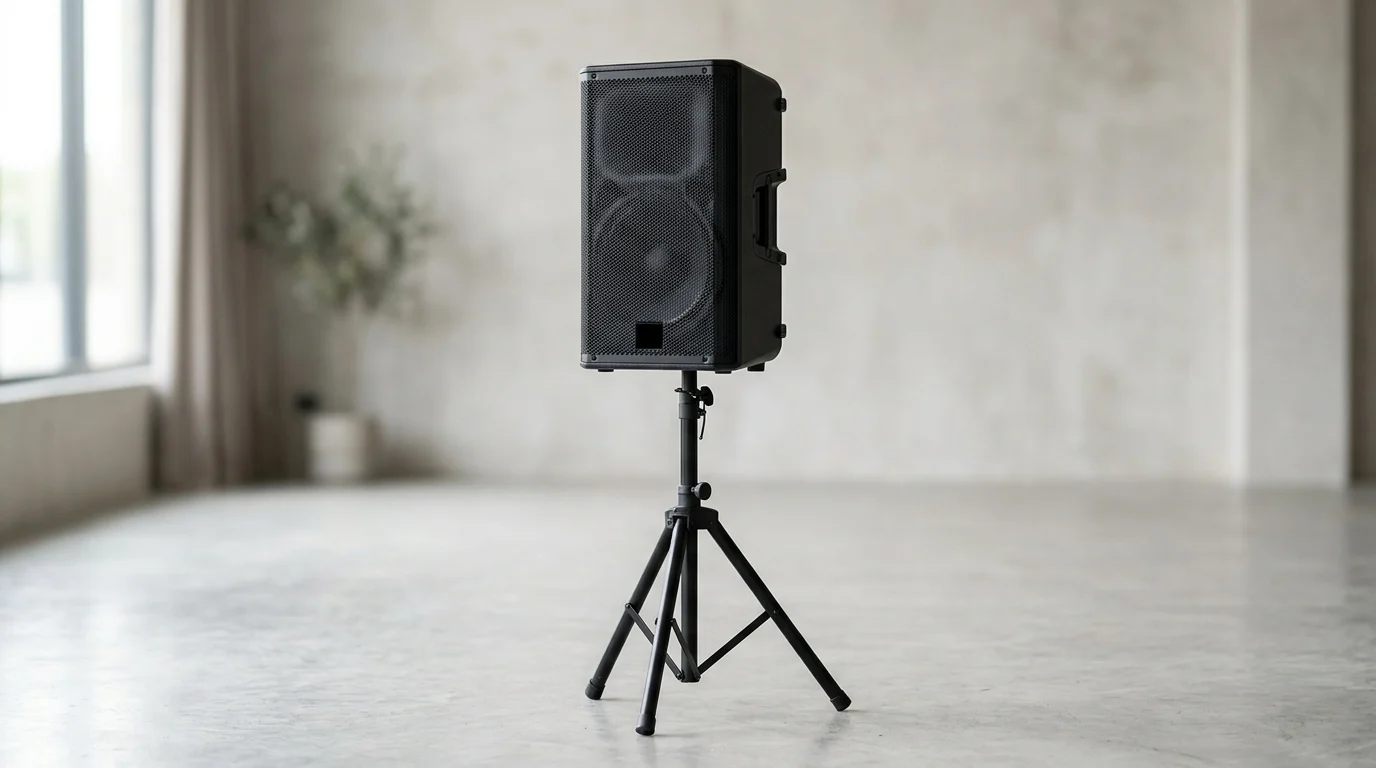
PA Speaker vs Horn Speaker: Key Differences
In the commercial audio and mass notification industry, the terminology surrounding acoustic transducers can often be a source of confusion. The term “PA speaker” (Public Address speaker) is frequently used as a blanket designation for any loudspeaker connected to a distributed audio system. While the broader professional audio industry often uses “PA speaker” to describe any sound reinforcement enclosure—including horn-loaded concert rigs—in commercial distributed audio, it typically refers to a direct-radiating loudspeaker. Understanding the distinction between a direct-radiating PA speaker and a horn speaker is critical for AV integrators, acousticians, and facility managers tasked with designing systems that meet specific intelligibility (often targeting a Speech Transmission Index of >0.50), coverage, and environmental requirements.
The primary divergence between these two technologies lies in their method of electro-acoustic transduction and acoustic coupling to the surrounding air. A standard PA speaker typically utilizes a moving-coil cone driver mounted within a sealed or ported enclosure. This design radiates sound directly into the environment, prioritizing a wide frequency response (typically 60 Hz to 20,000 Hz) and natural tonal balance. In contrast, a horn speaker utilizes a specialized compression driver coupled to a flared acoustic waveguide (the horn). This configuration acts as an acoustic transformer, matching the high mechanical impedance of the driver’s diaphragm to the low acoustic impedance of the surrounding air. This maximizes electro-acoustic efficiency, though typically at the expense of low-frequency reproduction (often rolling off steeply below 300 Hz).
For system designers, selecting between a PA speaker and a horn speaker is a calculation based on the physical constraints of the deployment space. The decision hinges on the required Sound Pressure Level (SPL), the ambient noise floor, the necessary throw distance, and the primary content being broadcast—whether that is full-range background music, critical voice paging, or emergency evacuation tones.
Core purpose and sound coverage
The core purpose of a traditional PA speaker is to deliver high-fidelity audio across a broad frequency spectrum. This makes it capable of reproducing both the nuances of recorded music and the natural timbre of the human voice. Because standard PA speakers rely on direct-radiating cones, their sound coverage tends to be relatively wide and conical, often dispersing audio at angles between 90° and 120°. This wide dispersion is highly effective for blanketing an area with uniform sound, provided the ceiling height (optimally 8 to 14 feet) and acoustic reflections are managed correctly.
Horn speakers, conversely, are engineered for maximum projection and penetration. Their primary function is to deliver highly intelligible, narrow-band audio over long distances or through environments with severe ambient noise. The flare of the horn dictates the dispersion pattern, which is typically much narrower and highly controlled—often restricted to 60° by 40° or tighter, yielding a high Directivity (Q) factor of 10 to 15. This focused directivity concentrates the acoustic energy into a specific beam, minimizing acoustic spill into unwanted areas and reducing the excitation of reverberant fields in highly reflective environments.
Typical public address and paging applications
In practical application, standard PA speakers are usually the default choice for environments where audio quality, aesthetic integration, and uniform coverage of low-to-moderate volume sound (typically 70 to 85 dB) are the primary goals. Integrators deploy surface-mount, pendant, and ceiling-recessed PA speakers extensively in retail stores, corporate boardrooms, hospitality venues, and educational facilities. In these settings, the system must seamlessly transition between providing unobtrusive background music (BGM) and clear, natural-sounding localized voice paging.
Horn speakers are frequently specified for industrial, outdoor, and life-safety applications where raw acoustic output and survivability supersede musical fidelity. They are standard in rail yards, manufacturing floors, sports stadiums, and municipal emergency warning systems. In a manufacturing plant with an ambient noise floor of 85 to 90 dB(A), a standard PA speaker would typically be drowned out or driven to failure attempting to overcome the noise. A horn speaker, however, can easily generate the 105 to 115 dB(A) peak output necessary to achieve the required +10 dB to +15 dB signal-to-noise ratio for intelligible emergency paging. It is worth noting that this indoor/outdoor divide is not absolute; weather-resistant direct-radiating PA speakers are often used outdoors for high-fidelity audio, while horn speakers are regularly deployed indoors in noisy, cavernous spaces like ice rinks or warehouses.
What Is a PA Speaker
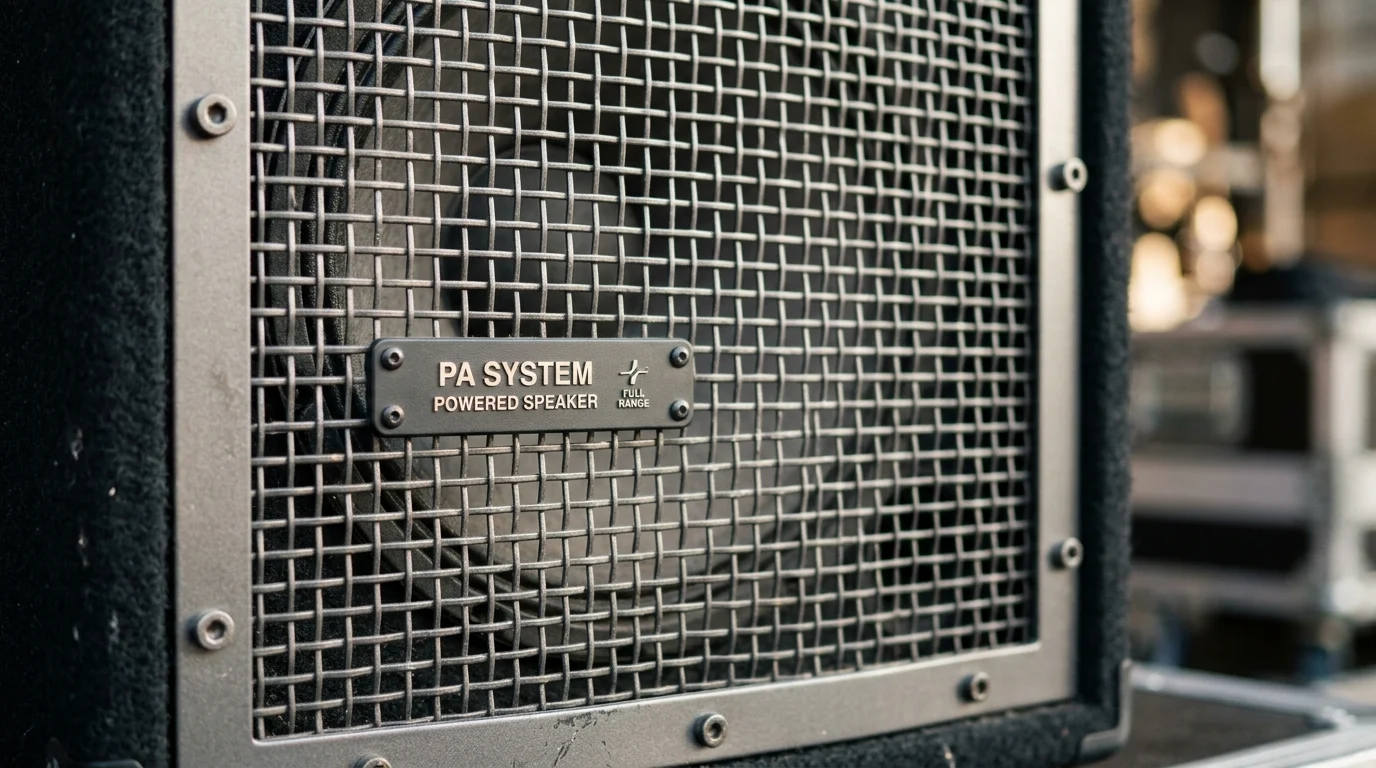
A PA speaker, in the context of commercial distributed audio, refers to a direct-radiating loudspeaker designed to reproduce a wide range of audio frequencies for general-purpose broadcasting. Installed commercial PA speakers are typically engineered for continuous operation within 70V or 100V constant-voltage distribution networks. This allows dozens or even hundreds of speakers to be daisy-chained across a vast facility using relatively small-gauge wire (typically 16 to 18 AWG), overcoming the immense signal loss that would occur with standard low-impedance (8-ohm) wiring over cable runs exceeding 100 to 200 feet.
The physical construction of a commercial PA speaker typically involves a rigid enclosure made from injection-molded ABS plastic, medium-density fiberboard (MDF), or steel. Inside the enclosure, one or more moving-coil transducers are mounted to a front baffle. The enclosure prevents the out-of-phase sound waves generated by the rear of the speaker cone from wrapping around and canceling out the sound waves produced by the front, which is essential for reproducing low and lower-midrange frequencies.
To interface with distributed audio networks, commercial PA speakers are equipped with integrated step-down line-matching transformers. These transformers feature multiple primary taps (e.g., 1.5W, 3W, 6W, 15W, 30W), allowing the system integrator to individually adjust the wattage drawn by each speaker. This capability is crucial for balancing SPL levels across different zones of a building.
How PA speakers reproduce speech and music
To achieve a wide and flat frequency response, commercial PA speakers frequently utilize a two-way acoustic design. This configuration divides the audio signal into two distinct frequency bands using an internal passive crossover network (typically crossing over between 2.5 kHz and 3.5 kHz). Low and mid-range frequencies are routed to a larger woofer cone (usually 4 to 8 inches in diameter), while high frequencies are directed to a smaller tweeter (typically 0.75 to 1 inch).
By dividing the labor between transducers optimized for their respective frequency ranges, two-way PA speakers can reproduce both the deep bass notes required for foreground music and the critical consonant sounds necessary for voice intelligibility. The crossover network ensures a smooth transition between the drivers, maintaining a natural vocal timbre that prevents listener fatigue during extended playback.
Best-fit indoor and commercial uses
Because they excel at reproducing a full frequency spectrum with wide dispersion, PA speakers are an optimal choice for commercial environments where the ambient noise floor is relatively low (typically under 65 to 70 dB(A)). Retail environments heavily rely on these speakers to create an immersive brand atmosphere through high-fidelity background music, while simultaneously utilizing them for employee paging. Corporate environments utilize ceiling-mounted PA speakers in lobbies and corridors to provide a seamless auditory experience.
Furthermore, PA speakers are designed with architectural integration in mind. Manufacturers offer these units in low-profile ceiling-recessed formats, pendant spheres for open-architecture ceilings, and sleek surface-mount cabinets. While traditionally viewed as indoor solutions, many modern PA speakers feature weatherized components, making them suitable for outdoor dining patios and theme parks where audio fidelity remains a priority.
What Is a Horn Speaker
A horn speaker is a specialized electro-acoustic transducer designed to maximize acoustic output, projection, and efficiency. Rather than relying on a large, direct-radiating cone, a horn speaker utilizes a small, rigid diaphragm housed within a compression driver. This driver is mechanically coupled to the narrow throat of an acoustic waveguide (often a 1-inch or 2-inch exit diameter)—the flared horn structure that gives the device its name.
The defining characteristic of a horn speaker is its ability to perform acoustic impedance matching. The compression driver generates sound waves at extremely high pressure within the narrow throat of the horn. As the sound waves travel outward through the expanding flare, the pressure decreases while the particle velocity increases, smoothly matching the impedance of the open air. This transformer-like action prevents massive acoustic reflections, allowing almost all the acoustic energy to be radiated forward.
Because of this intense efficiency, horn speakers require significantly less electrical power to generate high sound pressure levels compared to traditional PA speakers. A typical horn speaker can often produce 105 dB to 110 dB of output from a single watt of amplifier power measured at one meter, compared to just 85 to 90 dB for a standard cone speaker. However, the lowest frequency a horn can effectively reproduce is dictated by the circumference of its mouth. Consequently, most commercial paging horns cannot reproduce low bass frequencies, resulting in a sound profile focused on the midrange and high frequencies (typically 300 Hz to 8,000 Hz).
How horn loading increases projection
Horn loading drastically alters the directivity of the sound wave. While a bare cone driver spills acoustic energy in all directions, the rigid walls of a horn waveguide confine the sound wave, forcing it into a specific, predictable coverage pattern. By preventing sound energy from dispersing vertically or laterally into adjacent areas, the horn concentrates all available acoustic power straight ahead along its primary axis.
This concentration of energy allows horn speakers to achieve massive throw distances, often projecting intelligible speech 50 to 150 meters or more. The physical design ensures that the high-frequency sound waves remain coherent, allowing the critical articulation frequencies of human speech (2 kHz to 4 kHz) to punch through dense, noisy environments much more effectively than a wide-dispersion sound source.
Best-fit outdoor and industrial uses
The acoustic properties of horn speakers make them a leading choice for outdoor environments and heavy industrial applications. In locations such as railway stations, shipping ports, and lumber yards, projecting an announcement over vast distances is an operational requirement. The narrow frequency band of a horn speaker naturally filters out the low-frequency rumble of diesel engines and heavy machinery, ensuring that the voice paging signal occupies a distinct, audible space in the acoustic spectrum.
Additionally, horn speakers are inherently rugged. Because the delicate diaphragm is safely enclosed within the heavy casing of the compression driver, it is protected from the elements. Most commercial horn speakers are constructed from UV-resistant ABS plastic, spun aluminum, or fiberglass, easily achieving IP66 or IP67 ratings and operating in extreme temperature bands (e.g., -40°C to +60°C). This makes them ideal for marine environments, extreme weather installations, and hazardous manufacturing facilities.
Specification Comparison
When evaluating PA speakers versus horn speakers for a commercial audio design, AV integrators rely on a standardized set of electro-acoustic specifications to predict system performance. Acoustic modeling software, such as EASE (Enhanced Acoustic Simulator for Engineers), utilizes these specifications to generate heat maps of sound pressure levels and intelligibility scores across a digital 3D model of the venue.
The most critical metrics include frequency response, sensitivity (SPL at 1W/1m), nominal coverage angle, and the resulting Speech Transmission Index (STI). Furthermore, the physical and electrical specifications dictate the hardware’s survivability and total cost of ownership over its operational lifespan.
| Specification Dimension | Standard PA Speaker (Surface/Ceiling) | Horn Speaker (Paging/Industrial) |
|---|---|---|
| Frequency Response | 60 Hz – 20,000 Hz (Full Range) | 250 Hz – 10,000 Hz (Vocal Band) |
| Sensitivity (1W/1m) | 85 dB to 95 dB | 105 dB to 115 dB |
| Nominal Coverage Angle | 90° to 120° (Conical/Broad) | 40° to 60° (Highly Directional) |
| Typical Power Taps | 1.5W, 3W, 6W, 15W, 30W | 7.5W, 15W, 30W, 60W, 100W |
| Primary Use Case | BGM, FGM, Indoor Paging | Emergency Mass Notification, Outdoor |
| Typical IP Rating | IP20 to IP44 (Indoor/Covered) | IP66 to IP67 (Harsh Weather) |
| Enclosure Material | MDF, Light ABS, Steel back-cans | Heavy-duty ABS, Aluminum, Fiberglass |
Frequency response, SPL, and coverage angle
As outlined in the specification comparison, the broad frequency response of a standard PA speaker allows for rich music reproduction, but this full-range capability requires more amplifier power (often 15W to 30W per speaker) to achieve high SPLs. Its wide coverage angle means sound dissipates more rapidly over distance, following the inverse square law (-6 dB per doubling of distance).
Horn speakers operate on entirely different mathematical ratios. Their truncated frequency response perfectly brackets the human vocal range. Because energy is not wasted reproducing power-hungry low frequencies, sensitivity is extremely high. Coupled with a tight coverage angle, this localized SPL is directed exactly where it is needed with minimal power draw (often achieving target SPLs with just 2W to 5W of tapped power).
Intelligibility, throw distance, and music quality
Intelligibility in commercial audio is objectively measured using the Speech Transmission Index (STI), a scale from 0.0 to 1.0. Life safety codes (such as NFPA 72 or EN 54-24) typically require a minimum STI of 0.45 to 0.50 for emergency voice alarms. Over short distances in acoustically treated rooms, PA speakers achieve excellent STI scores (often >0.60). However, in large, reverberant spaces, the wide dispersion of a PA speaker excites the room’s reverberant field, causing overlapping echoes that severely degrade STI.
Horn speakers excel at maintaining high STI scores over long throw distances in hostile acoustic environments. By confining the acoustic energy to a narrow beam, a horn speaker minimizes reflections off ceilings and side walls. However, this same acoustic profile renders horn speakers generally unsuitable for high-quality music playback, as the lack of bass and over-emphasized midrange can result in listener fatigue if used for continuous background music.
Cost, durability, and lifecycle value
From a capital expenditure (CAPEX) perspective, standard commercial PA speakers are generally less expensive per unit (typically $40 to $150 USD) than heavy-duty industrial horn speakers. However, their lifecycle value is heavily dependent on the environment; deploying standard indoor PA speakers in high-humidity or outdoor areas will necessitate frequent replacement (often failing within 2 to 3 years).
Horn speakers represent a higher initial investment ($100 to $400+ USD) but offer vastly superior durability and lifecycle value in demanding environments, often boasting 15- to 20-year operational lifespans. Materials like UV-stabilized polycarbonate and spun aluminum are highly resistant to environmental degradation. Furthermore, many high-end compression drivers feature field-replaceable voice coil diaphragms, allowing technicians to repair a blown driver for a fraction of the cost of a new speaker.
How to Choose the Right Speaker
Selecting the appropriate loudspeaker technology is a multi-disciplinary process that requires assessing architectural acoustics, electrical engineering constraints, and life-safety compliance codes. Integrators must engineer a distributed array that provides uniform coverage, meets the required signal-to-noise ratio (standard target is +10 dB to +15 dB above ambient noise), and integrates safely into the facility’s existing infrastructure.
The design phase should begin with a thorough site survey or the analysis of architectural blueprints. Acoustic modeling is highly recommended for complex spaces to predict how the directivity of a horn or the wide dispersion of a PA speaker will interact with the physical boundaries of the room.
Match speaker type to environment and audience
The first critical decision matrix involves matching the transducer to the environment’s ambient noise and the audience’s primary activity. Integrators must measure the average and peak ambient noise levels (in dB-A) of the space.
| Environment | Typical Ambient Noise (dB-A) | Recommended Speaker Type | Target Paging SPL (dB-A) |
|---|---|---|---|
| Corporate Office / Library | 40 dB – 50 dB | Ceiling/Surface PA | 55 dB – 65 dB |
| Retail Store / Restaurant | 60 dB – 70 dB | Ceiling/Pendant PA | 75 dB – 85 dB |
| Municipal Parking Garage | 75 dB – 85 dB | Directional Horn | 90 dB – 100 dB |
| Manufacturing / Rail Yard | 85 dB – 95+ dB | High-Output Horn | 100 dB – 110+ dB |
If the environment is a retail floor with an ambient noise level of 65 dB, a network of ceiling-mounted PA speakers will easily provide clear paging while maintaining the wide frequency response required for high-fidelity background music.
Conversely, if the environment is a municipal parking garage with an ambient noise level of 85 dB due to vehicle traffic, a standard PA speaker will likely fail to deliver clear messaging. The system should utilize horn speakers aimed down the driving lanes to cut through the engine noise and control the acoustic energy, preventing it from bouncing endlessly off the concrete slabs. In this scenario, the audience only needs to clearly hear evacuation instructions or security warnings.
Check power, impedance, weather rating,
and mounting requirements to ensure long-term reliability. Once the acoustic needs are met, verify that the chosen speaker aligns with the amplifier’s power capabilities (maintaining a 20% minimum headroom margin) and the system’s impedance structure (e.g., 70V/100V vs. 8-ohm). Additionally, carefully review the IP (Ingress Protection) rating. While horn speakers naturally excel in harsh conditions, many manufacturers now offer highly weather-resistant, IP55-rated direct-radiating PA speakers for outdoor environments. Conversely, horn speakers are frequently deployed indoors in noisy, reverberant spaces like manufacturing plants. Ultimately, the choice between a PA speaker and a horn speaker comes down to balancing audio fidelity against raw output and directivity. By evaluating ambient noise, required throw distance, and the primary audio content, system designers can deploy the right technology for clear, reliable communication.
Key Takeaways
- Use direct-radiating PA speakers when you need broad, natural coverage for voice and music across a wide frequency range, typically around 60 Hz to 20,000 Hz.
- Use horn speakers when the priority is high-efficiency voice projection over distance, especially in noisy, outdoor, or industrial environments.
- Plan coverage by dispersion: many PA speakers spread sound around 90° to 120°, while horn speakers may focus output to about 60° by 40° or tighter.
- For emergency and mass notification applications, design around intelligibility targets such as an STI above 0.50 rather than loudness alone.
- Avoid using horn speakers as full-range music speakers because many models lose low-frequency output sharply below about 300 Hz.
- Match the speaker type to the site conditions, including ambient noise, throw distance, ceiling height, weather exposure, and hazardous-area requirements.
Frequently Asked Questions
Is a PA speaker the same as a horn speaker?
Not exactly. A PA speaker is often a broad term, but in distributed audio it usually means a direct-radiating speaker. A horn speaker uses a compression driver and flared horn to project sound farther and more efficiently.
When should I choose a horn speaker?
Choose a horn speaker for long-distance paging, emergency alerts, outdoor areas, or noisy industrial sites where speech intelligibility and projection matter more than music quality.
When is a standard PA speaker better?
A standard PA speaker is better for wider, more natural sound coverage, especially where music, announcements, and balanced voice reproduction are needed in offices, campuses, shops, or indoor facilities.
Why are horn speakers common in industrial environments?
Horn speakers are efficient, directional, and capable of cutting through high ambient noise. This makes them useful for mining, oil and gas, transportation, construction, maritime, and other harsh environments.
Do horn speakers reproduce bass well?
Usually no. Horn speakers are optimized for voice projection and often roll off sharply below about 300 Hz, while many PA speakers can cover a wider range, commonly around 60 Hz to 20,000 Hz.

Post time: Jun-18-2026