
Introduction
In industrial automation, communication is the infrastructure that lets machines, sensors, controllers, and software act on the same information at the right time. An industrial communication system is built for deterministic data exchange, high availability, and reliable operation in harsh environments where delays or failures can disrupt production and compromise safety. Understanding how these systems work helps explain why factories can monitor equipment in real time, coordinate processes across multiple devices, and connect operational technology with business systems. The sections that follow outline what an industrial communication system includes, how it differs from standard networking, and why it directly affects uptime, efficiency, and visibility.
Why Industrial Communication Systems Matter
An industrial communication system serves as the central nervous system of modern manufacturing, process control, and automation environments. Unlike standard enterprise IT networks that prioritize bandwidth and broad connectivity, industrial networks are engineered to facilitate the precise, real-time exchange of data between sensors, actuators, programmable logic controllers (PLCs), and supervisory systems. Bridging the gap between operational technology (OT) and information technology (IT), these systems form the foundational infrastructure required for Industry 4.0 initiatives.
The financial and operational stakes in industrial environments necessitate specialized communication architectures. A transient network failure or high latency spike that might cause a momentary buffering issue in an office environment can lead to catastrophic equipment damage, safety hazards, or thousands of dollars in scrapped materials on a factory floor. Consequently, industrial communication systems are designed to guarantee data delivery within strict, quantifiable timeframes, often targeting network availability metrics of 99.999% or higher.
How they improve uptime and visibility
By facilitating high-speed data exchange between field-level devices and upper-level supervisory control and data acquisition (SCADA) systems, modern networks drastically enhance overall equipment effectiveness (OEE). Continuous telemetry allows plant managers to shift from reactive to predictive maintenance models. When vibration sensors and motor drives communicate seamlessly over high-bandwidth channels—often operating at 100 Mbps to 1 Gbps—analytics engines can detect microscopic anomalies before mechanical failures occur.
This continuous visibility directly mitigates unplanned downtime. In heavy process industries, where a single hour of halted production can incur costs exceeding $100,000, the ability to trace a network fault to a specific port or cable break in seconds rather than hours fundamentally changes the maintenance paradigm. Advanced diagnostic protocols integrated into the communication system provide pinpoint accuracy regarding network health, minimizing troubleshooting delays and maximizing operational uptime.
Why interoperability, determinism, and cybersecurity matter
The core differentiator of an industrial communication system is determinism—the absolute guarantee that a message will be transmitted and received within a precise, predictable timeframe. In motion control applications, such as synchronized robotic arms or high-speed packaging lines, network jitter must often be kept strictly below 1 microsecond. Without this deterministic precision, multi-axis coordination fails, resulting in product defects and mechanical collisions.
Interoperability ensures that disparate equipment from various vendors can communicate without proprietary bottlenecks. Standardized protocols allow facilities to integrate specialized machinery into a cohesive plant-wide network, reducing vendor lock-in and integration costs. However, this increased connectivity expands the attack surface. Implementing robust cybersecurity measures, particularly adherence to the IEC 62443 standard, is no longer optional. Industrial communication systems must incorporate deep packet inspection, network segmentation, and port-level access control to defend against both external cyber threats and internal misconfigurations.
What an Industrial Communication System Includes
The architecture of an industrial communication system spans multiple layers, seamlessly integrating physical hardware with complex software protocols. Aligning closely with the Purdue Enterprise Reference Architecture, these systems segment network traffic from Level 0 (physical processes) up to Level 3 (manufacturing operations systems) and beyond. This layered approach ensures that critical control data remains isolated from less time-sensitive enterprise traffic.
Core layers and components
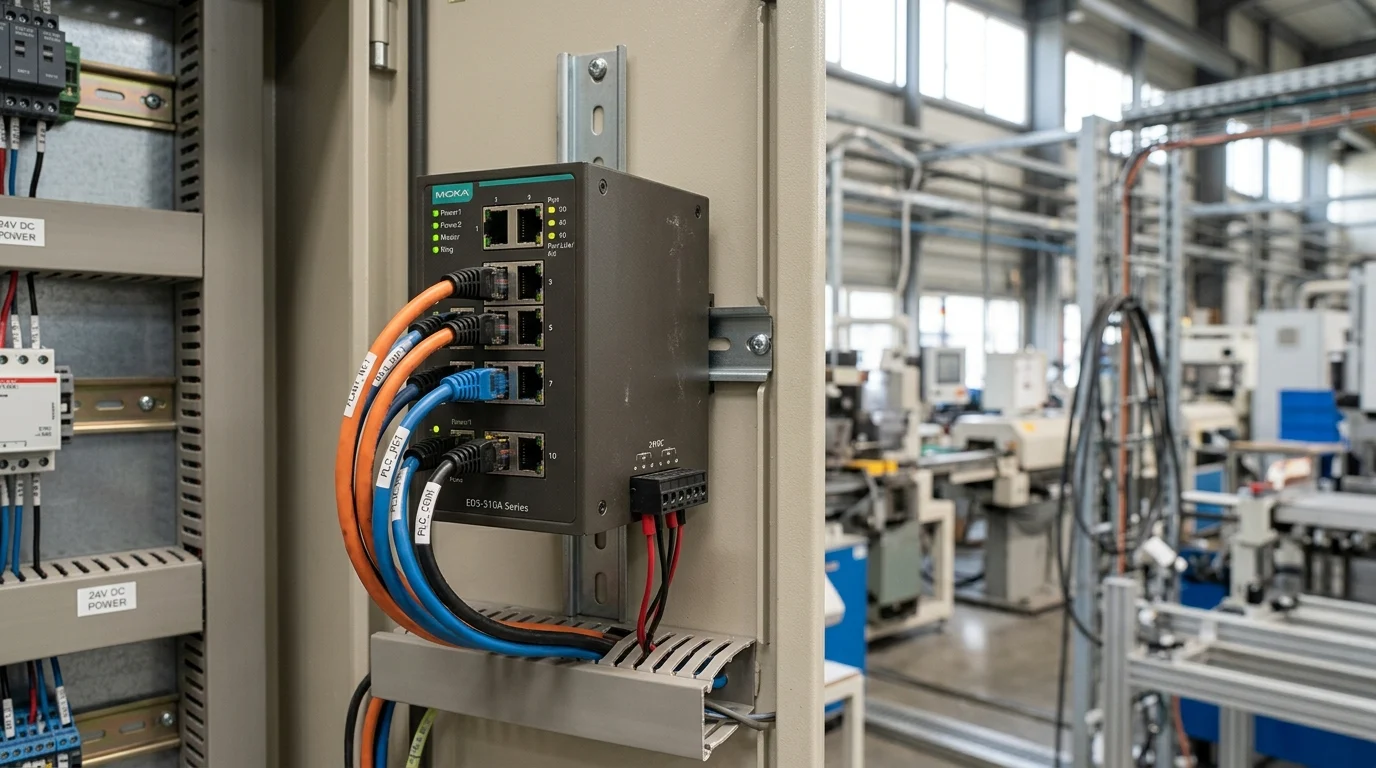
At the foundational level, physical components include ruggedized switches, routers, gateways, and cabling designed to withstand extreme temperatures, severe electromagnetic interference (EMI), and persistent vibration. Industrial Ethernet switches, for example, often feature IP67-rated enclosures, conformal coating on circuit boards, and redundant power inputs to survive harsh plant floor conditions.
Above the physical layer, the data link and application layers utilize specialized industrial protocols to manage traffic. Gateways and edge computing devices act as translators, converting legacy serial data into modern Ethernet packets. This allows older, isolated machinery to participate in advanced data collection strategies without requiring a complete hardware overhaul.
How protocols, media, topology, and timing shape design
The selection of physical media heavily dictates network capabilities and limitations. Standard industrial copper cabling (Cat5e or Cat6a shielded twisted pair) is ubiquitous but remains bound by a strict 100-meter length limit per segment. For sprawling facilities or environments with severe EMI, single-mode fiber optic cabling is deployed, capable of transmitting data over distances exceeding 10 kilometers without signal degradation.
Topology design further shapes system resilience. While enterprise IT typically relies on star topologies, industrial networks frequently utilize ring or daisy-chain configurations to optimize cabling runs and ensure redundancy. Protocols like the Media Redundancy Protocol (MRP) or Device Level Ring (DLR) allow a ring topology to recover from a cable break in under 50 milliseconds. Furthermore, precise timing is enforced via the IEEE 1588 Precision Time Protocol (PTP), which synchronizes device clocks across the network to sub-microsecond accuracy, a necessity for highly coordinated motion control.
| Media Type | Max Distance | Bandwidth Capacity | EMI Immunity | Typical Application |
|---|---|---|---|---|
| Copper (Cat5e/Cat6a) | 100 meters | 100 Mbps – 10 Gbps | Low to Moderate | General machine-level networking |
| Fiber Optic (Multi-mode) | ~2 kilometers | Up to 100 Gbps | Extremely High | Inter-building links, high EMI zones |
| Fiber Optic (Single-mode) | 10+ kilometers | Up to 100 Gbps | Extremely High | Long-haul process automation pipelines |
| Wireless (Wi-Fi 6 / 5G) | Variable (Cell/AP dependent) | 1 Gbps+ | Moderate | AGVs, mobile robotics, remote sensors |
How Protocol Options Compare
Evaluating an industrial communication system requires a deep understanding of protocol mechanisms. The transition from proprietary serial buses to Ethernet-based standards has unified the physical layer, but the application layers remain highly specialized. Selecting the correct protocol dictates not only the speed of the network but also the maximum number of devices it can support and the complexity of its integration.
Key criteria for protocol selection
Engineers must evaluate protocols based on strict performance criteria: minimum cycle time, maximum node count, topology support, and native redundancy mechanisms. A process automation plant monitoring tank levels may only require cycle times in the hundreds of milliseconds, making standard TCP/IP communication sufficient. Conversely, a high-speed printing press requires cycle times below 1 millisecond.
Another critical criterion is the protocol’s payload efficiency. Some protocols carry significant overhead for routing and diagnostics, which is acceptable for large-scale SCADA networks but detrimental to highly deterministic machine-level control. The choice of protocol also heavily influences hardware costs, as some high-performance standards require specialized Application-Specific Integrated Circuits (ASICs) or Field-Programmable Gate Arrays (FPGAs) inside every field device.
Industrial Ethernet vs fieldbus
Legacy fieldbus architectures, such as PROFIBUS DP or Modbus RTU, operate on serial connections (e.g., RS-485). These networks are highly robust and deterministic but suffer from severe bandwidth limitations, typically capping out at 12 Mbps for PROFIBUS and much lower for others. They are strictly hierarchical and struggle to handle the large volumes of diagnostic data required by modern predictive maintenance systems.
Industrial Ethernet protocols, including PROFINET, EtherNet/IP, and EtherCAT, have largely superseded fieldbus in new deployments. Operating at 100 Mbps to 1 Gbps, Industrial Ethernet provides the bandwidth necessary to transmit both real-time control data and non-real-time diagnostic data over the same physical wire. While fieldbus networks are often limited to 32 or 128 nodes per segment, Industrial Ethernet networks can theoretically scale to thousands of interconnected devices, provided the network is properly segmented.
Trade-offs in latency, scalability, and robustness
Achieving ultra-low latency often requires trade-offs in standard network compatibility. For instance, EtherCAT achieves cycle times of less than 100 microseconds for 1,000 distributed I/O points by utilizing a “processing on the fly” mechanism. However, this requires specialized hardware at the slave nodes and does not use standard Ethernet switches within the EtherCAT segment.
Conversely, protocols like EtherNet/IP rely entirely on standard, unmodified Ethernet hardware and the TCP/UDP/IP suite. This maximizes scalability and seamless IT/OT integration but makes achieving sub-millisecond determinism more reliant on careful network configuration, Quality of Service (QoS) prioritization, and high-performance managed switches.
| Protocol | Underlying Technology | Typical Cycle Time | Hardware Requirement | Primary Use Case |
|---|---|---|---|---|
| Modbus RTU | Serial (RS-485) | 10 – 100+ ms | Standard Microcontroller | Legacy process control, simple HVAC |
| EtherNet/IP | Standard Ethernet (CIP) | 1 – 10 ms | Standard Ethernet MAC | General factory automation (discrete) |
| PROFINET IRT | Modified Ethernet | < 1 ms | Specialized ASIC/Switch | High-speed manufacturing, motion |
| EtherCAT | Modified Ethernet | < 0.1 ms | Specialized Slave Controller | CNC, synchronized multi-axis robotics |
How to Select the Right System
Designing and deploying a robust industrial communication system requires balancing immediate operational needs with long-term scalability and security. A purely technical evaluation of bandwidth and latency is insufficient; engineers must adopt a Total Cost of Ownership (TCO) perspective that accounts for integration labor, ongoing maintenance, and the inevitable need for future expansion.
Assessing application requirements and installed base
Migration strategies must account for the existing installed base. In brownfield environments, completely replacing legacy fieldbus infrastructure is rarely economically viable. Instead, system integrators deploy protocol gateways and edge controllers to encapsulate serial data into Ethernet frames, bridging the old with the new. Engineers must carefully calculate the latency introduced by these translation gateways to ensure control loops remain stable.
For greenfield projects, assessing node scalability is paramount. Planners must project the number of network nodes required over the next decade. A common best practice is to design subnets that utilize no more than 50% to 60% of their available bandwidth and node capacity at initial launch. For example, limiting a single broadcast domain to fewer than 500 devices prevents broadcast storms from degrading network performance as the facility expands.
Standards for compliance, cybersecurity, and reliability
Compliance frameworks dictate the baseline for both functional safety and network defense. Where heavy machinery poses a threat to human life, the communication system must support safety protocols (e.g., PROFIsafe, CIP Safety) that comply with IEC 61508. These protocols utilize black-channel principles to achieve Safety Integrity Level 3 (SIL 3), ensuring the probability of dangerous failure on demand is less than 10^-7 per hour.
Simultaneously, the network architecture must align with the IEC 62443 cybersecurity standard. This involves establishing distinct security zones and conduits, deploying industrial firewalls, and implementing strict port security. Disabling unused physical ports and utilizing MAC address filtering at the switch level are fundamental steps in achieving a baseline security posture.
Implementation steps to reduce integration risk
Successful deployment relies on rigorous, phased validation to mitigate integration risks. Prior to physical installation, a comprehensive Factory Acceptance Test (FAT) should be conducted to simulate peak network traffic and validate protocol interoperability. This testing phase must verify that Quality of Service (QoS) configurations correctly prioritize critical control packets over bulk data transfers.
During physical implementation, strict adherence to cabling standards is required. Improper grounding or the use of unshielded cables in high-voltage areas can introduce electromagnetic interference, leading to packet loss and intermittent faults that are notoriously difficult to diagnose. Finally, establishing a baseline of network performance—documenting normal traffic volumes, jitter rates, and switch CPU loads—provides maintenance teams with the quantitative data necessary to detect and resolve network degradation before it impacts production.
Key Takeaways
- The most important conclusions and rationale for Industrial Communication System
- Specs, compliance, and risk checks worth validating before you commit
- Practical next steps and caveats readers can apply immediately
Frequently Asked Questions
What is an industrial communication system?
It is a rugged network that links sensors, PLCs, SCADA, phones, intercoms, and alarms so data and voice move reliably in real time across industrial sites.
Why does an industrial communication system matter for plant uptime?
It reduces downtime by delivering fast, predictable signals and clearer fault visibility, helping teams detect issues early and respond before failures stop production.
Which products are commonly used in harsh or hazardous environments?
Typical choices include explosion-proof or weatherproof telephones, video intercoms, emergency call boxes, PA systems, and IP PBX/VoIP devices built for noise, dust, moisture, and risk zones.
How do I choose between copper and fiber for an industrial network?
Use shielded copper for shorter runs up to 100 meters and standard installations. Choose fiber for long distances, high EMI areas, or when stronger isolation and backbone reliability are needed.
Why choose Siniwo for industrial communication solutions?
Siniwo provides one-stop design, integration, installation, and maintenance, with ATEX, CE, FCC, ROHS, and ISO9001-backed products for mining, oil and gas, transport, and other demanding sectors.
Post time: May-25-2026