
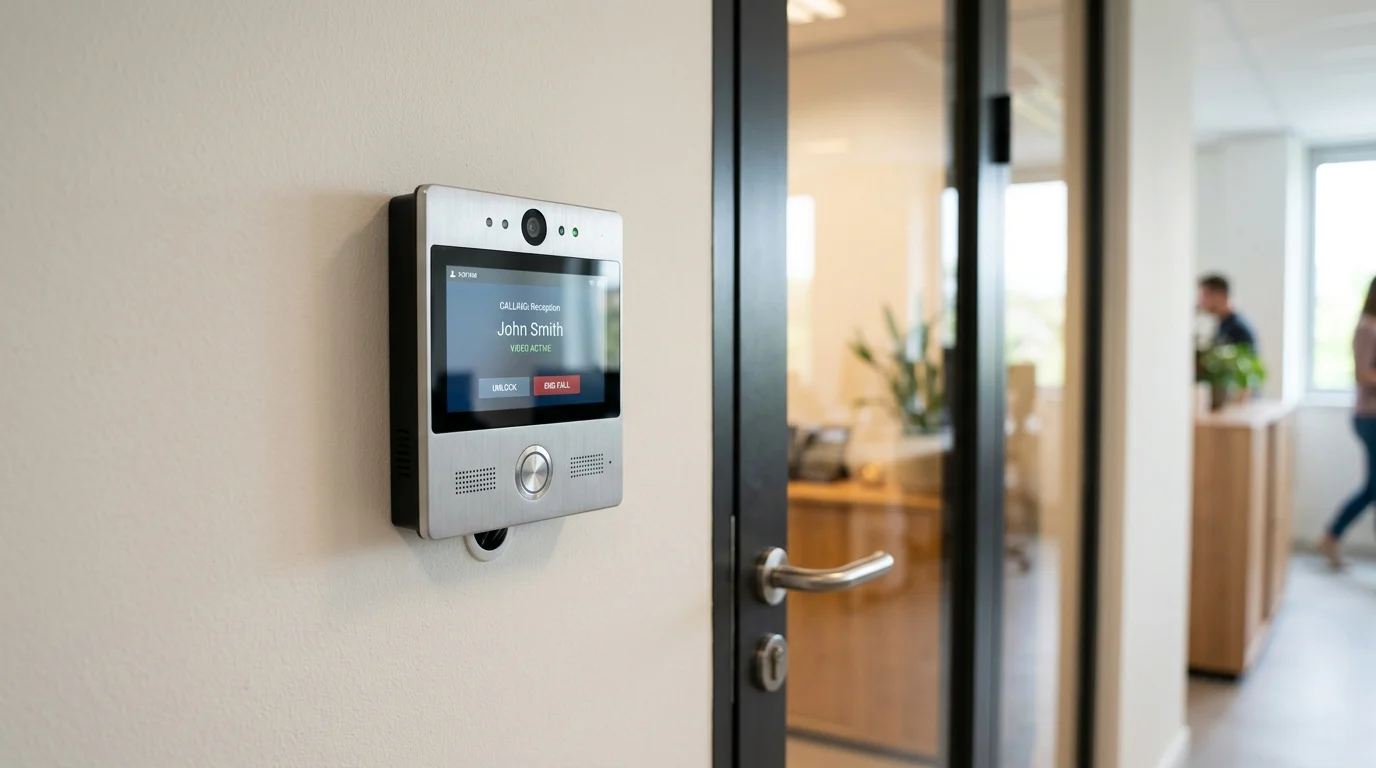
Why SIP Intercom Systems Matter for Commercial Access
Session Initiation Protocol (SIP), defined by the Internet Engineering Task Force (IETF) under RFC 3261, has fundamentally transformed enterprise communications. When applied to physical access control, a SIP intercom system acts as an IP-enabled endpoint on a Voice over Internet Protocol (VoIP) network. Unlike legacy analog intercoms that rely on closed-loop, proprietary wiring, SIP intercoms utilize standard Ethernet infrastructure to transmit audio, video, and control signals. This standardization allows enterprise facilities to unify their physical security and unified communications (UC) platforms into a single, cohesive architecture.
The deployment of SIP-based hardware replaces isolated access systems with network-native devices capable of complex routing, conditional call forwarding, and high-definition media streaming. By leveraging the same Private Branch Exchange (PBX) servers used for corporate telephony, organizations can eliminate redundant infrastructure. This convergence is particularly critical for commercial access, where rapid verification of visitors and seamless integration with existing IT ecosystems dictate both operational efficiency and facility security.
Visitor Communication and Entry Control
At the core of a SIP intercom system is the ability to facilitate real-time, bidirectional communication between a visitor at an entry point and an operator situated anywhere in the world. When a visitor presses the call button on the intercom, the device acts as a SIP User Agent (UA). It generates a SIP INVITE request, which the PBX routes to a designated endpoint—such as a receptionist’s IP phone, a security operations center (SOC) console, or a mobile application.
This IP-based routing allows for sophisticated entry control workflows. For instance, if a primary reception desk fails to answer within a predefined threshold (e.g., 15 seconds), the SIP protocol can automatically forward the call to a secondary security group or an off-site monitoring facility. To ensure natural, uninterrupted conversation, enterprise-grade SIP intercoms are engineered to maintain end-to-end audio latency below 150 milliseconds. Once the visitor’s identity is verified, the operator can transmit a Dual-Tone Multi-Frequency (DTMF) signal—typically configured via RFC 2833—which the intercom receives and translates into a command to trigger an onboard relay, thereby unlocking the door.
Operational and Security Benefits
The migration to SIP intercoms yields substantial operational and security benefits, driven largely by centralization and remote management capabilities. Because these devices reside on the corporate IP network, IT and security administrators can provision, monitor, and update hundreds of intercom units from a single interface. This centralized management significantly reduces maintenance overhead and allows for proactive health monitoring via Simple Network Management Protocol (SNMP) and automated alerting.
Financially, SIP intercoms capitalize on existing local area network (LAN) infrastructure. By utilizing Power over Ethernet (PoE) standard IEEE 802.3af, a single Cat5e or Cat6 cable delivers both data connectivity and up to 15.4 watts of direct current power to the endpoint. This eliminates the need for discrete high-voltage electrical runs to every door, reducing installation cabling costs by up to 40% in new construction projects. From a security standpoint, integrating SIP intercoms with broader security frameworks allows for automated incident logging. Every call attempt, connection duration, and door unlock event is recorded within the PBX call detail records (CDRs), providing a precise, auditable trail of access events.
What a SIP Intercom System Includes

A functioning SIP intercom ecosystem requires a combination of ruggedized edge devices, network switching infrastructure, and centralized call management software. Unlike a traditional doorbell or localized analog speaker, a SIP intercom is essentially a specialized VoIP computer housed in an environmentally hardened casing. Understanding the specific components that make up this architecture is essential for designing a system that meets both physical security requirements and IT network standards.
SIP Door Intercoms and Video Intercoms
The edge devices in this ecosystem are the SIP door intercoms and video intercoms installed at the physical entry points. These units must bridge the gap between sensitive electronic components and harsh external environments. Industrial-grade exterior SIP intercoms are typically rated IP65 or higher for dust and water ingress protection, and IK08 to IK10 for resistance against mechanical impact and vandalism. Inside the chassis, these devices feature embedded digital signal processors (DSPs) to handle acoustic echo cancellation and background noise reduction.
Video-enabled SIP intercoms add a critical visual verification layer. These units are equipped with wide-angle lenses, frequently offering a field of view ranging from 120 to 170 degrees to capture visitors regardless of their height or standing position. High-definition image sensors provide 1080p resolution, utilizing H.264 or H.265 video compression algorithms. This advanced compression ensures that high-quality video streams can be transmitted to the answering endpoint without saturating the local network bandwidth, typically requiring only 2 to 4 Mbps of throughput per active video call.
Required Hardware and Software Components
Beyond the physical intercom unit, the system relies on several backend hardware and software components. The central routing engine is the IP-PBX, which can be hosted on-premise, virtualized within a corporate data center, or delivered as a Cloud-based Unified Communications as a Service (UCaaS) platform. The PBX maintains the SIP registry and handles the logical mapping of extensions to physical IP addresses.
| Component | Standard/Specification | Primary Function |
|---|---|---|
| SIP Endpoint (Intercom) | RFC 3261, SIP 2.0 | Initiates and terminates media sessions at the door. |
| IP-PBX Server | Cloud / On-Premise / UCaaS | Routes SIP signaling between intercom and answering clients. |
| PoE Switch | IEEE 802.3af/at (15.4W – 30W) | Provides concurrent data and DC power delivery via Ethernet. |
| Door Strike Relay | 12V/24V DC Output | Receives DTMF commands to disengage physical locks. |
Network connectivity and power are provided by PoE switches. While standard 802.3af (15.4W) is sufficient for most audio and basic video intercoms, units deployed in extreme cold climates that require internal heating elements often demand PoE+ (IEEE 802.3at), which delivers up to 30W per port. Finally, the physical access component requires electronic door hardware—such as magnetic locks or electric strikes—wired directly to the intercom’s onboard relays. These relays are typically rated to switch 12V or 24V DC loads, forming the final link in the chain from digital SIP command to physical door release.
How SIP Intercom Systems Work
The operation of a SIP intercom system relies on a strict separation between the control plane—which handles call setup, modification, and teardown—and the data plane, which transports the actual audio and video streams. This decoupled architecture allows SIP to be highly flexible, enabling it to negotiate communication parameters between devices that may have vastly different hardware capabilities.
SIP Registration, Call Routing, and RTP Media
The lifecycle of an intercom session begins with SIP registration. Upon booting, the intercom sends a SIP REGISTER request to the PBX, authenticating itself using MD5 or SHA-256 digest authentication and announcing its current IP address. Once registered, the intercom is ready to initiate calls. When the call button is pressed, the unit sends a SIP INVITE message containing a Session Description Protocol (SDP) payload. The SDP outlines the media capabilities of the intercom, including supported audio codecs (such as G.711 for standard voice, G.722 for wideband HD audio, or Opus for variable network conditions) and video codecs.
The PBX processes this INVITE and routes it to the target extension. Once the receiving party accepts the call, a 200 OK message is sent back to the intercom, followed by an ACK to finalize the handshake. At this point, the SIP signaling steps aside, and the Real-time Transport Protocol (RTP) takes over the data plane. RTP establishes a direct peer-to-peer or server-relayed media stream between the intercom and the answering device, ensuring rapid delivery of audio and video packets with minimal buffering.
Network and Cybersecurity Requirements
Because SIP intercoms are essentially network appliances located on the exterior of a building, they introduce specific cybersecurity and network topology requirements. To prevent unauthorized network access via an exposed outdoor Ethernet cable, security architects strictly isolate intercoms using Virtual Local Area Networks (VLANs). Furthermore, port-based Network Access Control (NAC) using the IEEE 802.1X standard ensures that if a malicious actor unplugs the intercom and connects a laptop, the switch port will immediately disable data transmission.
To secure the communication payloads, modern SIP intercom deployments enforce encryption on both the control and data planes. SIP signaling is encrypted using Transport Layer Security (TLS 1.2 or 1.3), creating a SIPS (SIP Secure) connection that prevents eavesdropping on call routing data and DTMF unlock codes. The RTP media streams are concurrently secured using Secure Real-time Transport Protocol (SRTP), utilizing AES-128 or AES-256 ciphers to prevent interception or manipulation of the audio and video feeds. Quality of Service (QoS) rules are also mandatory; network administrators must tag intercom voice traffic with Differentiated Services Code Point (DSCP) value 46 (Expedited Forwarding) to prioritize it over standard data traffic.
Failover, Emergency Calling, and Audit Logs
In commercial and industrial environments, high availability is non-negotiable. SIP intercom systems achieve resilience through redundant SIP server configurations. Intercoms can be programmed with primary and secondary PBX IP addresses. If the primary server fails to respond to a SIP OPTIONS keep-alive ping, the intercom automatically fails over to the secondary server, typically executing the switch in under 5 seconds to ensure continuous entry control functionality.
Emergency calling features are also deeply integrated into SIP workflows. Intercoms designated as emergency help points can be programmed to bypass local reception and route calls directly to external emergency dispatchers (e.g., PSAPs) via SIP trunking. To satisfy compliance and security auditing requirements, all SIP transactions and system events are logged. The intercoms push these logs to centralized servers using the Syslog protocol. This audit trail captures critical diagnostics, including failed SIP registration attempts, SIP 4xx/5xx error codes, and exact timestamps of DTMF door unlock relays, facilitating rigorous post-incident forensic analysis.
How SIP Intercom Systems Compare With Alternatives
The physical security market offers several technological approaches to visitor communication and entry control. While legacy systems remain in operation across older facilities, the industry is experiencing a decisive shift toward open-standard IP solutions. Comparing SIP intercom systems with analog and proprietary IP alternatives highlights the architectural advantages and constraints of each approach.
SIP vs. Analog and Proprietary IP Intercoms
Analog intercoms represent the oldest and most rigid architecture in the access control space. They rely on dedicated 2-wire or 4-wire copper cabling connecting the door station directly to a specific master answering station. This point-to-point topology suffers from severe distance limitations; analog audio quality typically begins to degrade significantly beyond 300 meters due to electrical resistance and signal attenuation. Furthermore, analog systems cannot easily integrate with modern IT networks, isolating physical security from corporate communications.
| Feature | SIP Intercoms | Analog Intercoms | Proprietary IP Intercoms |
|---|---|---|---|
| Cabling Infrastructure | Cat5e/Cat6 (Ethernet) | 2-wire / 4-wire copper | Cat5e/Cat6 (Ethernet) |
| Maximum Native Distance | 100 meters (extendable via fiber) | Up to 300 meters (degrades) | 100 meters |
| Interoperability | High (Any SIP-compliant PBX) | Low (Requires specific master) | Low (Vendor-locked ecosystems) |
| Scalability | Virtually unlimited endpoints | Capped by physical matrix ports | Moderate (Requires vendor licensing) |
Proprietary IP intercoms resolve the cabling and distance issues of analog by utilizing Ethernet (which has a native 100-meter limit but is infinitely extendable via fiber optics and network switches). However, they utilize closed, vendor-specific communication protocols instead of the open SIP standard. This locks the enterprise into purchasing answering stations, software licenses, and hardware upgrades exclusively from a single manufacturer. In contrast, SIP intercoms provide hardware agnosticism. An enterprise can pair a SIP intercom from one manufacturer with a Cisco, Avaya, or Asterisk PBX, and answer calls on standard SIP softphones, completely avoiding vendor lock-in.
SIP Intercoms With Cloud PBX and Access Control Platforms
The true differentiation of SIP intercoms becomes apparent when integrating with modern Cloud PBX and enterprise Access Control systems. Cloud PBX platforms (such as Zoom Phone, Microsoft Teams via Direct Routing, or RingCentral) allow SIP intercoms to operate without any on-premise server infrastructure. A visitor pressing the intercom button can instantly ring a security guard’s smartphone app over a 5G network, enabling global entry control capabilities.
Simultaneously, SIP intercoms serve as edge devices for broader physical access control systems (PACS). Advanced SIP intercoms feature onboard Wiegand or Open Supervised Device Protocol (OSDP) interfaces. This allows the intercom to house an integrated RFID card reader or biometric scanner. By supporting OSDP Secure Channel (which utilizes AES-128 encryption), the SIP intercom securely transmits credential data back to the central access control server while simultaneously handling the SIP audio/video session. Furthermore, modern SIP units support RESTful APIs and Webhooks, allowing developers to trigger automated intercom actions based on complex security events, such as locking down a campus via a single software command.
How to Select, Deploy, and Maintain a SIP Intercom System
Successfully deploying a SIP intercom system requires a structured engineering approach that bridges the gap between physical security installations and IT network administration. Because these devices straddle the line between physical barriers and logical network nodes, procurement and deployment must be meticulously planned to ensure long-term reliability and compliance.
Site Survey and System Requirements
The deployment lifecycle begins with a comprehensive site survey. Physical mounting environments dictate the exact hardware specifications required. For instance, an intercom installed near a busy roadway or industrial machinery must undergo an acoustic evaluation; if ambient noise regularly exceeds 75 decibels (dB), the selected SIP intercom must feature active noise cancellation and a high-gain microphone to ensure intelligible audio transmission. Similarly, video intercoms facing direct sunlight require advanced image sensors equipped with Wide Dynamic Range (WDR) capabilities of at least 120dB to prevent visitors from appearing as dark silhouettes against a bright background.
System requirements must also map out the network topology. Network engineers must allocate static IP addresses or configure DHCP reservations for each intercom endpoint. The PoE power budget across all network switches must be calculated to ensure sufficient wattage is available, particularly if the deployment includes multi-button SIP directory units or intercoms with heavy-draw internal heating elements for sub-zero climates.
Compliance and Security Planning
Compliance with local building codes and data privacy regulations is a critical phase of the planning process. In the United States, intercom installations must adhere to the Americans with Disabilities Act (ADA). This mandates strict physical mounting parameters, such as ensuring that the operable parts (the call button) are positioned no higher than 48 inches above the finished floor, and that the device provides both audible and visual feedback (e.g., an LED indicator illuminating when the call is answered) for hearing-impaired users.
On the logical security front, data privacy regulations such as the General Data Protection Regulation (GDPR) influence how video SIP intercoms are configured. If the intercom is set to continuously record video to a Network Video Recorder (NVR) via the ONVIF protocol, administrators must configure automated retention policies. To comply with data minimization principles, video footage and SIP call metadata should typically be purged after a strict threshold, such as a 30-day rolling window, unless flagged for a specific security investigation.
Commissioning, Testing, and Ongoing Maintenance
The final phase encompasses commissioning, rigorous testing, and the establishment of ongoing maintenance protocols. During commissioning, technicians must verify SIP registration status, validate that QoS tags are properly applied across all network hops, and test the DTMF relay to ensure the physical door strike disengages with the correct timing (typically a 3 to 5-second unlock duration). If SIP 4xx client errors or 5xx server errors occur, network engineers utilize packet capture (PCAP) tools like Wireshark to trace the SIP signaling and identify misconfigurations in the PBX dial plan or firewall NAT rules.
For ongoing maintenance, establishing a firmware update schedule is paramount to patch newly discovered VoIP vulnerabilities. Because SIP intercoms are critical security devices, enterprise buyers should select hardware with a proven Mean Time Between Failures (MTBF) exceeding 50,000 hours. Coupling high-MTBF hardware with automated network monitoring ensures that the SIP intercom system remains a reliable, secure, and highly available component of the organization’s overarching access control strategy.
Key Takeaways
- A SIP intercom works as a VoIP endpoint, using standard Ethernet infrastructure to carry audio, video, and access-control signaling.
- SIP routing can forward unanswered entry calls after a set threshold, such as 15 seconds, to another desk, security group, or off-site monitoring team.
- Operators can unlock doors remotely by sending DTMF commands, commonly via RFC 2833, to trigger the intercom’s onboard relay.
- PoE under IEEE 802.3af can deliver data and up to 15.4 watts of power over one cable, simplifying door and gate installations.
- Using existing LAN and PBX infrastructure can reduce redundant systems and may lower new-construction cabling costs by up to 40%.
- For industrial or hazardous locations, choose rugged SIP intercoms with weatherproof, waterproof, or explosion-proof designs and relevant certifications.
Frequently Asked Questions
What is a SIP intercom system?
A SIP intercom system is an IP-based intercom that uses Session Initiation Protocol to route voice, video, and door-control signals over a VoIP network instead of dedicated analog wiring.
How does a SIP intercom unlock a door?
After a visitor is verified, an operator can send a DTMF command through the SIP call. The intercom receives the signal and activates an onboard relay connected to the door lock.
Can SIP intercoms work with an existing PBX?
Yes. SIP intercoms can register as endpoints on many IP PBX or VoIP systems, allowing calls to route to desk phones, dispatch consoles, mobile apps, or security teams.
Why use PoE for SIP intercom installation?
Power over Ethernet lets one Cat5e or Cat6 cable provide both network connectivity and power, reducing separate electrical work and simplifying installation at doors, gates, and help points.
Are SIP intercoms suitable for harsh industrial sites?
Yes, when built for the environment. Rugged weatherproof, waterproof, or explosion-proof SIP intercoms are used in mining, oil and gas, transportation, maritime, campuses, and security applications.

Post time: Jun-17-2026