
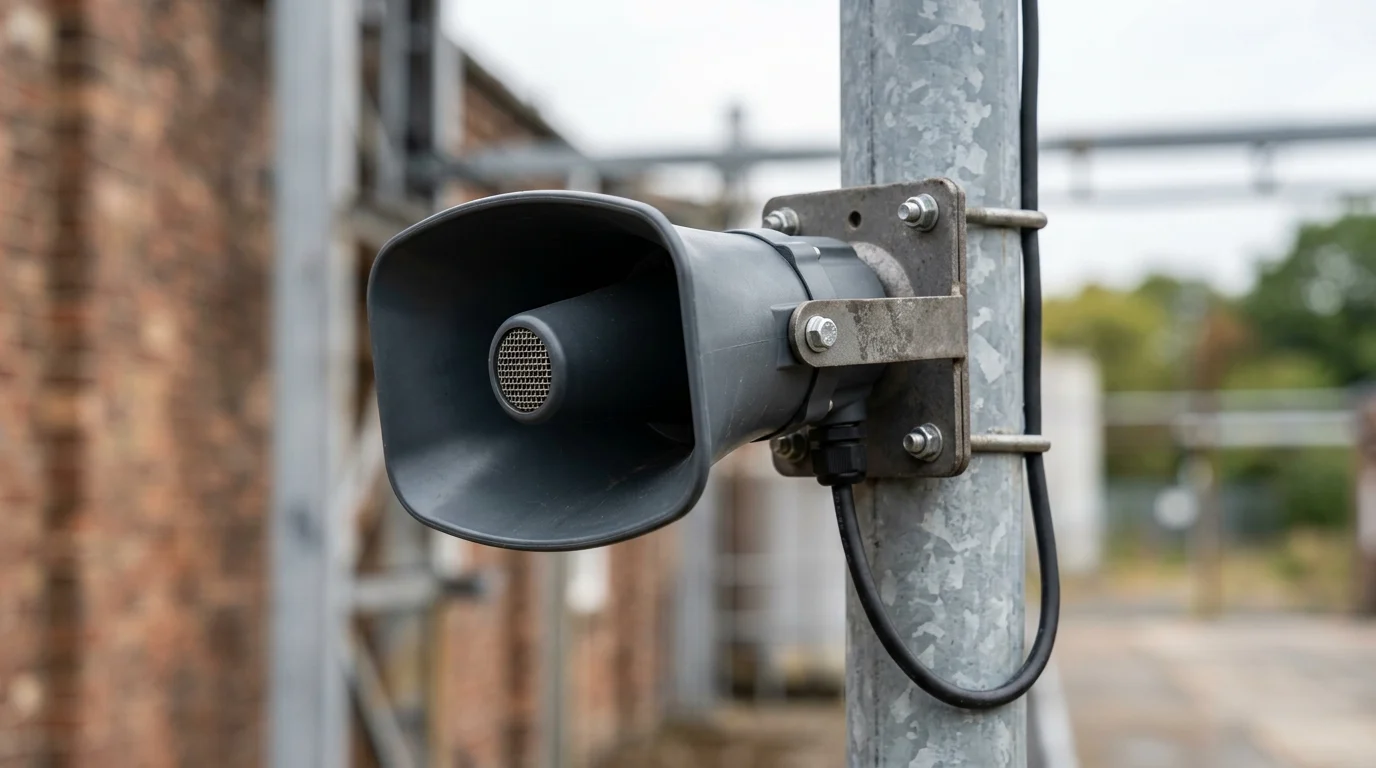
How IP Ratings Affect Industrial Speaker Selection
The deployment of a robust industrial speaker IP rating standard serves as the foundational parameter for any waterproof loudspeaker PA system in manufacturing, petrochemical, and heavy industry environments. In these settings, public address systems are not merely operational conveniences; they are critical life-safety infrastructure required for emergency mass notification, evacuation protocols, and daily operational signaling. Consequently, the environmental resilience of the acoustic hardware directly dictates the reliability of the entire communication network.
Selecting the appropriate Ingress Protection (IP) rating is a highly technical process that bridges acoustical engineering with mechanical durability. Engineers must evaluate atmospheric particulates, fluid exposure, and ambient humidity to specify equipment capable of surviving continuous industrial wear. Failure to accurately match the IP rating of a speaker to its operational environment results in rapid component degradation, compromised intelligibility, and ultimately, system failure at moments when communication is most critical.
Why IP Ratings Matter for Risk and Uptime
The primary function of an industrial PA system is to maintain continuous uptime, particularly during crisis scenarios where failure is not an option. IP ratings provide a quantifiable metric for assessing risk against environmental ingress, which is the leading cause of premature failure in industrial electronics. Airborne dust can accumulate on transducer voice coils, leading to thermal failure or mechanical binding, while moisture ingress causes short circuits, corrosion of internal contacts, and degradation of paper-based speaker cones.
Quantitative field data underscores the financial and operational risks of under-specifying equipment. Unrated or inadequately rated speakers installed in facilities with relative humidity consistently exceeding 70% exhibit an annualized failure rate of up to 45% within the first 18 months of deployment. By contrast, correctly specified IP-rated waterproof loudspeakers reduce environmental-related failures to less than 2% over a five-year lifecycle. This drastic reduction in failure rates directly impacts facility risk profiles, minimizing the exorbitant costs associated with emergency maintenance, production halts, and potential OSHA or regional safety compliance penalties.
Where IP-Rated Speakers Fit in Plant-Wide PA Systems
Plant-wide PA systems rarely operate in a homogenous environment; rather, they span diverse micro-climates across a single facility. A comprehensive acoustic design utilizes a tiered approach to industrial speaker IP ratings, deploying highly protected units only where necessary to optimize the overall budget without sacrificing reliability. For example, control rooms and administrative corridors typically require standard commercial-grade or low-IP speakers, as they are climate-controlled and free from industrial particulates.
Moving outward into the facility, the required protection levels escalate. Loading docks and semi-enclosed warehousing zones demand baseline protection against wind-blown dust and indirect moisture. Processing floors, particularly those in food and beverage manufacturing or chemical processing, require heavy-duty waterproof loudspeakers capable of withstanding direct, high-pressure washdowns. By mapping the specific environmental hazards of each facility zone to the corresponding IP rating, system integrators can engineer a cohesive, plant-wide PA network that guarantees uniform audio coverage and localized environmental survivability.
What Industrial Speaker IP Ratings Confirm
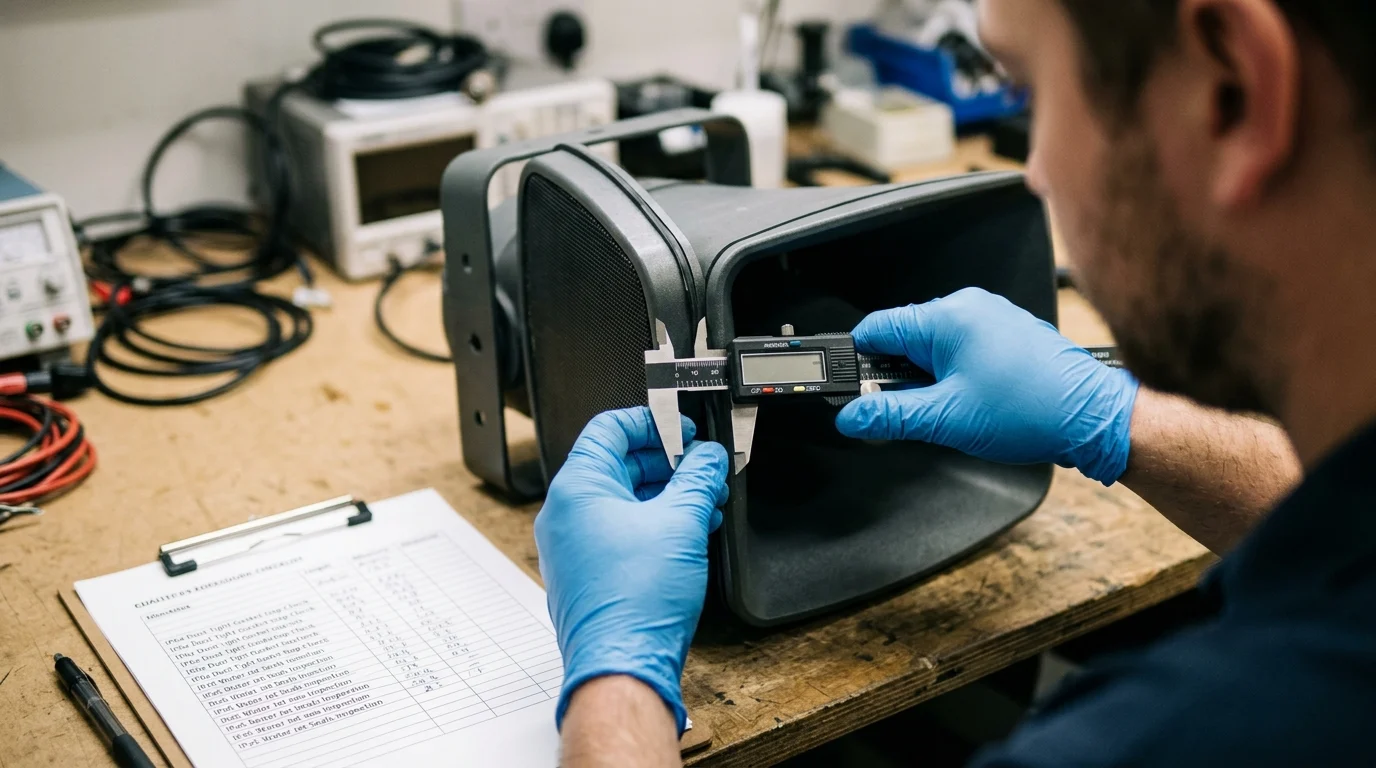
The Ingress Protection (IP) rating system, defined globally by the international standard IEC 60529, provides a rigorous, standardized framework for classifying the degrees of protection provided by electrical enclosures. For industrial speakers, this standard eliminates ambiguity regarding terms like “waterproof” or “weather-resistant,” replacing marketing terminology with empirical, reproducible laboratory test parameters.
Understanding exactly what an industrial speaker IP rating confirms allows procurement engineers to verify that the hardware will survive specific facility conditions. The rating evaluates the integrity of the speaker housing, the sealing of the cable entry glands, and the protective barriers covering the acoustic transducers.
How the First and Second IP Digits Work
The IP code is composed of two distinct numerical digits, each representing a different category of environmental resistance. The first digit, ranging from 0 to 6, indicates the enclosure’s level of protection against the ingress of solid foreign objects, from large tools and fingers down to microscopic dust particles. A rating of 6 represents total dust-tightness, requiring a vacuum test where no dust can enter the enclosure over a specified duration.
The second digit, ranging from 0 to 9K, quantifies the level of protection against the ingress of water. This scale is not strictly linear; it covers varying types of water exposure, including condensation, vertical drips, splashing, high-pressure jets, and complete submersion. For instance, a second digit of 5 indicates protection against low-pressure water jets (12.5 liters per minute) from any direction, while a 6 denotes protection against powerful water jets (100 liters per minute at 100 kPa pressure).
What IP54, IP55, IP65, IP66, IP67, and IP68 Mean
To navigate the selection of waterproof loudspeaker PA systems, engineers must understand the specific testing criteria for the most common industrial IP ratings. The table below outlines the exact thresholds for these standardized classifications.
| IP Rating | Solid Ingress Protection | Liquid Ingress Protection | Standardized Test Parameters (Water) |
|---|---|---|---|
| IP54 | Dust-protected (limited ingress permitted) | Splashing water | 10 liters/min splashed from all angles for 5 minutes. |
| IP55 | Dust-protected | Low-pressure water jets | 12.5 liters/min through a 6.3mm nozzle at 30 kPa for 3 minutes. |
| IP65 | Dust-tight (no ingress) | Low-pressure water jets | 12.5 liters/min through a 6.3mm nozzle at 30 kPa for 3 minutes. |
| IP66 | Dust-tight | Heavy seas / Powerful jets | 100 liters/min through a 12.5mm nozzle at 100 kPa for 3 minutes. |
| IP67 | Dust-tight | Temporary immersion | Submersion in water at a depth of 1 meter for 30 minutes. |
| IP68 | Dust-tight | Continuous immersion | Submersion beyond 1 meter (exact depth and time defined by manufacturer). |
An IP66 rating is generally considered the baseline for true heavy-industrial and outdoor applications, as it guarantees survivability against driving rain and direct hose-downs. IP67 and IP68 are reserved for specialized applications where the speaker may be temporarily or permanently submerged, such as in flood-prone mining galleries or marine docking structures.
What IP Ratings Do Not Cover
While an industrial speaker IP rating provides critical data regarding dust and water, it is not a comprehensive indicator of overall environmental durability. A common engineering pitfall is assuming that a high IP rating automatically implies resistance to all facility hazards. IEC 60529 does not evaluate an enclosure’s resistance to ultraviolet (UV) radiation, which can rapidly degrade standard ABS plastics in outdoor deployments.
Furthermore, IP ratings do not cover chemical corrosion or physical impact. A speaker may be completely waterproof (IP67) but still succumb to structural failure if exposed to acidic vapors in a petrochemical plant. Similarly, impact resistance is measured separately by the IK rating scale (IEC 62262). A heavy-duty industrial speaker might require an IK08 rating (capable of withstanding a 5-Joule impact) in addition to an IP66 rating to survive in a high-traffic warehousing environment.
Choosing IP Ratings by Operating Environment
Specifying the correct industrial speaker IP rating requires mapping the exact environmental hazards of a given facility zone to the corresponding testing parameters of the IEC 60529 standard. Over-specifying results in unnecessary capital expenditure, while under-specifying guarantees premature hardware failure. The selection process must account for regular operational conditions as well as worst-case maintenance scenarios.
Different industrial sectors present unique challenges that dictate not only the IP rating but also the structural design of the waterproof loudspeaker PA system. By categorizing facility zones into distinct use cases, engineers can standardize their procurement approach and ensure consistent audio performance across diverse operational environments.
Indoor, Semi-Outdoor, Washdown, and Marine Use Cases
The environment directly dictates the required combination of ingress protection and material construction. Indoor manufacturing zones without liquid processes typically require only IP54 protection to guard against ambient airborne dust. Semi-outdoor areas, such as loading canopies or transit shelters, face wind-driven rain and condensation, necessitating a minimum of IP65.
For severe environments, the requirements escalate significantly. Washdown areas in food production or pharmaceutical facilities face daily sanitation cycles using high-temperature, high-pressure water mixed with caustic chemicals. These zones require IP66 or IP69K ratings. Marine environments, including offshore oil platforms and coastal ports, face the added threat of continuous salt spray and potential wave impact, demanding IP66 or IP67 protection.
| Operating Environment | Primary Hazard Profile | Minimum Recommended IP Rating | Optimal Enclosure Material |
|---|---|---|---|
| Indoor Assembly | Airborne particulates, low humidity | IP54 | High-impact ABS or Polycarbonate |
| Semi-Outdoor | Wind-driven rain, temperature swings | IP65 | UV-stabilized ASA plastic or Aluminum |
| Washdown Zones | High-pressure water, chemical agents | IP66 / IP69K | 316L Stainless Steel |
| Marine / Offshore | Salt fog, wave impact, heavy rain | IP66 / IP67 | 316L Stainless Steel or Marine-grade Glass Reinforced Plastic (GRP) |
How to Compare IP Rating, Enclosure, and Mounting Needs
An IP rating is only as reliable as the enclosure material and the mounting hardware supporting it. A speaker boasting an IP66 rating is useless if its housing cracks under thermal stress or its mounting bracket rusts away. When comparing options, engineers must evaluate the synergy between the IP rating and the enclosure metallurgy. For example, standard 304 stainless steel may pit and fail in marine environments despite housing an IP67-rated speaker; therefore, 316L stainless steel with a Pitting Resistance Equivalent Number (PREN) greater than 32 is required.
Mounting needs also impact the integrity of the IP rating. Cable entry points are the most common failure vectors for waterproof loudspeakers. Installers must use appropriately rated cable glands (e.g., M20 IP68 brass glands) and ensure that mounting brackets do not require drilling into the sealed speaker housing, which would instantly void the manufacturer’s IP certification.
How Waterproofing Can Affect Acoustic Performance
Achieving a high industrial speaker IP rating often requires mechanical compromises that can alter the unit’s acoustic performance. To achieve IP66 or IP67 ratings, manufacturers must protect the delicate transducer cones from water pressure. This is typically accomplished by utilizing specialized hydrophobic acoustic meshes (such as PTFE membranes) or by completely sealing the driver behind a rigid, resonating front panel.
These waterproofing techniques inherently introduce acoustic impedance. High-frequency sound waves lack the energy to easily penetrate dense waterproof membranes. As a result, an IP66-rated horn speaker might experience a 2 to 4 dB reduction in sound pressure level (SPL) at frequencies above 8 kHz compared to a non-rated equivalent. System designers must account for this high-frequency attenuation during the acoustic modeling phase, often compensating by increasing the amplifier tap settings or deploying speakers at a higher density to maintain Speech Transmission Index (STI) targets for emergency voice evacuation.
How to Verify IP Rating Claims
While manufacturers frequently advertise high industrial speaker IP ratings, engineers and procurement specialists must rigorously validate these claims through standardized documentation and comparative analysis. The industrial audio market includes a wide spectrum of equipment quality, and taking marketing specifications at face value can introduce severe vulnerabilities into life-safety PA systems.
Verification requires a deep understanding of international testing protocols and the ability to distinguish between self-certified claims and empirical laboratory data. Establishing a strict verification protocol ensures that the delivered waterproof loudspeaker PA system will perform precisely as engineered during its operational lifecycle.
Test Reports and Standards to Request
To confirm an IP rating, procurement teams should mandate the submission of formal test reports from accredited third-party laboratories. Self-certification by the manufacturer is common for lower ratings (IP54), but high-level claims (IP66, IP67, IP68) must be backed by independent validation. The testing laboratory should hold an active ISO/IEC 17025 accreditation, which guarantees the facility possesses the calibrated equipment and technical competence to execute IEC 60529 testing accurately.
When reviewing the test report, engineers should verify the specific test conditions. For an IP66 report, the documentation must explicitly state that the speaker was subjected to a 12.5mm nozzle delivering 100 liters of water per minute at a distance of 2.5 to 3 meters for a minimum of 3 minutes, and that subsequent internal inspection revealed no harmful water ingress.
How IP Ratings Compare With Other Certifications
In North American markets, engineers frequently encounter the NEMA 250 standard alongside or in place of IEC 60529 IP ratings. While there is overlap, the two standards are not perfectly interchangeable. An industrial speaker IP rating strictly measures protection against solid objects and water, whereas NEMA ratings introduce additional environmental variables such as corrosion resistance, icing, and oil seepage.
For example, a NEMA 4X rating is often considered roughly equivalent to IP66 regarding dust and water protection. However, the “X” in NEMA 4X signifies proven corrosion resistance, typically requiring the enclosure to survive a rigorous 200-hour salt spray test. An IP66 speaker constructed from standard ABS plastic would fail the NEMA 4X corrosion standard. Therefore, when verifying specifications for highly corrosive environments, engineers must look beyond the IP rating and request complementary NEMA certifications or specific ASTM B117 salt fog test results.
Red Flags in IP-Rated Speaker Specifications
During the specification review process, several red flags can indicate substandard engineering or deceptive marketing regarding an industrial speaker IP rating. The most prominent red flag involves vague IP68 claims. According to IEC 60529, the specific depth and duration for IP68 submersion testing must be defined by the manufacturer, provided it is more severe than the IP67 standard (1 meter for 30 minutes). If a specification sheet claims “IP68″ but fails to state parameters such as “submersion at 2 meters for 24 hours,” the rating is incomplete and invalid.
Another critical red flag is the presence of unsealed mechanical switches or exposed terminal blocks on a speaker claiming IP65 or higher. True waterproof loudspeakers utilize sealed cable glands and internal terminal chambers. If the installation manual requires the installer to open the primary acoustic chamber to connect the wiring, the factory IP rating is compromised the moment the unit is serviced in the field. High-quality industrial speakers isolate the wiring junction box from the main transducer enclosure to preserve the environmental seal.
Final Selection Process for Industrial Speakers
The final selection of an industrial speaker IP rating demands a holistic approach that moves beyond simply choosing the highest available number. System integrators must synthesize environmental data, acoustic requirements, and budgetary constraints to specify a waterproof loudspeaker PA system that delivers reliable intelligibility over a long operational lifespan.
Strategic procurement views the IP rating not merely as a mechanical specification, but as a primary driver of the system’s Total Cost of Ownership (TCO). A well-specified speaker network minimizes maintenance interventions, reduces downtime, and ensures that life-safety communications remain operational during worst-case facility events.
How to Balance Environment, Performance, and Budget
Balancing environment, performance, and budget requires a thorough TCO analysis. High-IP-rated speakers command a significant initial capital expenditure. For instance, an ATEX-certified, IP66-rated stainless steel horn speaker may carry a 40% to 60% price premium over a standard IP54 aluminum model. However, deploying the cheaper IP54 model in a heavy washdown zone will result in repeated failures.
The true cost of a compromised speaker includes not only the replacement hardware but also the specialized labor required for industrial maintenance—often involving scaffolding, specialized lifts, and temporary zone shutdowns. By investing the 60% premium upfront for the correct IP66 rating, facilities typically reduce their maintenance expenditures by over 80% across a five-year lifecycle, easily justifying the initial capital outlay while ensuring unbroken PA system performance.
When to Specify a Higher IP Rating
While precise matching of IP ratings to environmental hazards is standard practice, there are specific scenarios where intentionally over-specifying the industrial speaker IP rating is the superior engineering choice. One such scenario involves facility flexibility. If a plant’s layout is frequently reconfigured, specifying IP66 speakers universally across processing areas ensures that equipment remains protected even if a dry zone is temporarily converted into a liquid handling area.
Over-specification also serves as a critical safety margin for extreme weather events. In coastal industrial facilities, standard rainfall might only necessitate an IP54 rating, but the threat of hurricane-force wind-driven rain or unexpected flooding makes IP66 or IP67 the prudent choice. Providing this buffer guarantees that the mass notification system survives the very catastrophic events it is designed to alert personnel about.
Lifecycle Criteria for Long-Term Reliability
The ultimate goal of specifying an accurate industrial speaker IP rating is to maximize long-term reliability. When evaluating hardware, engineers should cross-reference the IP rating with the manufacturer’s stated Mean Time Between Failures (MTBF). A properly specified IP-rated speaker, deployed in an environment compatible with its testing thresholds, should achieve an MTBF exceeding 50,000 hours.
To ensure this lifecycle is realized, facility managers must implement standardized installation and maintenance protocols. This includes utilizing torque-controlled tools to secure enclosure bolts without crushing weatherproof gaskets, inspecting cable drip loops to prevent water from pooling at the entry glands, and conducting annual visual inspections of the acoustic mesh. By combining rigorous IP rating verification with disciplined lifecycle management, industrial facilities can deploy waterproof loudspeaker PA systems that provide decades of flawless, life-saving communication.
Key Takeaways
- Use the IP rating as a primary specification when selecting industrial speakers for dusty, humid, outdoor, or washdown areas.
- Evaluate each plant zone separately because control rooms, loading docks, processing floors, and outdoor areas often require different protection levels.
- Specify higher IP-rated waterproof loudspeakers where direct water jets, high humidity, corrosion, or airborne particulates could cause system failure.
- Correctly matched IP-rated speakers can reduce environmental failure risk and improve PA system uptime over a multi-year lifecycle.
- For life-safety announcements and evacuation messaging, prioritize environmental durability as highly as acoustic coverage and intelligibility.
Frequently Asked Questions
What does an industrial speaker IP rating mean?
An IP rating shows how well a speaker enclosure resists solids and liquids. The first digit covers dust protection, while the second covers water protection. For industrial PA systems, this helps engineers match loudspeakers to dusty, wet, outdoor, or washdown environments.
Which IP rating is best for waterproof loudspeakers?
For wet or outdoor industrial areas, IP65 is often a baseline because it resists dust and water jets. For high-pressure washdowns or harsher exposure, IP66, IP67, or higher may be required depending on cleaning methods, immersion risk, and site conditions.
Why are IP-rated speakers important for emergency PA systems?
Emergency PA systems must work during alarms, evacuations, and operational incidents. Dust, moisture, corrosion, and humidity can damage unrated speakers, reducing intelligibility or causing failure. Proper IP-rated loudspeakers improve uptime and reduce maintenance risk in harsh environments.
Do all areas of a plant need the same speaker IP rating?
No. Control rooms may need lower protection, while loading docks, processing floors, marine zones, and chemical areas need higher-rated speakers. A zone-by-zone assessment helps control cost while keeping critical communication reliable.
How can humidity affect industrial PA loudspeakers?
High humidity can corrode contacts, weaken speaker cones, and cause electrical faults. In facilities where relative humidity frequently exceeds 70%, under-rated speakers may fail much faster than properly specified waterproof models.

Post time: Jun-23-2026