
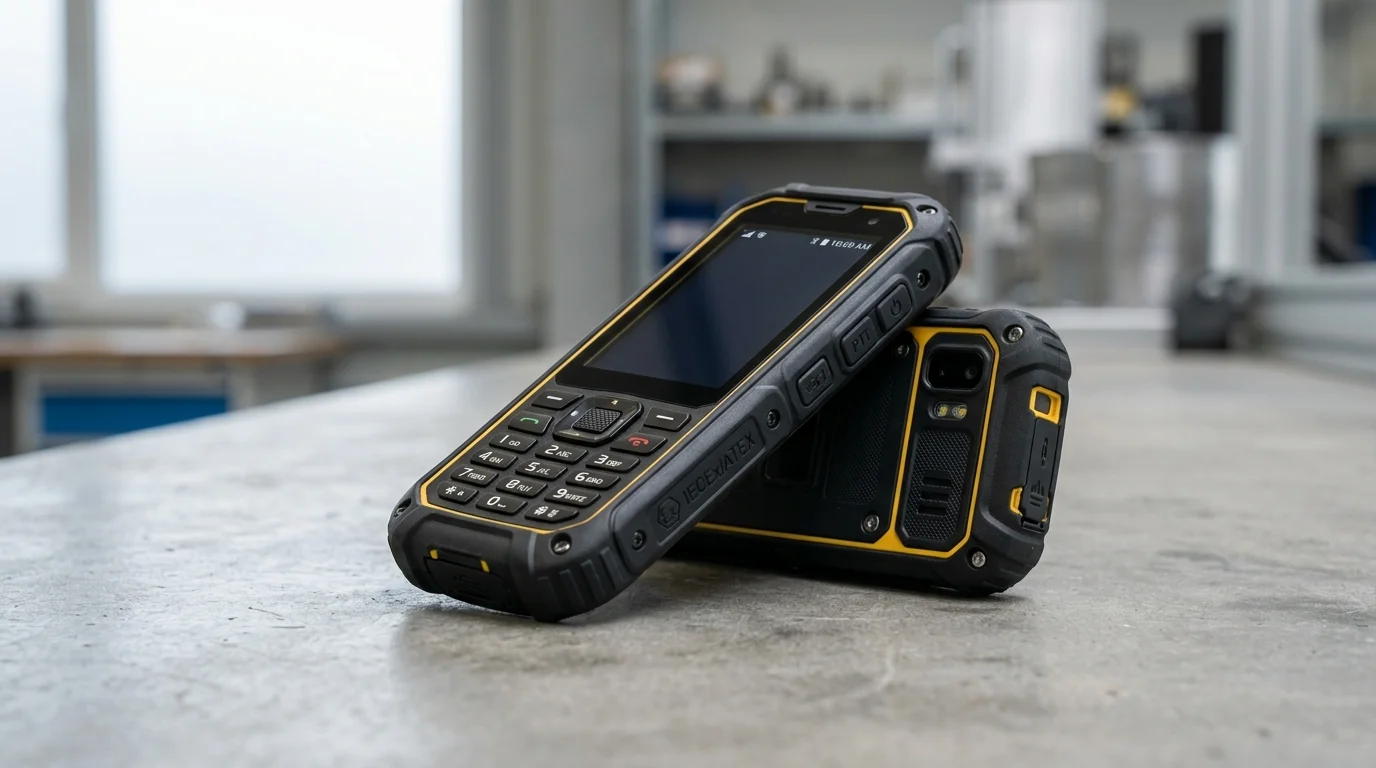
Introduction
In hazardous industrial zones, the wrong mobile device can turn routine communication into an ignition risk. This article examines seven explosion proof phones designed for environments with flammable gases, vapors, or combustible dust, focusing on the features that matter most in safety systems. You will learn how these devices differ from standard smartphones, which certifications and protection ratings to check, and how factors such as battery design, durability, network support, and hands-free use affect field operations. The overview is intended to help safety managers, engineers, and procurement teams compare options more confidently before moving into the detailed product breakdown.
Why Explosion Proof Phones Matter for Industrial Safety
Industrial environments characterized by the presence of flammable gases, vapors, or combustible dust require specialized communication infrastructure to maintain operational continuity and personnel safety. Standard consumer mobile devices introduce severe ignition risks in these hazardous areas, making the deployment of explosion proof phones a critical compliance and safety mandate.
These specialized devices, often referred to as intrinsically safe smartphones, are engineered to prevent the release of sufficient electrical or thermal energy to ignite a specific hazardous atmospheric mixture. Implementing a robust mobile communication strategy using these certified devices directly mitigates the probability of catastrophic industrial incidents while enabling real-time data exchange and remote collaboration.
How explosion proof phones reduce communication risks
Standard consumer electronics present multiple ignition vectors, including battery short circuits, electrostatic discharge, and component overheating. A conventional smartphone battery can easily generate a micro-spark exceeding 0.25 millijoules (mJ), which surpasses the minimum ignition energy required for many volatile hydrocarbon-air mixtures.
Explosion proof phones mitigate these risks through intrinsic safety principles. By strictly limiting the current and voltage available to the device’s circuitry—even under catastrophic fault conditions—these phones ensure that any potential spark remains well below critical ignition thresholds. Furthermore, advanced thermal management systems restrict surface temperatures, preventing the device from acting as a thermal ignition source even during intensive processing tasks or prolonged cellular transmission in ambient temperatures up to +60°C.
Industries and hazardous scenarios that need them
The necessity for explosion proof communication devices spans multiple industrial sectors. In the oil and gas industry, upstream drilling operations and downstream refineries operate continuously within ATEX Zone 1 (gases) and Zone 2 environments. Chemical processing plants require intrinsically safe devices to manage the risks associated with volatile solvents, demanding equipment that will not arc during routine operation or accidental drops.
Beyond petrochemicals, the agricultural, mining, and pharmaceutical sectors face severe combustible dust hazards. Grain handling facilities and pharmaceutical milling operations frequently classify as Zone 21 or Zone 22 hazardous areas. In these environments, an accumulation of combustible dust on a standard device could lead to thermal blanketing and subsequent ignition. Explosion proof phones designed for dust environments feature specialized ingress protection to completely seal out particulates, ensuring safe operation in these highly volatile scenarios.
What Defines an Explosion Proof Phone
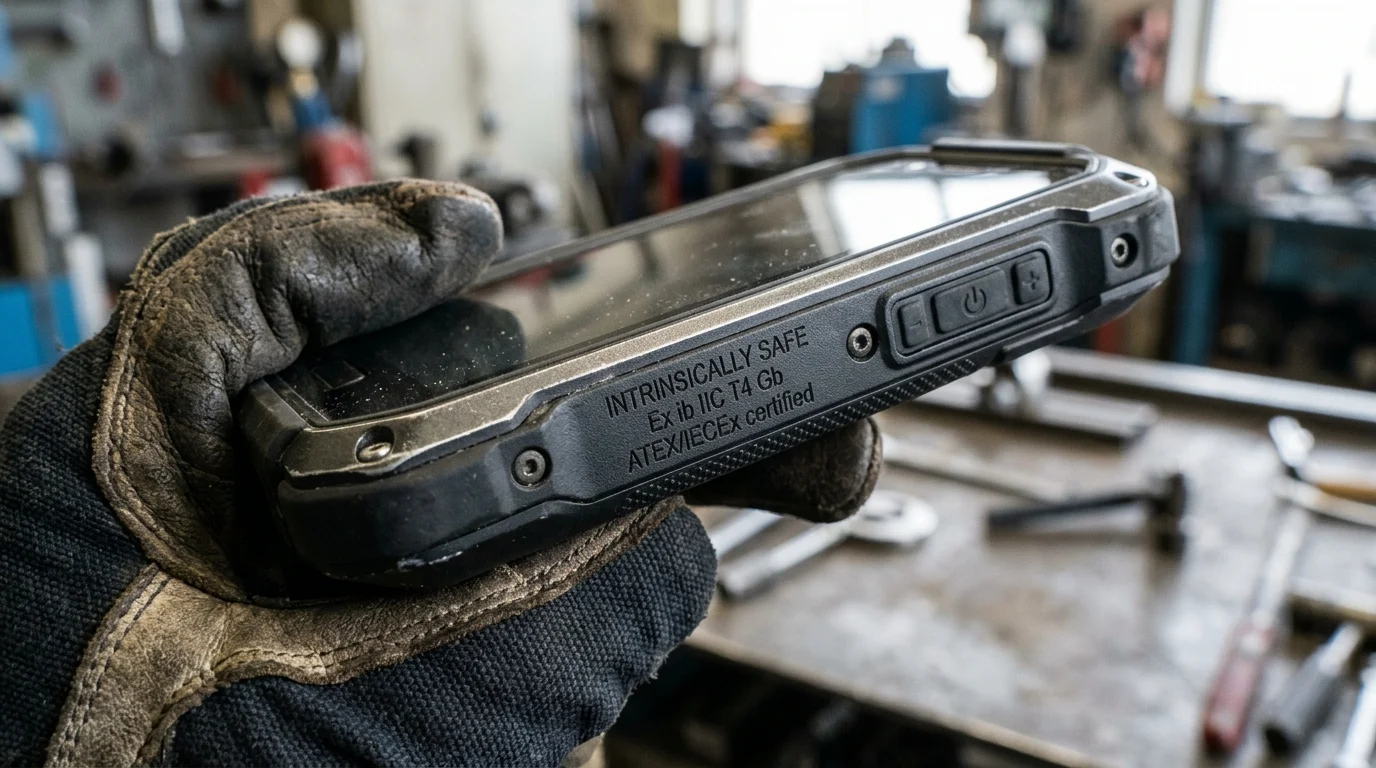
Identifying an explosion proof phone requires looking beyond standard ruggedized marketing claims. True explosion proof devices are defined by a stringent set of international certifications, specialized hardware engineering, and dedicated safety features designed specifically for high-risk industrial workforces.
These devices must balance the computational demands of modern industrial software with the strict energy limitations required to maintain intrinsic safety, resulting in highly specialized mobile architectures.
Certifications, ingress ratings, and intrinsic safety standards
The fundamental definition of an explosion proof phone is rooted in its regulatory certifications. Devices must comply with regional and international standards such as the ATEX Directive 2014/34/EU in Europe, IECEx globally, and UL913 or Class/Division standards in North America. These certifications dictate exactly which hazardous zones (e.g., Zone 1/21 for high risk, Zone 2/22 for lower risk) the device is legally permitted to enter.
Coupled with intrinsic safety are extreme ingress and durability ratings. Standard requirements include IP68 certification, guaranteeing the device can withstand water immersion up to 1.5 meters for at least 30 minutes, and complete protection against micro-particulate dust ingress. Furthermore, these devices must pass rigorous drop tests, often conforming to MIL-STD-810H standards, ensuring the internal intrinsically safe barriers remain intact even after repeated 1.2-meter drops onto solid concrete.
Battery design, push-to-talk, and lone worker features
Battery architecture is heavily regulated in explosion proof phones. To prevent thermal runaway and limit available fault energy, battery capacities are often restricted, typically ranging between 3000 mAh and 4400 mAh for Zone 1 devices. These batteries are permanently integrated or require specialized tools for removal to prevent accidental disconnection in a hazardous area, which could generate a lethal arc.
Beyond hardware safety, these phones are defined by their operational features. Dedicated Push-to-Talk (PTT) buttons enable instant, radio-like communication over cellular networks, essential for workers wearing heavy protective gloves. Additionally, integrated Lone Worker Protection (LWP) utilizes the phone’s accelerometers and gyroscopes to detect anomalies; for instance, identifying a 60-degree tilt indicating a worker has fallen, or a freefall lasting over 0.5 seconds, automatically triggering emergency SOS protocols and broadcasting GPS coordinates.
Top 7 Explosion Proof Phones Compared
The market for explosion proof phones is highly specialized, dominated by a select group of manufacturers who invest heavily in compliance engineering. Selecting the appropriate model requires evaluating the specific hazardous zone classifications of the facility against the device’s operational capabilities.
While standard smartphones compete on camera resolution and bezel size, explosion proof models compete on ruggedization, certification breadth, and sustained performance in extreme industrial environments.
How the top 7 models compare
The leading devices in the intrinsically safe market offer varying specifications tailored to different operational requirements. The table below outlines how seven prominent models compare across critical industrial metrics.
| Model | ATEX Certification | IP Rating | Battery Capacity | Operating System |
|---|---|---|---|---|
| i.safe MOBILE IS530.1 | Zone 1/21 | IP68 | 3600 mAh | Android |
| Ecom Smart-Ex 02 | Zone 1/21 | IP68 | 4400 mAh | Android |
| Sonim RS60 | Zone 2 | IP68 | 8000 mAh | Android |
| Bartec Pixavi Phone | Zone 1/21 | IP68 | 3200 mAh | Android |
| RugGear RG850 | Zone 2/22 | IP68 | 4000 mAh | Android |
| i.safe MOBILE IS330.1 | Zone 1/21 | IP68 | 3050 mAh | Android |
| Atexxo iPhone 14 | Zone 2 | IP68 | Standard | iOS |
Models designed for Zone 1/21 environments feature the most stringent energy limitations, whereas Zone 2 devices, like the Sonim RS60 or modified Atexxo iPhones, offer higher battery capacities and broader consumer-like features due to slightly relaxed regulatory constraints.
Key trade-offs between leading options
Choosing among these top models requires navigating distinct trade-offs. The most significant compromise is between form factor and hazardous area rating. Zone 1 certified devices utilize heavy internal potting and specialized non-conductive casings, frequently pushing the device weight beyond 300 grams and resulting in a bulky profile. Conversely, Zone 2 devices are lighter and closer to consumer aesthetics but cannot legally be taken into the most volatile plant areas.
Another critical trade-off involves audio performance versus battery life. Industrial environments routinely exceed 90 decibels (dB) of ambient noise. Devices like the Ecom Smart-Ex 02 and i.safe MOBILE IS530.1 feature amplified front-facing loudspeakers pushing over 95 dB to ensure PTT messages are heard. However, driving these high-output speakers alongside continuous GPS tracking for lone worker safety rapidly drains the intrinsically safe batteries, often requiring strict power management protocols to ensure the device survives a standard 12-hour operational shift.
How to Compare Cost and Procurement Factors
Procuring explosion proof phones represents a significant capital expenditure, with individual unit costs generally ranging from $1,200 for Zone 2 devices to well over $3,500 for flagship Zone 1 smartphones. Evaluating these devices requires a comprehensive financial analysis that extends far beyond the initial purchase price.
Enterprise mobility managers must calculate the Total Cost of Ownership (TCO) by factoring in deployment logistics, lifecycle management, and the hidden costs of device downtime in mission-critical environments.
Criteria that reveal total cost of ownership
The initial hardware acquisition typically accounts for only 40% to 50% of the total cost of ownership for an explosion proof phone. The remaining costs are distributed across software licensing, specialized peripheral acquisition, and ongoing IT support. Because these devices are deployed in harsh environments, mechanical wear is accelerated; however, their ruggedized nature means the replacement cycle is typically 3 to 5 years, compared to the 1 to 2-year cycle of consumer devices in industrial settings.
Downtime is the most critical metric in TCO calculations. If a consumer device fails in a refinery, a worker cannot simply swap a battery or use a temporary consumer phone, as doing so violates safety protocols. The cost of a worker being offline, or the potential fines for compliance violations, vastly outweighs the premium paid for a certified intrinsically safe device with a guaranteed sub-1% annual hardware failure rate.
Sourcing, service, spare parts, MDM, and carrier support
Strategic procurement requires evaluating vendor support and supply chain logistics. Manufacturers or specialized distributors often enforce Minimum Order Quantities (MOQs), typically ranging from 10 to 50 units for direct enterprise pricing and custom firmware provisioning. Organizations must also secure guaranteed access to certified spare parts; replacing a screen or battery on an intrinsically safe device requires authorized service centers to maintain the ATEX/IECEx certification validity.
Furthermore, integration capabilities dictate long-term viability. Devices must support zero-touch enrollment and seamless integration with Mobile Device Management (MDM) platforms to push security patches remotely. Carrier support is equally vital; procurement teams must verify that the selected hardware is certified for industrial private LTE/5G networks (such as CBRS band 48) or specialized public safety networks like FirstNet, ensuring uninterrupted connectivity in remote or heavily shielded industrial facilities.
How to Choose the Right Explosion Proof Phone
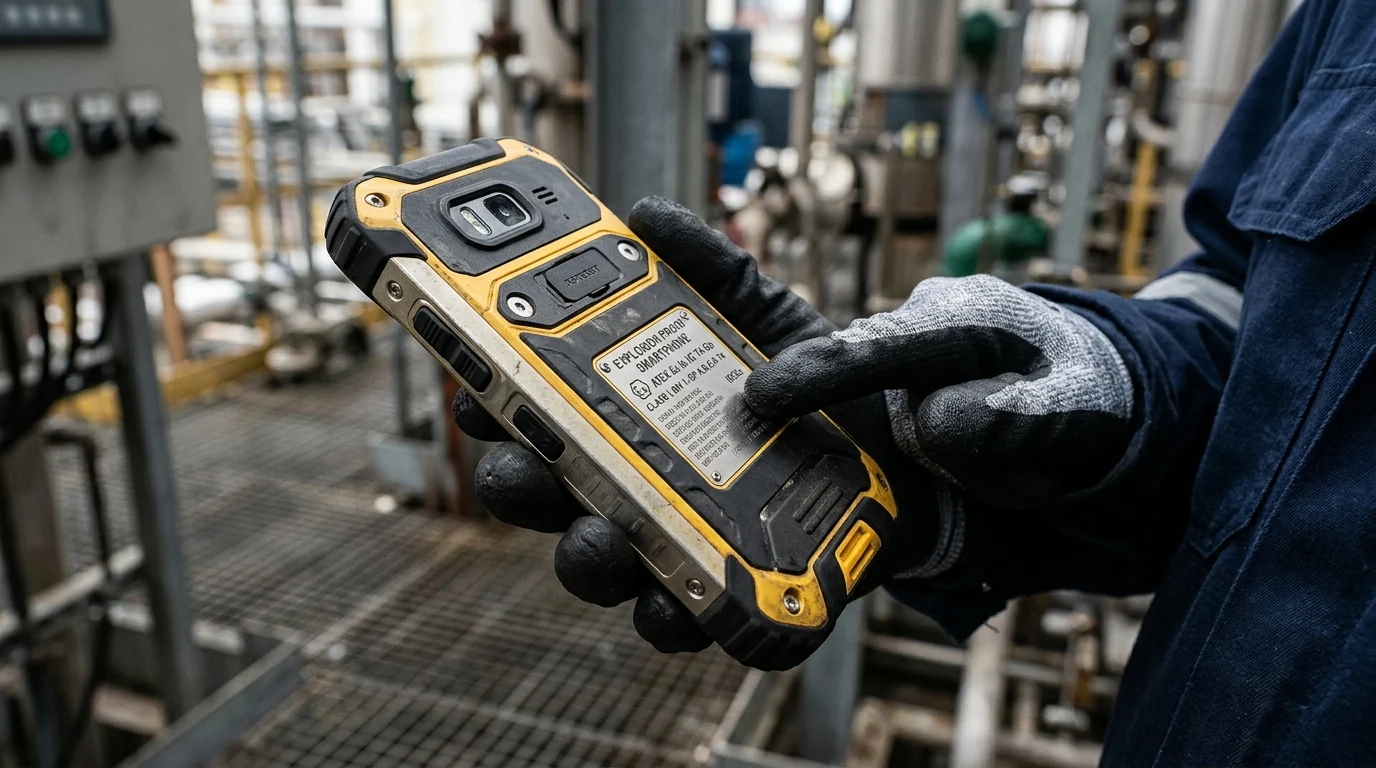
Selecting the ideal explosion proof phone requires a methodical approach that aligns regulatory compliance with user acceptance. A mismatched device can lead to severe safety liabilities, poor field adoption, and wasted capital.
By structuring the selection process around technical audits and rigorous field testing, organizations can confidently deploy a mobile communication fleet that enhances operational efficiency without compromising facility safety.
A step-by-step selection process
The selection process must begin with a comprehensive site audit. Safety officers must map the facility to determine the exact proportion of Zone 1 versus Zone 2 areas. If only 10% of a facility is classified as Zone 1, standardizing entirely on expensive Zone 1 devices may be unnecessary; a mixed-fleet deployment could optimize the budget. Next, IT departments must define software requirements, ensuring the chosen devices support the necessary Android Enterprise Recommended standards or specific proprietary maintenance applications.
Following the technical audit, organizations should execute a structured pilot program. This involves deploying 2 to 5 test units of the shortlisted models into the actual working environment for a 30 to 90-day evaluation period. During this phase, field workers test the devices while wearing standard Personal Protective Equipment (PPE), evaluating screen responsiveness through heavy gloves and assessing PTT audio clarity near active machinery.
Decision criteria for the final shortlist
When finalizing the shortlist, decision-makers should evaluate devices against strict enterprise criteria tailored to hazardous environments. The matrix below highlights key differentiators to assess during the final selection phase.
| Evaluation Criteria | Standard Enterprise Device | Intrinsically Safe Device | Operational Impact |
|---|---|---|---|
| Drop Resistance | 1.0m to flat surface | MIL-STD-810H (1.2m to concrete) | Reduces hardware replacement rates by up to 60% |
| Operating Temperature | 0°C to 35°C | -20°C to +60°C | Ensures functionality in extreme industrial climates |
| Audio Output | ~70-80 dB | >90 dB with noise cancellation | Guarantees PTT clarity in high-decibel machinery zones |
| Lifecycle Support | 1-2 years | 3-5 years guaranteed patches | Lowers TCO and stabilizes MDM deployments |
The final decision must be a consensus between the HSE (Health, Safety, and Environment) department, ensuring all legal compliance boxes are checked, and the end-users, ensuring the device is practically usable. A device that meets all regulatory standards but features an interface too cumbersome to operate with industrial gloves will ultimately hinder productivity and fail its core communication mandate.
Key Takeaways
- The most important conclusions and rationale for Explosion Proof Phones
- Specs, compliance, and risk checks worth validating before you commit
- Practical next steps and caveats readers can apply immediately
Frequently Asked Questions
What makes a phone truly explosion proof?
It must carry hazardous-area certifications such as ATEX, IECEx, or UL913, plus suitable zone ratings like Zone 1/21 or Zone 2/22. Ruggedness alone is not enough.
Which industries need explosion proof phones most?
Oil and gas, mining, chemical plants, pharmaceuticals, grain handling, maritime, and construction sites with flammable gas or combustible dust risks need certified devices.
How do I choose the right hazard-zone rating?
Match the phone’s certification to your site classification. Zone 1/21 suits higher-risk areas; Zone 2/22 fits lower-risk exposure. Always verify local compliance requirements before purchase.
Why consider Siniwo for explosion proof communication systems?
Siniwo provides one-stop industrial communication services, from design and integration to installation and maintenance, with certified products for hazardous and harsh environments in 70+ countries.
Are explosion proof phones enough for a complete industrial safety system?
Usually not. They work best with integrated telephones, intercoms, emergency call boxes, PA systems, and IP PBX/VoIP to ensure reliable communication across the whole site.
Post time: Apr-28-2026