
Strategic Role of Prison Telephone Systems
The deployment of a specialized prison telephone system represents a critical infrastructure investment for correctional facilities worldwide. Unlike standard commercial telecommunications, these systems must bridge the gap between heavy-duty physical security and advanced digital monitoring. For wholesale buyers, telecom integrators, and government procurement agencies, sourcing the correct hardware involves balancing stringent regulatory requirements with robust operational lifespans.
Strategic procurement in this sector goes beyond simply acquiring durable handsets. It necessitates a comprehensive understanding of how physical hardware endpoints integrate with backend management software to facilitate secure, monitored, and highly controlled communication networks within high-risk environments.
Security impact on inmate communications
In correctional environments, the telephone network is a primary vector for both authorized inmate communication and potential security vulnerabilities. Hardware must support seamless integration with backend call management systems (CMS) that handle real-time monitoring, biometric voice authentication, and automated call recording. System integrators typically require endpoints capable of executing strict programmable protocols, such as automated 15-minute call cut-offs and pre-approved number dialing restrictions.
Furthermore, the physical security impact of the hardware cannot be overstated. Vandal-resistant features prevent devices from being weaponized or dismantled. High-grade systems must guarantee 99.9% operational uptime, as communication blackouts in prison populations are recognized catalysts for institutional unrest.
Buyer segments and procurement models
The B2B market for inmate communication systems is heavily segmented into distinct buyer categories: government correctional departments, private prison operators, and specialized telecom integrators. Each segment operates under different procurement models. Government entities generally rely on rigid Request for Proposal (RFP) structures, prioritizing compliance, long-term support, and hardware durability over a typical 3-to-5-year contract lifecycle.
Telecom integrators, conversely, often source white-label or OEM hardware from established manufacturers to bundle with proprietary software platforms. These buyers focus heavily on interoperability, API support for VoIP systems, and favorable wholesale margin structures, seeking hardware partners capable of scaling production to meet multi-facility deployment schedules.
Core Features and System Architecture
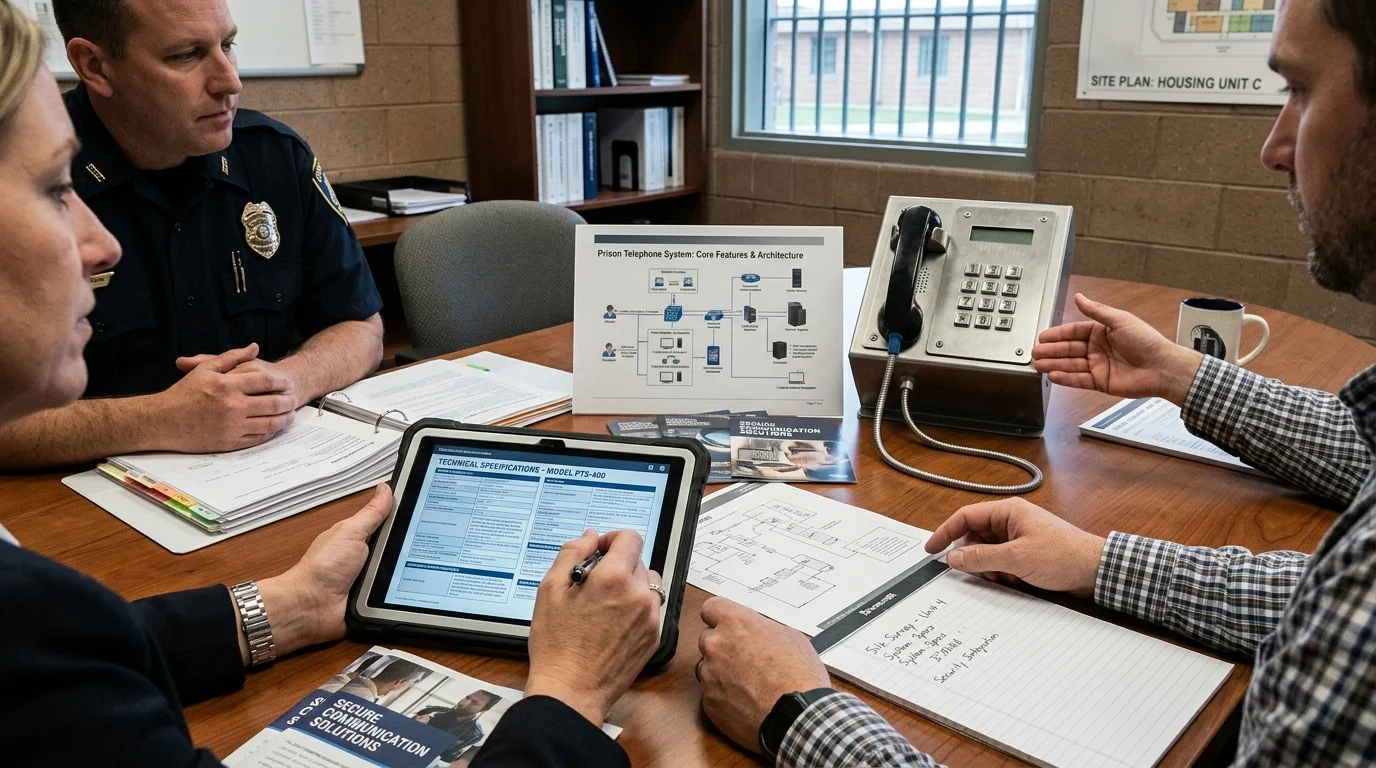
Modern correctional telecommunications rely on a hybrid architecture that combines ruggedized physical endpoints with sophisticated digital routing. Understanding the core features of these systems is essential for procurement officers tasked with matching hardware specifications to facility infrastructure requirements.
Key system components
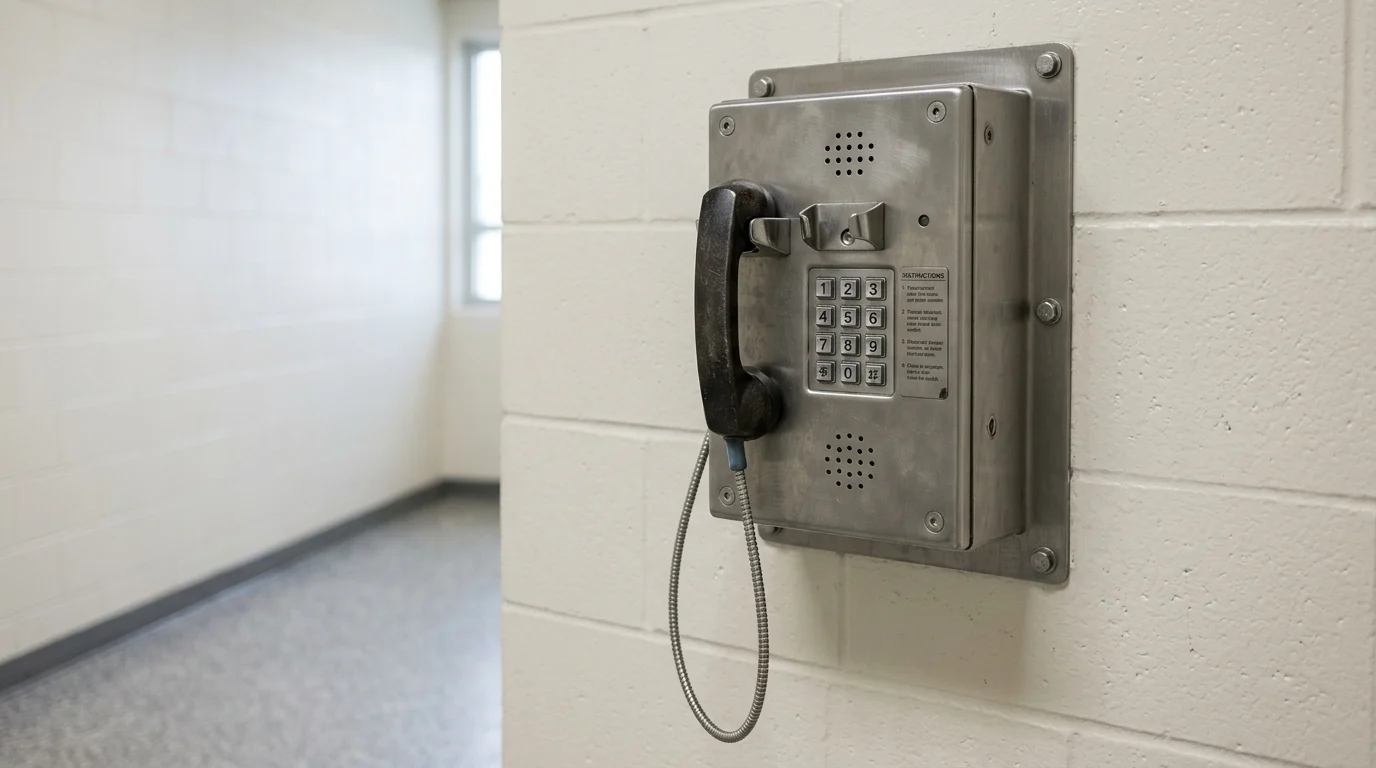
The physical integrity of a prison telephone system relies on purpose-built components designed to withstand extreme abuse. Key elements include housings constructed from cold-rolled steel or SUS304 stainless steel, typically ranging from 1.5mm to 2.0mm in thickness. Handsets must be molded from high-impact polycarbonate and connected via armored cords. These heavy-duty cords are engineered with a pull strength exceeding 1,000 pounds to prevent them from being detached and used as ligatures or weapons.
Additionally, the internal components must be protected by tamper-proof security screws, requiring specialized tools for maintenance access. Keypads, when present, are often constructed from weather-resistant zinc alloy to endure continuous, forceful use without mechanical failure.
Analog, VoIP, SIP, and intercom options
The choice between Analog, VoIP, SIP, and dedicated intercom options dictates the facility’s underlying communication architecture. Traditional analog systems remain prevalent in older facilities due to existing 2-wire copper infrastructure. However, the industry is rapidly transitioning toward SIP-based VoIP systems. VoIP endpoints allow for centralized IP PBX management, facilitating easier integration with digital recording servers and automated voice prompts.
For maximum security zones, point-to-point analog or digital intercoms are often deployed. These systems bypass external networks entirely, providing direct, un-routable communication between inmates and control rooms, which is critical during lockdowns or emergency scenarios.
Technical specifications for sourcing
When sourcing hardware, procurement teams must evaluate specific technical thresholds to ensure long-term viability. The table below outlines standard baseline specifications required for modern deployments.
| Specification | Analog System | SIP / VoIP System |
|---|---|---|
| Audio Codecs | N/A (Baseband) | G.711, G.722, G.729 |
| Cabling Infrastructure | 2-wire copper | Cat5e / Cat6 |
| Power Supply | Telephone line powered | PoE (802.3af) or 12V DC |
| Environmental Protection | IP54 to IP65 | IP65 to IP67 |
| Mean Time Between Failures (MTBF) | > 50,000 hours | > 50,000 hours |
| Network Bandwidth | N/A | ~64-100 kbps per channel |
Selecting the correct protocol and specification band directly impacts the Total Cost of Ownership (TCO) and the scope of required infrastructure upgrades.
Supplier Evaluation and Compliance
Evaluating manufacturers of prison telephone systems requires a rigorous vetting process. Industrial communication specialists must demonstrate not only the capability to produce ruggedized hardware but also adherence to international quality and safety benchmarks. Sourcing from unverified suppliers introduces unacceptable security and operational risks.
Supplier qualification criteria
Supplier qualification in this niche is heavily dependent on manufacturing autonomy and quality control. Top-tier manufacturers, such as those specializing in explosion-proof and industrial communications, typically maintain in-house production for over 90% of their core components. This vertical integration is crucial for maintaining strict quality tolerances and shielding buyers from supply chain disruptions.
Procurement teams should verify ISO9001 certification as a baseline. Furthermore, evaluating a supplier’s historical footprint—such as successful deployments across 50+ countries or specialized experience in adjacent harsh environments like mining and maritime—provides confidence in their engineering capabilities.
Compliance, testing, and documentation
Compliance documentation is non-negotiable for correctional facility deployments. Devices must carry standard telecommunications certifications including FCC and CE marks, alongside ROHS compliance for material safety. Physical durability must be validated through standardized testing, specifically the IK10 impact resistance rating, which ensures the enclosure can withstand a 20-joule impact without compromising internal electronics.
In specific facility areas, such as industrial workshops or maintenance zones where combustible materials are present, telephones may also require ATEX or IECEx certifications to guarantee explosion-proof operation. Buyers must demand verifiable test reports from accredited third-party laboratories during the initial RFP phase.
OEM comparison framework
For telecom integrators, the ability to source OEM (Original Equipment Manufacturer) or ODM (Original Design Manufacturer) solutions is a critical competitive advantage. A robust OEM comparison framework should assess a supplier’s willingness to customize firmware, alter keypad layouts, and integrate proprietary SIP protocols.
Suppliers should be evaluated on their engineering agility. For instance, modifying a standard rugged telephone to include a specialized auto-dialer or integrating it with a specific IP PBX brand should not extend standard production timelines by more than 15 to 20 days. Comprehensive Service Level Agreements (SLAs) guaranteeing technical support response times within 24 to 48 hours are also vital components of the OEM partnership.
Commercial and Deployment Considerations
Transitioning from technical specifications to commercial realities, buyers must carefully navigate the logistical and financial aspects of bulk procurement. Effective deployment of a prison telephone system requires meticulous alignment of supply chain variables, pricing models, and site-specific installation constraints.
MOQ, lead times, and spare parts planning
Establishing favorable Minimum Order Quantities (MOQs) and manageable lead times is essential for continuous deployment schedules. Standard ruggedized analog units often carry lower MOQs, sometimes as few as 10 to 50 units, while heavily customized SIP terminals may require MOQs of 100+ units to justify production runs. Typical lead times for industrial-grade telecom equipment range from 30 to 45 days, depending on customization depth.
Inventory planning must include a calculated spare parts ratio. Given the high-abuse environment, procurement officers should mandate a 3% to 5% spare parts buffer in their initial purchase orders. Sourcing component-level spares—such as replacement armored cords, magnetic reed hooks, and security screws—ensures rapid on-site repairs without replacing the entire $200-$400 terminal.
Pricing, margins, and channel strategy
The pricing architecture for prison communication hardware varies significantly based on technology and ruggedization levels. Standard vandal-proof analog wall phones typically range from $150 to $250 per unit at wholesale volumes. Upgrading to SIP-enabled, IP66-rated terminals pushes the unit cost into the $300 to $500 band, while advanced units featuring integrated video intercoms can exceed $800.
For distributors and integrators, hardware margins are often secondary to the recurring SaaS revenue generated by the call management software. Therefore, the channel strategy relies on sourcing highly reliable, competitively priced hardware that minimizes warranty claims and truck rolls, thereby protecting the profitability of the long-term software service contract.
Implementation and site alignment
Implementation logistics hinge on whether the deployment is a greenfield new build or a brownfield retrofit. Retrofitting older facilities often dictates the continued use of analog systems due to the prohibitive cost of pulling new Cat6 cable through reinforced concrete walls. In these scenarios, hybrid IP PBX gateways are utilized in the telecom closet to bridge analog endpoints to modern digital networks.
For modern facilities, deploying PoE (Power over Ethernet) utilizing the 802.3af standard is highly recommended. PoE eliminates the need for separate electrical conduit runs to each telephone location, potentially reducing localized installation and cabling costs by up to 30%, while allowing central UPS systems to maintain network uptime during power outages.
Selection Framework for Buyers
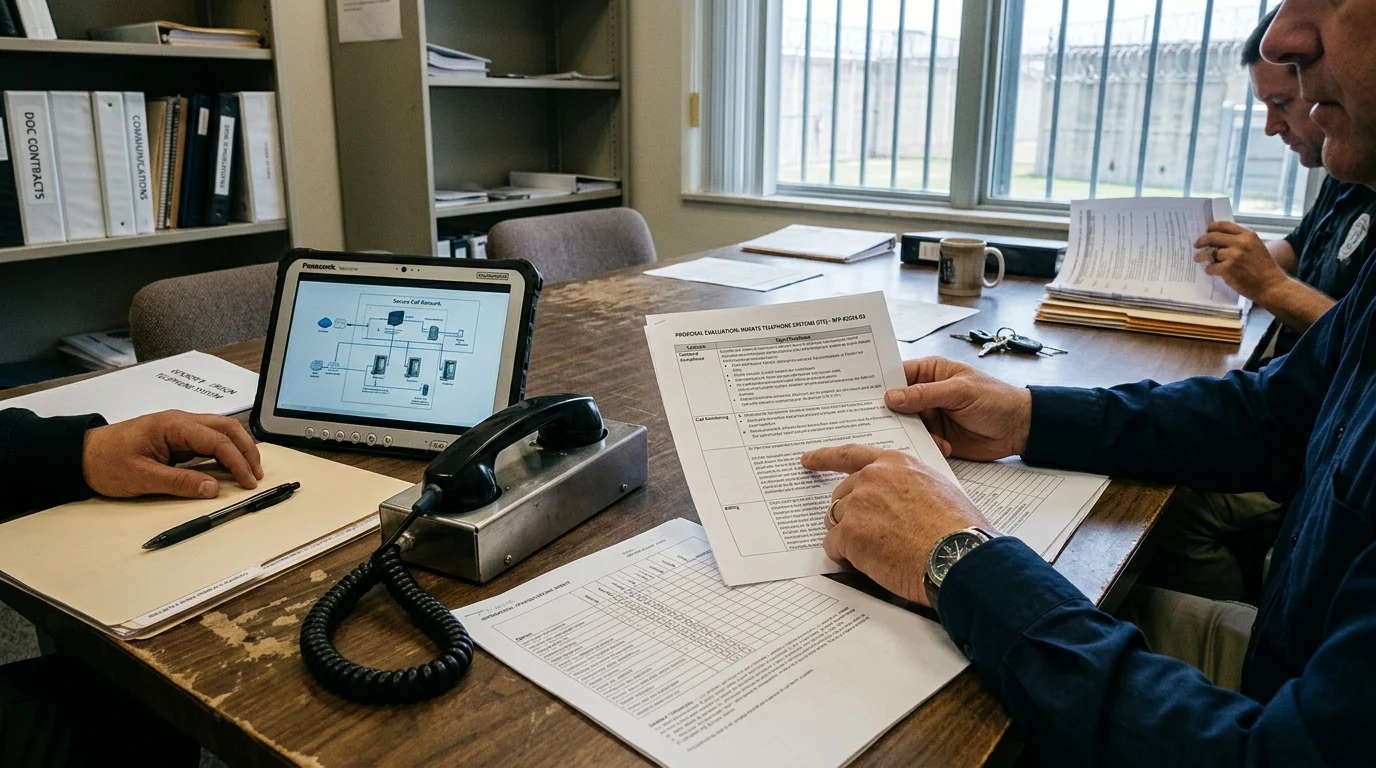
Synthesizing the technical, compliance, and commercial data into a unified selection framework allows wholesale buyers to execute procurements with confidence. A structured approach minimizes risk and aligns hardware capabilities with the specific security mandates of correctional institutions.
Procurement decision criteria
The primary decision criterion for B2B buyers must be the Total Cost of Ownership (TCO) calculated over a standard 5-to-7-year hardware lifecycle. TCO encompasses not only the initial unit cost and shipping but also the projected failure rate, the cost of specialized maintenance tools, and the downtime associated with hardware swaps.
Secondary criteria involve the scalability of the system. Procurement teams must ensure that the chosen manufacturer can support future expansions, offering backward-compatible firmware and consistent physical form factors so that phase-two deployments visually and technically match the initial installation.
Supplier shortlist and sourcing framework
To finalize a supplier shortlist, buyers should utilize a weighted sourcing framework that objectively scores manufacturers across critical performance indicators. The following table provides a recommended matrix for evaluating potential prison telephone system suppliers.
| Evaluation Criteria | Target Benchmark | Sourcing Weight |
|---|---|---|
| Hardware Durability & Security | IK10 impact, IP65+ rating, 1000-lb cord | 30% |
| Production Capacity & Lead Time | Scalable to 1,000+ units/month, < 40 days | 25% |
| Quality Control & Manufacturing | ISO9001, 90%+ in-house component production | 20% |
| Commercial Terms & Flexibility | Net 30/60 options, Flexible MOQs (e.g., 50 units) | 15% |
| Technical Support & OEM Capability | < 48-hour SLA, Custom SIP firmware integration | 10% |
Applying this framework ensures that procurement decisions are driven by quantifiable metrics rather than upfront unit costs alone. By prioritizing manufacturers that score highly in durability, production autonomy, and compliance, buyers can secure robust communication infrastructure that meets the uncompromising demands of the correctional sector.
Key Takeaways
- Wholesale sourcing and supply-chain implications for Prison Telephone System
- Specifications, compliance, and commercial terms buyers should validate
- Actionable recommendations for distributors and procurement teams
Frequently Asked Questions
What makes a prison telephone system different from a standard phone system?
It combines vandal-resistant hardware with controlled calling, recording, and monitoring. In prisons, phones must support approved-number dialing, call time limits, and secure integration with call management platforms.
Should a correctional facility choose analog or SIP/VoIP prison phones?
Use analog when existing 2-wire infrastructure must be retained. Choose SIP/VoIP for centralized IP PBX management, easier recording integration, and scalable deployment across multiple facilities.
Which hardware features are essential for prison telephone endpoints?
Look for stainless steel or cold-rolled steel housings, armored cords, tamper-proof screws, impact-resistant handsets, and IP-rated protection. These features reduce vandalism, downtime, and maintenance costs.
Can Siniwo support prison telephone projects beyond just supplying phones?
Yes. Siniwo provides one-stop industrial communication services, including design, integration, installation, and maintenance support, which helps telecom integrators and procurement teams streamline correctional deployments.
Why is durability so important in a prison telephone system?
High durability helps maintain uptime, prevents devices from being dismantled or misused, and supports safer daily operations. Rugged endpoints are critical in high-abuse areas where communication interruptions can escalate risk.
Post time: Apr-17-2026