
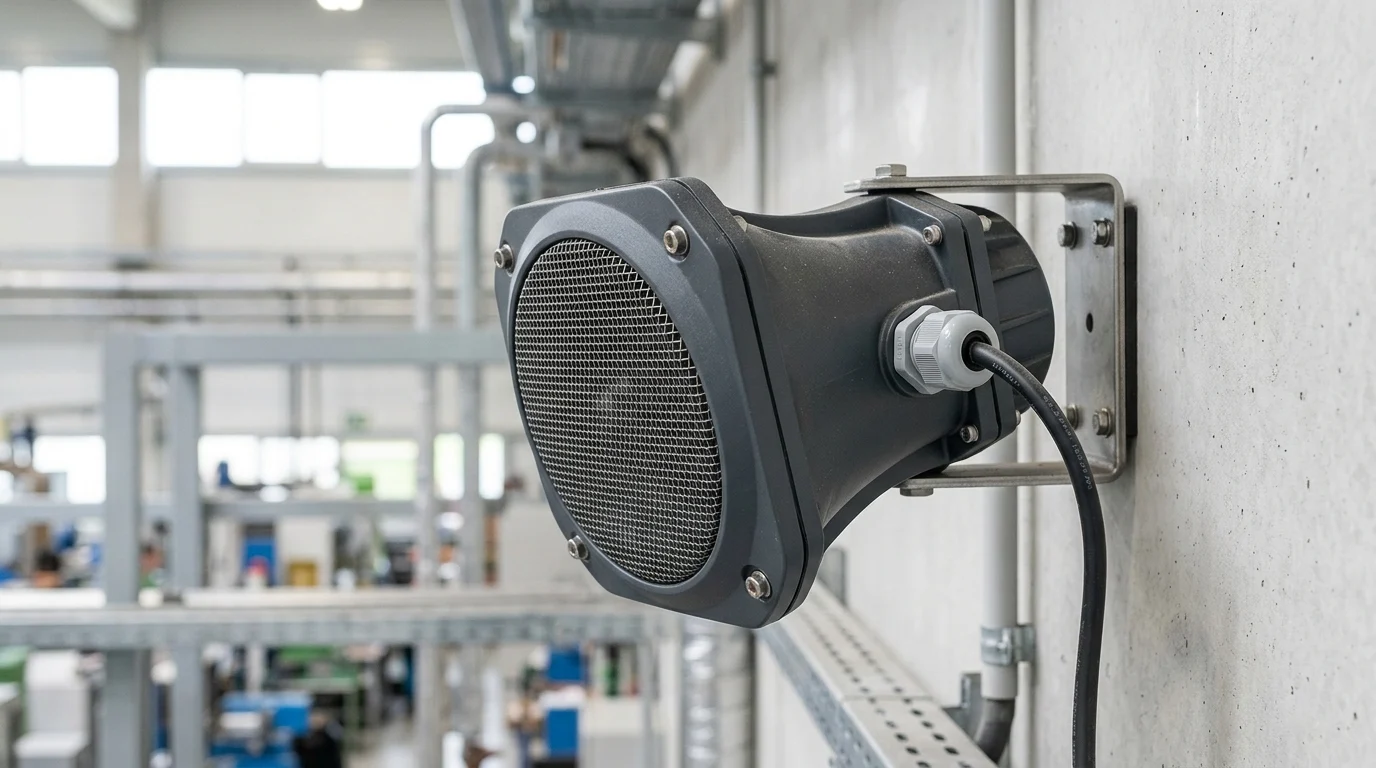
Why Industrial Speaker IP Ratings Matter
Specifying audio notification and public address systems for industrial facilities requires a rigorous approach to environmental survivability. While acoustic parameters like sound pressure level (SPL) and frequency response dictate audibility, the Ingress Protection (IP) rating ultimately determines the operational lifespan of the unit. An industrial speaker IP rating defines the enclosure’s mechanical defense against particulate matter and liquids, which are the primary vectors for premature electromechanical failure in harsh environments.
How IP ratings affect system reliability
The correlation between an industrial speaker IP rating and overall system reliability is direct and measurable. Public address and general alarm (PAGA) systems in industrial plants are often tied to life-safety protocols, requiring a Mean Time Between Failures (MTBF) exceeding 50,000 hours. When enclosures lack adequate sealing, environmental ingress accelerates component degradation, routinely slashing MTBF to under 10,000 hours. Consequently, selecting an enclosure that acts as an absolute barrier to site-specific contaminants is a fundamental requirement for maintaining continuous operational readiness and avoiding catastrophic communication breakdowns during emergency events.
How dust, water, and vibration create failure risks
Dust, water, and ambient vibration interact to create severe failure risks for acoustic transducers. Industrial speaker voice coil gaps operate with extremely tight tolerances, frequently between 0.2mm and 0.5mm. When conductive or abrasive dust breaches the enclosure, it accumulates in the magnetic gap, causing friction, voice coil deformation, and eventual thermal failure. Similarly, water ingress introduces moisture to the internal circuitry and transformer taps, initiating galvanic corrosion and electrical shorting. While IP ratings do not explicitly measure vibration resistance, heavy industrial vibration accelerates the degradation of rubber gaskets and silicone sealants, making a robust IP-rated mechanical design even more critical to prevent secondary ingress failures.
Where IP54, IP66, and IP67 are commonly used
The deployment of IP54, IP66, and IP67 industrial speakers follows distinct environmental zoning within industrial architecture. IP54 units are standard across climate-controlled manufacturing floors, indoor warehousing, and packaging halls where exposure is limited to ambient airborne dust and occasional splashing from routine cleaning. IP66 speakers dominate outdoor perimeter PA systems, petrochemical processing zones, and food-and-beverage facilities where high-pressure, high-volume washdowns are mandatory. Finally, IP67 devices are reserved for the most extreme exposure zones, including marine vessel decks, flood-prone mining galleries, and chemical bunding areas where temporary submersion is a realistic operational hazard.
What Industrial Speaker IP Ratings Certify
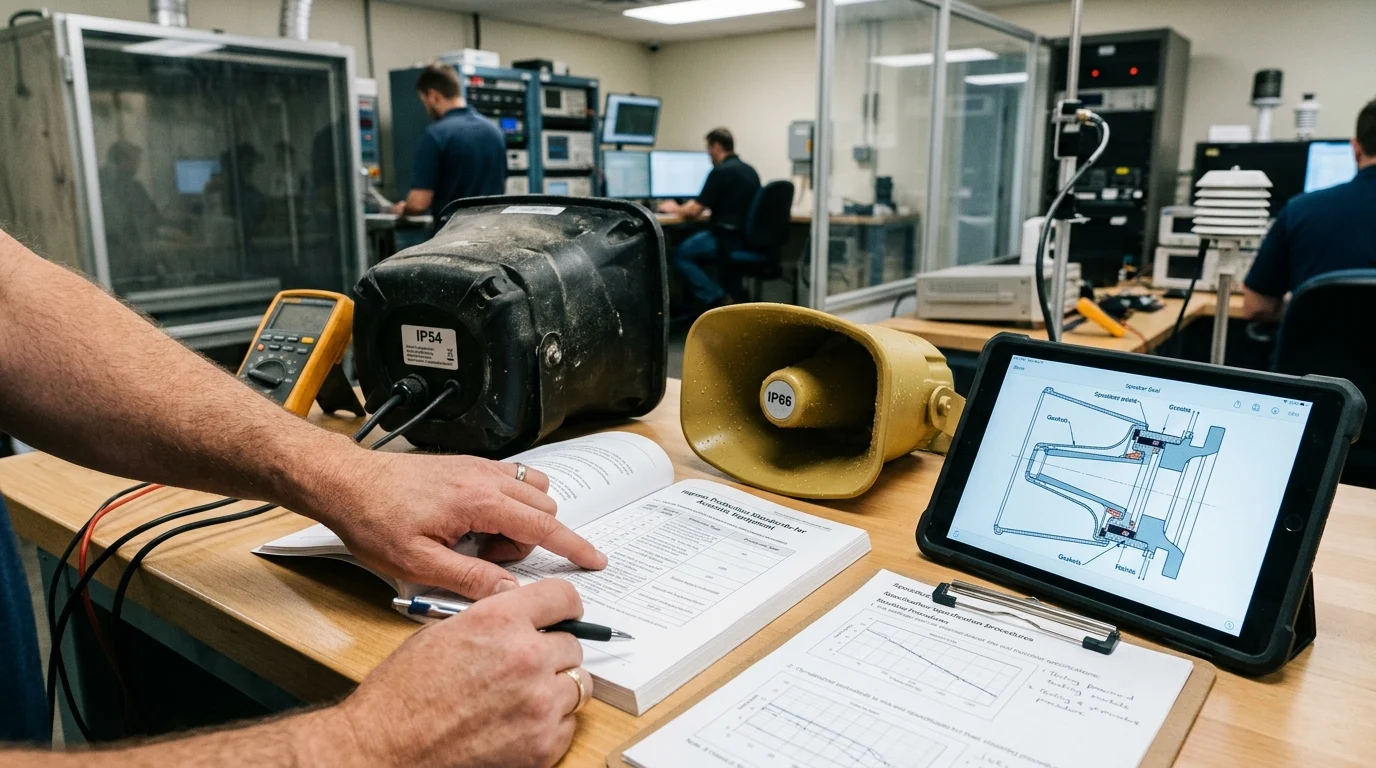
Industrial speaker IP ratings are formally defined by the IEC 60529 standard, which establishes a universal classification system for the degrees of protection provided by enclosures. Understanding the precise testing parameters of this standard is vital for engineers seeking to validate acoustic equipment against specific environmental hazards.
What the first and second IP digits mean
The IP code utilizes a two-digit alphanumeric system to quantify resistance to solids and liquids. The first digit (ranging from 0 to 6) indicates the level of protection against solid foreign objects and dust ingress. The second digit (ranging from 0 to 9) specifies the degree of protection against water penetration.
| First Digit (Solids) | Definition | Second Digit (Liquids) | Definition |
|---|---|---|---|
| 5 | Dust-protected (limited ingress permitted, no harmful deposit) | 4 | Protected against splashing water from any direction |
| 6 | Dust-tight (no ingress of dust, complete vacuum test) | 6 | Protected against powerful water jets (100 kPa at 3 meters) |
| - | - | 7 | Protected against temporary submersion (1 meter depth for 30 minutes) |
For an industrial speaker, achieving a “6″ for the first digit requires a vacuum pump test demonstrating zero talcum powder penetration over an 8-hour period, ensuring absolute particulate isolation.
What IP ratings do not prove
Despite their rigorous testing parameters, industrial speaker IP ratings do not prove comprehensive environmental survivability. IEC 60529 tests solely evaluate ingress; they do not assess an enclosure’s resistance to ultraviolet (UV) radiation, chemical degradation, or extreme temperature cycling. For instance, a polycarbonate speaker housing may achieve an IP66 rating in a laboratory but become brittle and crack after two years of UV exposure or exposure to caustic cleaning agents. Furthermore, IP ratings do not account for mechanical impact resistance, which is separately governed by the IK rating scale (IEC 62262), nor do they address the risks of internal condensation caused by high humidity and fluctuating temperatures.
How test conditions, mounting, and cable entries affect protection
The validity of an industrial speaker IP rating is heavily contingent upon proper installation techniques, specifically regarding mounting orientation and cable entries. Laboratory IP testing is conducted under highly controlled, static conditions with all ports perfectly sealed. In the field, a speaker’s protection is only as strong as its weakest ingress point, which is frequently the cable gland. Utilizing an M20 cable gland that lacks a matching or superior IP rating instantly compromises the entire enclosure. Additionally, many acoustic horns feature engineered weep holes to drain internal condensation; if the speaker is mounted at an incorrect angle, these weep holes become ingress pathways, invalidating the certified protection level and allowing water to pool against the transducer diaphragm.
How IP54, IP66, and IP67 Compare
Differentiating between IP54, IP66, and IP67 requires analyzing not only the testing thresholds but also the specific engineering modifications required to achieve each tier. As the protection level increases, manufacturers must implement more advanced acoustic materials and sealing technologies, which directly impacts the unit’s cost and acoustic efficiency.
IP54 performance in controlled factory environments
An IP54 rating provides sufficient defense for controlled factory environments where equipment is subject to settling dust and incidental liquid exposure. During IEC testing, an IP54 speaker must withstand water splashed at a rate of 10 liters per minute for 5 minutes without suffering detrimental electrical effects. To achieve this, manufacturers typically utilize standard weather-resistant paper or treated cloth cones combined with basic foam gaskets. Because the sealing requirements are moderate, IP54 speakers maintain high acoustic sensitivity and represent the most cost-effective baseline for indoor industrial audio, typically costing 30% to 40% less than fully sealed outdoor equivalents.
When IP66 protection is justified
When an environment escalates to require IP66 protection, the engineering approach shifts to total isolation. IP66 speakers are tested against powerful water jets delivering 100 liters per minute at a pressure of 100 kPa from a distance of 3 meters. This severity justifies its use in heavy washdown areas, such as meat processing plants or marine port terminals exposed to driving rain. To survive this, IP66 units abandon standard cones in favor of specialized Mylar, phenolic, or titanium diaphragms. The enclosures rely on heavy-duty silicone O-rings, potted transformers, and labyrinthine acoustic pathways designed to deflect kinetic water energy before it reaches the transducer.
When IP67 protection is necessary
IP67 protection is necessary only when the operational environment presents a tangible risk of fluid submersion. The IEC 60529 standard dictates that an IP67 device must prevent water ingress when completely submerged in 1 meter of water for 30 minutes. Designing an industrial speaker to transmit sound while completely sealed against hydrostatic pressure is highly complex. These units require hermetically sealed driver chambers, pressure-compensating membranes (such as expanded PTFE vents) to prevent internal pressure buildup, and corrosion-resistant 316L stainless steel hardware. Due to the acoustic impedance introduced by absolute sealing, IP67 speakers often require higher wattage amplifiers to achieve the same SPL as lower-rated counterparts, representing a significant premium in both unit cost and infrastructure requirements.
How to Select the Right IP Rating
Specifying the correct industrial speaker IP rating demands a calculated approach that balances environmental reality against capital expenditure. Sound engineering practice requires project managers to evaluate the micro-environment of each speaker location rather than applying a blanket specification across an entire facility.
How to match exposure severity to IP protection
Matching exposure severity to IP protection begins with a thorough site audit. Engineers must quantify the volume, pressure, and frequency of liquid exposure, as well as the nature of airborne particulates. For a logistics center handling dry goods, ambient dust is the primary concern, making IP54 the mathematically sound choice. Conversely, in a pharmaceutical cleanroom requiring daily sterilization with 1000 kPa pressure washers, a standard IP66 rating might prove insufficient, pushing the requirement toward specialized IP69K units. The goal is to align the IEC 60529 test parameters directly with the worst-case operational scenario the speaker will face during its intended 10-to-15-year lifecycle.
How to avoid under-specifying or over-specifying
Both under-specifying and over-specifying industrial speaker IP ratings carry substantial financial penalties. Under-specifying an IP54 speaker for an outdoor loading dock guarantees rapid failure, resulting in replacement cycles as short as 6 to 12 months, alongside the hidden costs of maintenance labor and system downtime. Conversely, over-specifying IP67 speakers for an indoor, climate-controlled assembly line constitutes severe capital waste. High-tier IP enclosures carry cost premiums of 50% to 100% over standard units. Multiplying this premium across a 200-speaker PA system can unnecessarily inflate a project budget by tens of thousands of dollars without delivering any tangible improvement in system reliability.
What supplier test evidence to request
To ensure compliance and guarantee performance, buyers must demand rigorous test evidence from suppliers rather than accepting datasheet claims at face value. Procurement teams should request formal IEC 60529 test reports issued by accredited third-party laboratories, such as TÜV Rheinland, UL, or Intertek. Furthermore, it is critical to verify the manufacturer’s internal quality control standards. Buyers should ask for the Acceptable Quality Limit (AQL) used during batch testing; an AQL of 0.65 or 1.0 for ingress protection ensures that the sealing integrity proven in the lab is consistently replicated on the assembly line.
Industrial Speaker IP Rating Decision Guide
Consolidating environmental data, acoustic requirements, and budgetary constraints into a standardized procurement strategy ensures consistent system performance. The following decision framework provides a structured methodology for selecting the optimal industrial speaker IP rating for any commercial or industrial application.
Selection matrix for IP54, IP66, and IP67
The selection matrix below categorizes the three primary IP ratings against critical environmental and financial variables. This tool allows system integrators to rapidly cross-reference their site conditions with the appropriate acoustic hardware tier.
| IP Rating | Particulate Defense | Liquid Defense | Washdown Compatibility | Relative Cost Index | Typical Application |
|---|---|---|---|---|---|
| IP54 | Dust-protected | Splash resistant | None | 1.0x (Baseline) | Indoor warehousing, dry manufacturing, control rooms |
| IP66 | Dust-tight | Powerful jets | Yes (Standard pressure) | 1.4x – 1.6x | Outdoor perimeters, food & beverage, petrochemical |
| IP67 | Dust-tight | Submersion (1m, 30 min) | Yes (Incidental pooling) | 2.0x – 2.5x | Marine decks, mining galleries, flood zones |
Using this matrix prevents the common engineering error of deploying splash-resistant hardware in jet-wash zones, thereby safeguarding the acoustic infrastructure.
Final buyer checklist
Before finalizing a purchase order for industrial audio equipment, project managers should execute a comprehensive buyer checklist to validate the specification.
- Verify Cable Gland Ratings: Ensure that all specified cable glands, conduits, and junction boxes match or exceed the speaker’s IP rating to maintain end-to-end circuit integrity.
- Confirm Mounting Angles: Review manufacturer documentation to confirm the permitted installation angles. Improper tilt can negate IP66 ratings by allowing water to pool in acoustic horns rather than draining.
- Assess Chemical Exposure: If the environment involves corrosive gases or caustic cleaning agents, verify that the enclosure material (e.g., glass-reinforced polyester or 316 stainless steel) provides chemical resistance, as IP ratings do not cover chemical degradation.
- Check Temperature Extremes: Cross-reference the site’s ambient temperature range with the speaker’s operating specifications to ensure that internal condensation will not compromise the acoustic drivers despite intact external seals.
Key Takeaways
- Use IP54 speakers only in controlled indoor areas where exposure is limited to airborne dust and occasional splashing.
- Specify IP66 speakers for outdoor PA systems, petrochemical sites, and food or beverage areas that require high-pressure washdowns.
- Choose IP67 speakers for marine decks, flood-prone mining galleries, and chemical containment areas where temporary immersion may occur.
- Remember that IEC 60529 IP ratings define dust and water protection, but they do not certify vibration resistance or explosion-proof safety.
- Match the IP rating to the real site hazard because inadequate sealing can reduce system reliability from life-safety MTBF targets above 50,000 hours to under 10,000 hours.
Frequently Asked Questions
What does an industrial speaker IP rating mean?
An IP rating, defined by IEC 60529, shows how well a speaker enclosure resists solids and liquids. The first digit covers dust and objects; the second covers water. For industrial PA and alarm systems, this rating helps predict reliability in harsh, wet, dusty, or outdoor locations.
Is IP54 enough for an industrial speaker?
IP54 can be suitable for indoor factories, warehouses, and packaging areas with limited dust and occasional splashing. It is not ideal for high-pressure washdowns, outdoor storm exposure, marine decks, or flood-prone areas where IP66 or IP67 protection is safer.
What is the main difference between IP66 and IP67?
IP66 is dust-tight and protected against powerful water jets, making it strong for washdown and outdoor PA systems. IP67 is also dust-tight but adds protection against temporary immersion, which is useful in marine, mining, drainage, or flood-risk zones.
Is IP67 always better than IP66 for industrial speakers?
Not always. IP67 protects against temporary immersion, while IP66 is specifically tested for powerful water jets. If the site uses pressure washdowns, IP66 may be the more relevant requirement; if submersion is possible, IP67 is the better choice.
Do IP ratings prove that a speaker is explosion-proof?
No. IP ratings measure protection against dust and water, not ignition risk. For oil, gas, chemical, mining, or hazardous areas, look for explosion-proof construction and certifications such as ATEX in addition to the required IP rating.

Post time: Jun-20-2026