
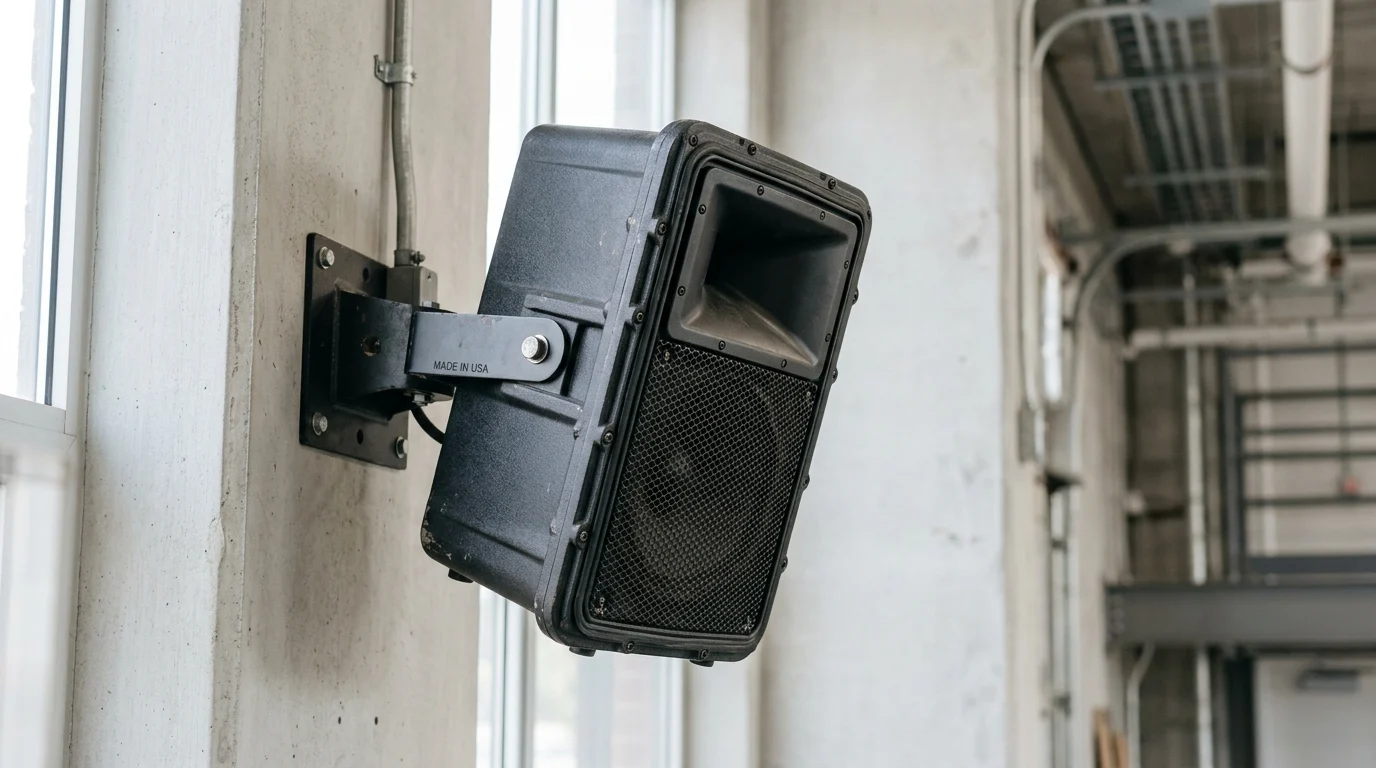
Why the Right Industrial Speaker Matters
In industrial facilities, the acoustic environment is rarely an afterthought; it is a critical operational variable. Heavy machinery, high-pressure processing lines, and material handling equipment generate continuous noise profiles that challenge basic communication networks. Deploying an industrial speaker system in these harsh environments requires more than merely amplifying sound—it necessitates a deliberate alignment of acoustic engineering, material durability, and life-safety compliance.
When procurement and engineering teams under-specify public address and general alarm (PA/GA) equipment, the resulting failures extend far beyond poor audio quality. Operational bottlenecks occur when instructions cannot be heard over ambient noise, and catastrophic outcomes risk materializing when emergency evacuation signals fail during critical incidents. Selecting the correct industrial speaker ensures that mission-critical communications penetrate high-decibel environments reliably, maintaining both operational continuity and strict regulatory adherence.
Business Risks of Under-Specified Speakers
Deploying commercial-grade audio equipment in industrial settings introduces severe business vulnerabilities. The most immediate risk is the loss of intelligibility. In a facility where ambient noise consistently exceeds 85 dB(A), a speaker lacking the appropriate sound pressure level (SPL) or frequency response will render voice commands unintelligible, leading to production errors, workflow interruptions, and costly equipment damage due to miscommunication.
Furthermore, under-specified speakers expose organizations to substantial regulatory and liability risks. Occupational safety bodies mandate clear, unambiguous alarm systems. For instance, failing to provide adequate auditory warning systems can result in severe penalties, with regulatory bodies like OSHA levying fines that can exceed $15,625 per violation for severe safety infractions. In the event of a severe industrial accident, the inability to prove that the emergency notification system met the required acoustic thresholds can result in severe legal and financial liabilities for the operating company.
Lifecycle Cost, Uptime, and Safety Impact
The true cost of an industrial speaker system is captured not in its initial capital expenditure (CAPEX), but in its total lifecycle cost and impact on facility uptime. Commercial speakers subjected to harsh industrial conditions—such as extreme temperature fluctuations, particulate ingress, or corrosive atmospheres—degrade rapidly. A standard commercial speaker might exhibit a Mean Time Between Failures (MTBF) of 5,000 to 10,000 hours in a benign environment, but this plummets drastically in a chemical plant or foundry.
Conversely, a purpose-built industrial speaker is engineered for longevity, often boasting an MTBF exceeding 50,000 hours even under continuous duress. While the upfront cost of an industrial unit may be three to five times higher than a commercial alternative, the savings in maintenance labor, replacement parts, and avoided downtime yield a significantly lower total cost of ownership (TCO) over a 10-year operational lifecycle. More importantly, the guaranteed uptime of a ruggedized speaker ensures that life-safety systems remain active, directly protecting the workforce and minimizing the risk of facility-wide shutdowns.
What Defines a Harsh-Environment Industrial Speaker
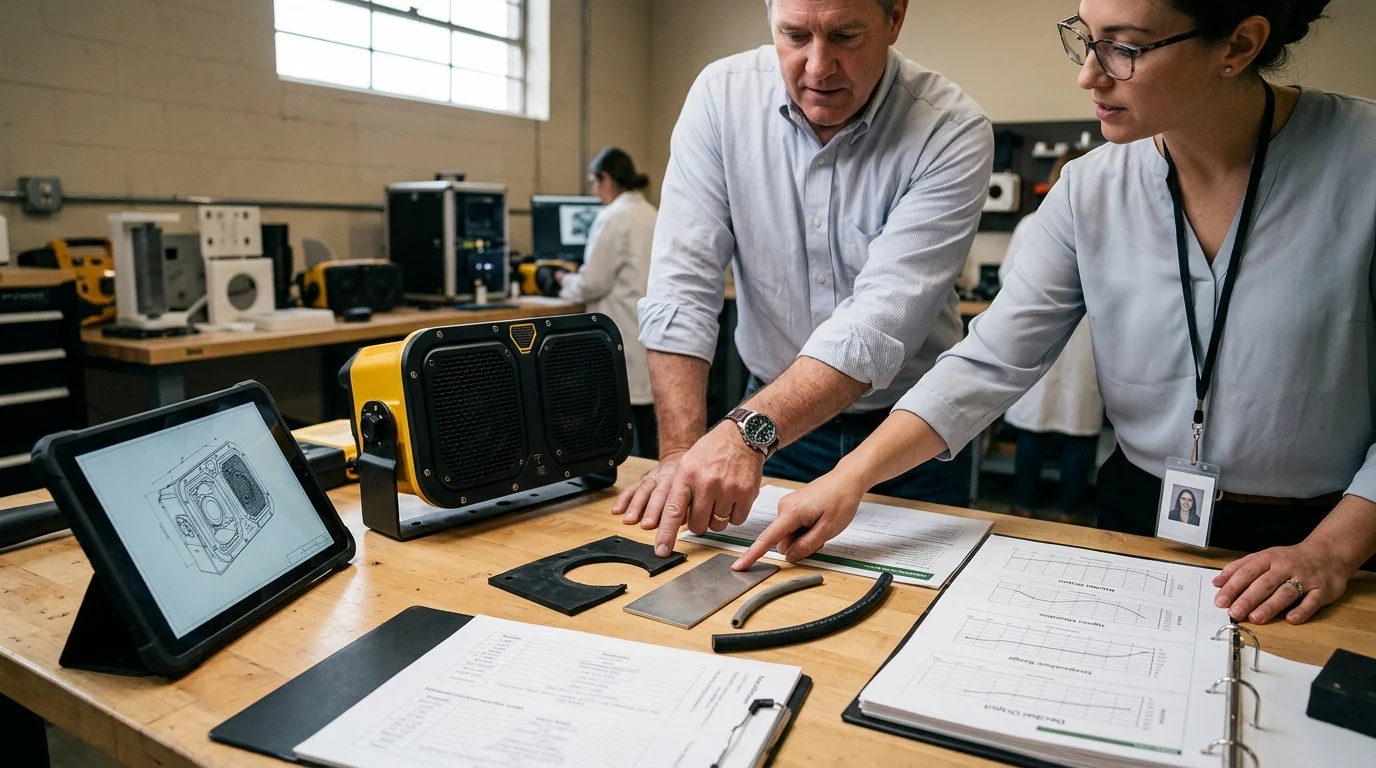
Defining an industrial speaker requires looking beyond basic wattage and frequency response. A true harsh-environment speaker is categorized by its survivability in extreme conditions and its ability to project clear audio through complex, high-noise atmospheres. These devices are engineered to operate at the intersection of ruggedized material science and specialized acoustic dynamics.
To properly evaluate an industrial speaker, system integrators must assess the specific environmental stressors of the installation site and match them against the device’s protective and acoustic specifications. This ensures the speaker will not only survive the physical environment but will also perform its primary function: delivering highly intelligible audio.
Industrial vs. Commercial Audio Systems
The distinction between industrial and commercial audio systems lies primarily in their construction materials and thermal tolerances. Commercial speakers typically utilize ABS plastics, paper cones, and basic weatherproofing suitable for climate-controlled retail or office spaces. When exposed to UV radiation, chemical vapors, or extreme temperatures, these materials warp, degrade, and ultimately fail.
Industrial speakers are manufactured from high-impact, UV-stabilized polycarbonates, marine-grade aluminum, or 316L stainless steel. Their internal components feature treated phenolic or titanium diaphragms that resist moisture and chemical degradation. Thermally, an industrial speaker is designed to operate within a much wider temperature band, typically ranging from -40°C to +70°C, ensuring functionality in both freezing outdoor yards and sweltering boiler rooms.
| Specification Feature | Commercial Audio Systems | Harsh-Environment Industrial Speakers |
|---|---|---|
| Enclosure Material | ABS Plastic, MDF | 316L Stainless Steel, Polycarbonate, Aluminum |
| Operating Temperature | 0°C to +40°C | -40°C to +70°C |
| Diaphragm Material | Paper, standard mylar | Titanium, treated phenolic, polyimide |
| Typical MTBF | 5,000 – 10,000 hours | 50,000+ hours |
Key Environmental Conditions to Assess
Before selecting a speaker, a comprehensive environmental audit of the installation zone is mandatory. The primary stressors include airborne particulates (dust, metal shavings), moisture (high humidity, direct rain, high-pressure washdowns), and chemical exposure (corrosive gases, salt spray in offshore applications).
Vibration and shock are also critical factors, particularly in heavy manufacturing or near large rotating machinery. Speakers in these zones must comply with structural integrity standards, such as MIL-STD-810G, to ensure that continuous low-frequency vibrations do not loosen internal voice coils or mounting brackets. Evaluating these conditions dictates the necessary ingress protection and enclosure materials required to prevent premature failure.
SPL, Intelligibility, and Sound Dispersion
Acoustic performance in harsh environments is defined by three metrics: Sound Pressure Level (SPL), intelligibility, and sound dispersion. To overcome ambient industrial noise, a speaker must generate an SPL of at least +10 dB to +15 dB above the continuous background noise level at the listener’s position. For example, if a compressor room operates at 90 dB(A), the speaker must deliver 100-105 dB(A) at the operator’s location.
However, sheer volume is insufficient without intelligibility, measured by the Speech Transmission Index (STI). An STI score above 0.50 is generally required for clear voice comprehension. Achieving this requires speakers with a frequency response optimized for human speech (typically 300 Hz to 4,000 Hz) and controlled dispersion angles. Narrow dispersion horns (e.g., 60 to 70 degrees) are used to punch through noise over long distances without creating excessive reverberation, whereas wide dispersion cabinets (up to 120 degrees) are better suited for broader coverage in lower-noise, open-plan assembly areas.
Durability and Protection Specifications
The physical resilience of an industrial speaker is quantified through standardized global rating systems. These specifications provide a reliable framework for matching the hardware to the exact severity of the environment, ensuring that the internal electronics remain isolated from external destructive forces.
Understanding how to interpret and apply these protection specifications—ranging from basic waterproofing to advanced explosion-proof certifications—is the cornerstone of specifying a reliable industrial PA/GA system.
IP Ratings, NEMA Types, and Corrosion Resistance
Ingress Protection (IP) ratings and National Electrical Manufacturers Association (NEMA) types are the primary indicators of a speaker’s durability. The IP rating system uses two digits: the first indicates protection against solids (dust), and the second against liquids (water). For harsh industrial environments, IP66 (protection against heavy seas or powerful jets of water) or IP67 (protection against temporary submersion) are the standard baselines.
In North America, NEMA ratings are frequently used alongside IP ratings, offering additional context regarding corrosion resistance. A NEMA 4X rating, for instance, not only guarantees protection against windblown dust and hose-directed water but also certifies resistance to corrosion. Achieving this often requires the speaker housing and mounting brackets to be constructed from 316L stainless steel or specialized glass-reinforced polyesters (GRP).
| IP Rating | NEMA Equivalent (Approx.) | Protection Level Description | Typical Industrial Application |
|---|---|---|---|
| IP54 | NEMA 3 | Dust protected, splashing water | Light assembly, indoor warehouses |
| IP66 | NEMA 4 | Dust tight, powerful water jets | Washdown areas, outdoor yards |
| IP67 | NEMA 4X | Dust tight, temporary submersion | Marine/Offshore, chemical processing |
When Explosion-Proof Speakers Are Required
In facilities where flammable gases, vapors, or combustible dusts are present—such as petrochemical refineries, grain elevators, or paint manufacturing plants—standard industrial speakers pose an ignition risk. In these hazardous locations, explosion-proof or intrinsically safe speakers are legally required. These devices are heavily regulated by frameworks like ATEX and IECEx in Europe, and the National Electrical Code (NEC) Class/Division system in North America.
An explosion-proof speaker (e.g., rated for ATEX Zone 1 or Class I, Division 1) features a flameproof enclosure (Ex d). This design ensures that if an internal electrical fault creates a spark that ignites ambient gas within the speaker housing, the enclosure will contain the explosion and cool the escaping exhaust gases below the auto-ignition temperature of the surrounding atmosphere. Specifying these units requires precise matching of the speaker’s certification to the exact gas group (e.g., IIB, IIC) and temperature class (e.g., T4, T6) of the facility.
Comparing Horn, Cabinet, and Paging Speakers
Industrial speakers generally fall into three form factors: horn speakers, cabinet speakers, and specialized paging projectors. Horn speakers are the standard for extreme noise environments. Utilizing a compression driver coupled with a flared horn, they are highly efficient, often capable of producing SPLs exceeding 120 dB at 1 meter. Their directional nature makes them ideal for penetrating high ambient noise over long distances, though their frequency response is heavily skewed toward mid and high frequencies, making them poor for background music.
Cabinet and projector speakers are utilized when broader frequency response and higher audio fidelity are required, such as in control rooms or lower-noise production floors. While they offer superior STI for complex voice messages, they typically max out at lower SPLs (90 to 105 dB at 1 meter) and require more amplifier power to achieve the same coverage area as a horn. Selecting between these types involves balancing the need for raw acoustic penetration against the requirement for audio fidelity.
Integration, Compliance, and Cost Factors
Procuring an industrial speaker is only part of the equation; integrating it into a facility-wide communication network introduces complex electrical, regulatory, and financial variables. The speaker must interface seamlessly with existing amplification infrastructure while adhering to regional life-safety codes.
Evaluating the integration requirements upfront prevents costly redesigns during the installation phase and ensures that the deployed system operates efficiently over its intended lifecycle.
Voltage, Impedance, and Amplifier Compatibility
Industrial PA/GA systems typically utilize high-voltage distributed audio lines—most commonly 70V in North America and 100V internationally—rather than the 8-ohm low-impedance systems found in consumer audio. This high-voltage approach minimizes power loss over the long cable runs required in expansive industrial facilities, allowing dozens of speakers to be daisy-chained on a single amplifier channel.
To interface with these systems, industrial speakers are equipped with internal step-down transformers. These transformers feature multiple wattage “taps” (e.g., 1W, 2W, 4W, 8W, 15W, 30W), allowing installers to adjust the power draw and resulting SPL of each individual speaker based on its specific location. Proper calculation of transformer taps is critical; the total wattage of all tapped speakers on a line must not exceed 80% of the amplifier’s rated output capacity to prevent transformer saturation and amplifier failure.
Certifications and Regional Standards
Compliance with regional and application-specific standards is non-negotiable for industrial audio systems, particularly when they double as emergency evacuation networks. In North America, speakers used for fire alarms and emergency signaling must be certified to UL 1480 (Fire Protective Signaling Systems). In Europe, the equivalent standard is EN 54-24, which dictates strict performance criteria for voice alarm speakers.
Furthermore, speakers deployed in specific sectors must meet niche certifications. Marine and offshore speakers often require approvals from classification societies like DNV or ABS. Compliance with environmental directives, such as RoHS and REACH, is also necessary for global procurement. Verifying these certifications during the selection phase ensures that the installation will pass final safety inspections and audits by local authorities having jurisdiction (AHJ).
Installation and Total Cost of Ownership
The physical installation of industrial speakers heavily influences the Total Cost of Ownership (TCO). Heavy-duty explosion-proof speakers can weigh between 5 kg and 15 kg, requiring robust, vibration-resistant mounting brackets—often swivel-type stainless steel brackets that allow for precise acoustic aiming. The cost of running specialized armored or fire-resistant cabling to these units can frequently exceed the cost of the speakers themselves.
When calculating TCO, procurement teams must look beyond the initial unit price, which typically ranges from $300 to $800 for standard industrial horns, and up to $2,000 for specialized ATEX-certified units. A cheaper, less durable speaker will incur significant labor costs for elevated replacement work, scaffolding rentals, and potential production halts. Investing in a highly durable, appropriately certified unit drastically reduces maintenance interventions, yielding a lower TCO and providing reliable safety coverage year over year.
Industrial Speaker Selection Framework
Selecting the optimal industrial speaker requires a systematic approach that bridges acoustic science with facility engineering. Relying on guesswork or copying legacy specifications often results in systems that are either dangerously underpowered or unnecessarily expensive.
By utilizing a structured selection framework, facility managers, acoustical engineers, and procurement officers can confidently specify equipment that meets precise operational and safety requirements.
Step-by-Step Selection Process
The selection process must begin with a comprehensive acoustic survey of the facility. Engineers must map the ambient noise levels in dB(A) across different operational zones during peak production. Following the acoustic survey, an environmental audit is conducted to identify the presence of moisture, dust, extreme temperatures, and explosive gases. This defines the necessary IP, NEMA, and ATEX/Hazardous Location ratings.
Next, the system architecture must be evaluated. The selected speakers must match the facility’s amplifier infrastructure (e.g., 70V/100V line compatibility) and total power budget. Finally, a review of local regulatory requirements dictates the specific life-safety certifications (such as UL 1480 or EN 54-24) the hardware must carry. Following these four steps ensures a technically sound and compliant procurement process.
Balancing Acoustic Performance and Durability
A persistent challenge in industrial audio design is balancing acoustic performance with physical durability. Highly durable materials, such as thick cast aluminum or explosion-proof enclosures, excel at protecting internal components but can dampen acoustic resonance and limit frequency response. This can slightly degrade the natural sound of voice audio compared to thinner, commercial-grade cabinets.
To mitigate this, system designers must prioritize intelligibility over high-fidelity musicality. By selecting speakers with a frequency curve tailored to the human vocal range (accentuating the 1 kHz to 4 kHz band), the system can achieve a high Speech Transmission Index (STI) despite the heavy, ruggedized enclosure. Furthermore, utilizing multiple lower-wattage speakers strategically distributed throughout a space often yields better intelligibility and more even coverage than relying on a single, massively powerful horn that creates deafening hotspots and echoes.
Final Specification Checklist
Before finalizing a purchase order, engineering and procurement teams should cross-reference their chosen hardware against a final specification checklist. First, verify the acoustic output: does the speaker’s SPL at the tapped wattage provide the required +15 dB over the maximum ambient noise at the listener’s distance? Confirm that the dispersion angle matches the physical layout of the zone to minimize wasted acoustic energy.
Second, validate the physical and regulatory specs. Ensure the IP rating aligns with the worst-case environmental exposure, such as high-pressure washdowns requiring IP66. Confirm that the hazardous area certification matches the exact Zone or Division classification of the mounting location. Finally, verify that the mounting hardware is rated for the speaker’s weight (often 5kg to 15kg for heavy industrial units) and the site’s vibration profile. Completing this checklist guarantees the deployment of a resilient, effective, and compliant industrial audio system.
Key Takeaways
- Specify industrial speakers by ambient noise level, required SPL, coverage distance, and voice intelligibility rather than wattage alone.
- Avoid commercial-grade speakers in harsh facilities because dust, moisture, corrosion, vibration, and temperature swings can cause rapid failure.
- For hazardous areas such as oil and gas, mining, or chemical processing, verify required explosion-proof certifications such as ATEX before procurement.
- Consider lifecycle cost because rugged industrial speakers can reduce replacements, maintenance, downtime, and safety-system failures over a 10-year operating period.
- Integrate speakers with PA/GA, paging, VoIP, intercom, and emergency call systems to ensure alarms and instructions reach workers reliably.
Frequently Asked Questions
What makes an industrial speaker suitable for harsh environments?
A suitable industrial speaker combines high sound pressure level, durable enclosure materials, corrosion resistance, ingress protection, temperature tolerance, and clear voice intelligibility. In hazardous areas, it should also meet relevant certifications such as ATEX or other applicable safety standards.
How loud should an industrial speaker be in a noisy facility?
The speaker must be loud enough to overcome ambient noise while preserving intelligibility. In areas above 85 dB(A), teams should calculate required SPL at listener distance and consider speaker placement, coverage angles, and PA/GA system design.
Why not use commercial speakers in industrial sites?
Commercial speakers are not designed for dust, moisture, vibration, corrosion, extreme temperatures, or explosive atmospheres. They may fail faster, reduce emergency message clarity, increase maintenance costs, and create compliance or liability risks.
Are explosion-proof speakers required for oil, gas, or mining sites?
They may be required where flammable gases, vapors, or dust are present. Facilities should follow hazardous-area classification requirements and select certified equipment, such as ATEX-rated communication products, where applicable.
How does speaker selection affect total cost of ownership?
A rugged industrial speaker may cost more upfront, but it can reduce replacements, maintenance labor, downtime, and emergency communication failures. Purpose-built units can deliver much longer service life than commercial alternatives in harsh conditions.

Post time: Jun-18-2026