
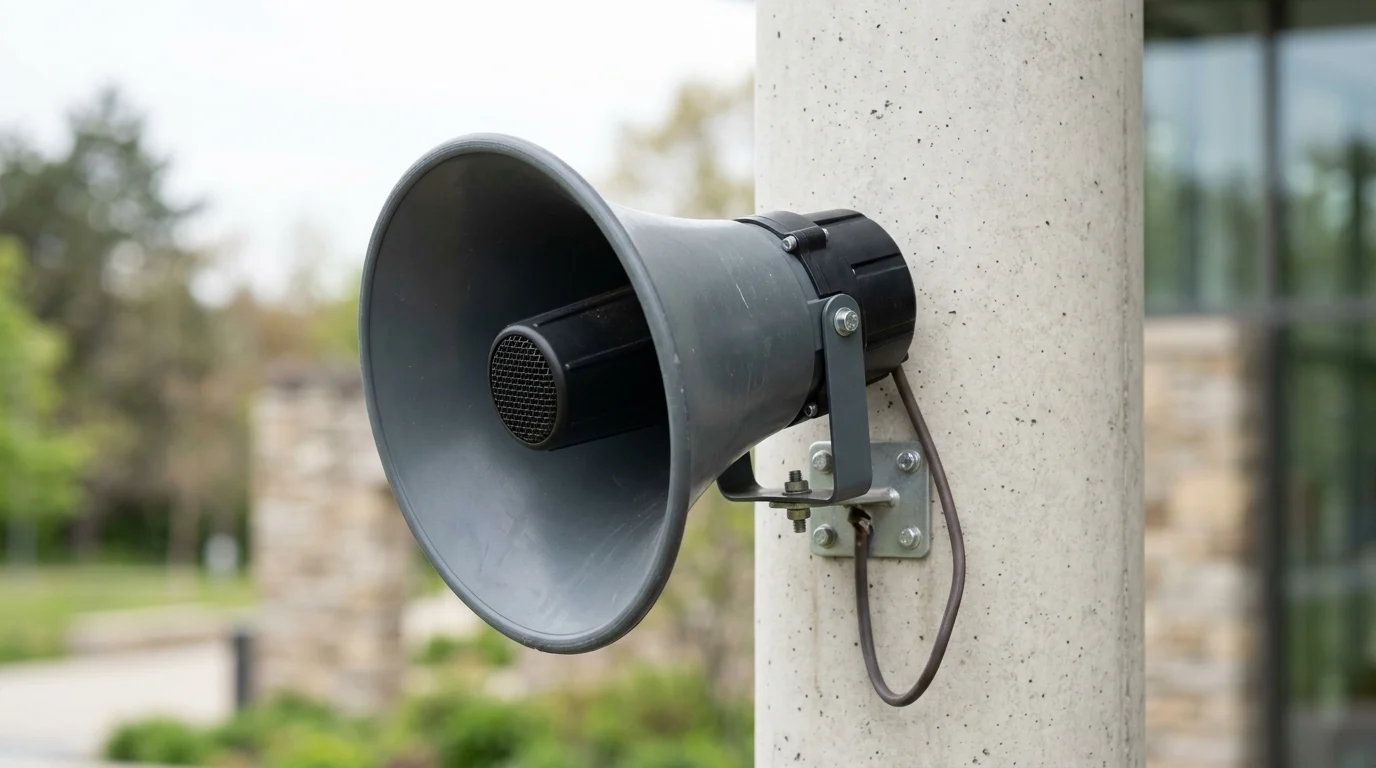
How Public Address Speakers Strengthen Emergency Communication
In high-stakes environments, the efficacy of emergency communication infrastructure dictates the success of evacuation and crisis mitigation protocols. A public address speaker system serves as a primary communication medium for mass notification, bypassing the latency, opt-in requirements, and bottlenecks inherent in individual digital alerts.
While modern facilities often integrate SMS, email, and digital signage into their security matrix, acoustic broadcasting remains a highly immediate and effective tool. Designing these systems for critical life-safety applications requires a strict departure from standard commercial audio, prioritizing uncompromising reliability, clear message delivery, and effective sound penetration.
Why Emergency Planners Rely on Public Address Speakers
Emergency planners prioritize public address systems because they provide facility-wide broadcasting capabilities that do not rely on end-user devices. Unlike cellular networks, which frequently experience severe bandwidth congestion during localized crises resulting in significant SMS delivery latencies, a hardwired or dedicated IP public address speaker infrastructure guarantees immediate message propagation. This immediacy is critical in scenarios such as active shooter events, chemical spills, or severe weather warnings, where human survival depends on real-time situational awareness.
Furthermore, modern acoustic arrays are explicitly engineered to penetrate high-ambient-noise environments. Industrial manufacturing facilities, aviation hangars, and transit hubs often register continuous baseline noise levels between 75 dB and 85 dB. Emergency planners rely on specialized high-output transducers that can dynamically cut through this acoustic clutter. By utilizing advanced compression drivers and precise dispersion angles, these systems ensure that critical evacuation directives are not merely broadcast, but are comprehensively understood by occupants regardless of their immediate surroundings, visual focus, or lack of mobile connectivity.
How Public Address Speakers Reduce Response Time
The deployment of a distributed public address speaker network reduces facility evacuation times by eliminating the “verification phase” of human psychological response. When occupants hear a standard, non-verbal fire alarm tone, empirical behavioral studies indicate they often spend valuable minutes seeking secondary confirmation—looking for smoke, asking colleagues, or checking their phones—before physically initiating evacuation.
In stark contrast, clear voice instructions broadcast through a highly intelligible public address system reduce this hesitation delay drastically. By providing specific, actionable directives—such as identifying which stairwells are safe, declaring a lock-down, or initiating a shelter-in-place protocol—these systems eliminate operational ambiguity. Regulatory bodies recognize this efficiency; for instance, the National Fire Protection Association (NFPA) mandates that emergency communications must reach targeted human populations within 10 seconds of alarm initiation. High-intelligibility speakers ensure that acoustic energy translates directly into rapid human action, compressing the overall incident response timeline and reducing casualty risks.
What Defines an Emergency-Ready Public Address Speaker System

Engineering an emergency-ready public address speaker system requires moving beyond rudimentary commercial background music applications. It demands a rigorous synthesis of high-efficiency amplification, acoustically tailored transducers, and fault-tolerant digital signal processing designed to operate under catastrophic conditions.
Core Components of a Public Address Speaker System
The architecture of a life-safety public address speaker network is built upon several mission-critical hardware components. At the core of the head-end equipment are Class D amplifiers, chosen specifically for their exceptional thermal efficiency (often exceeding 85%) and their ability to operate reliably on secondary DC backup battery power without generating excessive heat in the equipment racks. These amplifiers drive the transducers via 70V or 100V constant-voltage lines, an electrical topology that allows dozens of speakers to be daisy-chained over thousands of feet of fire-rated FPLP (plenum) or FPLR (riser) cabling with minimal voltage drop.
Upstream from the amplification stages, Digital Signal Processors (DSPs) manage equalization, delay matrices, and dynamic range compression. DSPs are vital for tuning the system to the specific acoustic signature of the facility. By utilizing parametric equalizers to notch out resonant room frequencies, the DSP ensures that the raw audio signal is heavily optimized for the human speech band (typically 300 Hz to 3400 Hz) before it ever reaches the physical speaker cone, thereby maximizing clarity.
Intelligibility, Coverage, and Sound Pressure Level
The ultimate metric of a public address speaker system is its intelligibility, formally quantified by the Speech Transmission Index (STI). For voice evacuation purposes, international life-safety standards generally require a minimum STI of 0.50 (on a scale of 0 to 1.0), ensuring that complex syllables and consonants are distinct enough for listeners to comprehend instructions without context. Achieving this requires strict engineering control over both Sound Pressure Level (SPL) and spatial coverage patterns.
To successfully overcome background noise, the system must deliver an SPL that is precisely 10 dB to 15 dB higher than the ambient baseline. For example, in a manufacturing plant with a continuous 80 dB ambient noise level, the public address speakers must reliably produce a minimum of 95 dB at the listener’s ear. Acoustical engineers mathematically map the dispersion angles (often 90 to 120 degrees) of each speaker to ensure overlapping coverage zones. This dense spacing eliminates acoustic “dead spots” where the SPL might drop below the critical +10 dB threshold, ensuring uniform intelligibility across the entire floor plan.
It is important to note that emergency communication effectiveness cannot be judged solely by acoustic metrics. To meet accessibility requirements, such as those mandated by the Americans with Disabilities Act (ADA), audio systems must be paired with visual notification appliances (like strobe lights). This ensures that occupants who are deaf or hard of hearing, as well as individuals wearing hearing protection in high-noise environments, receive the same critical alerts.
Horn Speakers vs. Ceiling and Wall-Mounted Speakers
Selecting the correct transducer typology is fundamental to achieving both the required SPL and seamless architectural integration. The choice typically falls between high-output horn speakers and distributed ceiling or wall-mounted enclosures, each serving distinct acoustic purposes.
| Speaker Type | Typical SPL Output (1W/1m) | Ideal Application Environment | Effective Frequency Response |
|---|---|---|---|
| Compression Horn Speaker | 105 dB – 115 dB | Outdoors, Heavy Industrial, Warehouses | 300 Hz – 8 kHz (Narrow band) |
| Ceiling-Mounted Coaxial | 85 dB – 95 dB | Corporate Offices, Hospitals, Retail | 80 Hz – 18 kHz (Wide band) |
| Wall-Mounted Cabinet | 90 dB – 98 dB | Corridors, Stairwells, Transit Hubs | 100 Hz – 15 kHz (Moderate band) |
Horn speakers utilize a compression driver coupled with a flared waveguide to maximize acoustic projection and weather resistance. Often carrying IP66 ratings, they are indispensable for large, noisy expanses where raw volume is paramount. Conversely, ceiling and wall-mounted speakers provide wider frequency responses and broader, conical dispersion angles. These characteristics are essential for maintaining high STI in reverberant indoor environments with lower ceilings, where the harsh directivity of a horn would cause excessive acoustic reflections.
Compliance, Safety, and System Integration Requirements
An emergency public address speaker network cannot operate in isolation. It must function as a strictly compliant, seamlessly integrated node within a facility’s broader life-safety, fire detection, and physical security ecosystem.
How Public Address Speaker Systems Support Safety Standards
Regulatory compliance dictates the fundamental design, survivability, and performance of any emergency voice alarm communication (EVAC) system. In North America, the NFPA 72 code establishes stringent criteria for system survivability, audibility, and intelligibility. Similarly, in European jurisdictions, the EN 54-24 standard governs the construction and acoustic performance of voice alarm speakers, while EN 54-16 covers the central control equipment.
While these codified regulatory mandates dictate minimum survivability—such as requiring systems to sustain 24 hours of quiescent standby operation followed by 30 minutes of continuous alarm broadcasting under secondary battery power—engineers often employ additional best practices to exceed these baselines. For instance, compliant speakers must feature fire-resistant enclosures and be equipped with ceramic terminal blocks and thermal fuses. This electromechanical design ensures that if a localized fire destroys one speaker, the thermal fuse severs it from the circuit, preventing a dead short that would otherwise disable the entire audio zone.
Key Integration Points with Fire Alarms and Security Systems
The efficacy of a public address speaker system relies heavily on its automated interoperability with fire detection and physical security platforms. Integration is typically achieved at the hardware level through dry contact closures or, increasingly in modern deployments, via IP-based protocols such as SIP (Session Initiation Protocol) and ONVIF.
When a Fire Alarm Control Panel (FACP) detects a localized event—such as a triggered smoke detector or water flow switch—it instantly transmits a logic state change to the public address routing matrix. Within a strict latency window, the PA system must automatically mute low-priority background music, override any non-emergency paging, and initiate pre-recorded evacuation protocols. In physical security applications, integration with Video Management Systems (VMS) allows security personnel to trigger automated, highly localized audio warnings through specific exterior speakers when perimeter breaches are detected via intelligent surveillance cameras.
Zoning, Priority Override, Backup Power, and Fail-Safe Design
To guarantee uninterrupted operation during a chaotic crisis, public address speaker systems employ sophisticated zoning logic and robust fail-safe architectures. Zoning allows safety operators to execute phased, vertical evacuations in high-rise buildings—for example, directing occupants on the fire floor and the floor directly above to evacuate first, while instructing other zones to remain in place. Priority override matrices are hard-coded to ensure that live emergency microphone announcements from a fire command center supersede all automated messages.
At the hardware level, fail-safe design involves N+1 amplifier redundancy. If a primary amplifier fails due to component fatigue, a dedicated standby unit automatically assumes the audio load within a fraction of a second, ensuring zero interruption to the broadcast. Additionally, the system control matrix utilizes end-of-line (EOL) monitoring to continuously measure the 100V line impedance using inaudible pilot tones. If the DSP detects a significant impedance shift—indicating a severed cable, a short circuit, or a blown speaker coil—it immediately generates a fault report at the master control station, allowing for proactive maintenance.
Despite these fail-safes, public address systems are not immune to vulnerabilities. Single points of failure, such as severed main trunk cables, highlight the need for redundant wiring paths. Furthermore, facility planners must account for scenarios where voice announcements could be detrimental, such as active threat situations that may require silent lockdown protocols rather than audible broadcasts.
How to Design and Install Public Address Speakers
Translating theoretical acoustic requirements into a functional public address speaker system demands a methodical, engineering-led approach to site assessment, logical routing design, and lifecycle maintenance.
Site Assessment Steps Before Installation
The physical installation of a public address speaker network must be preceded by an exhaustive acoustic site assessment. Audio engineers utilize predictive acoustic modeling software, such as EASE (Enhanced Acoustic Simulator for Engineers), to virtually map the facility’s 3D geometry, ceiling heights, and specific construction materials.
A critical metric analyzed during this predictive phase is the RT60 value—the time it takes for a sound pulse to decay by 60 decibels. In highly reverberant spaces where the RT60 exceeds 1.5 seconds (such as glass-atrium lobbies, indoor swimming pools, or concrete transit stations), deploying standard omnidirectional ceiling speakers will produce overlapping echoes, completely destroying speech intelligibility. In such hostile acoustic environments, the assessment will necessitate the use of highly directional, digitally steerable line array speakers, or alternatively, a highly dense distribution of low-power speakers positioned close to the listener to maximize the ratio of direct sound to reverberant sound.
Message Routing, Pre-Recorded Alerts, and Live Paging
Once the physical transducer layout is established, engineers configure the logical architecture governing message routing, automated triggers, and paging parameters. Modern public address systems utilize digital matrix routers capable of handling 64 or more simultaneous audio channels across hundreds of distinct physical zones.
During an emergency, the system relies on solid-state, non-volatile memory to store and trigger pre-recorded alerts. These automated messages ensure that calm, standardized, and legally vetted instructions are delivered instantly. However, the system must also facilitate dynamic live paging. Paging consoles located at security desks, reception areas, or dedicated command centers are programmed with specific zone-selection buttons. This architecture allows incident commanders to provide real-time instructions as a crisis evolves—such as redirecting crowds away from a blocked exit—instantly overriding any pre-recorded loop currently playing in that specific zone.
Testing, Commissioning, and Maintenance
The final phase of deployment involves rigorous testing, formal commissioning, and the establishment of a continuous maintenance protocol. Commissioning an emergency public address speaker system requires empirical verification of acoustic performance to ensure compliance with the initial EASE models.
Technicians use specialized acoustic audio analyzers to measure the Speech Transmission Index and Sound Pressure Level at a standard listener height of 1.5 meters above the finished floor, documenting the results across a dense grid map of the facility to prove compliance to the Authority Having Jurisdiction (AHJ). Post-commissioning, proactive maintenance is not optional; it is a strict regulatory requirement. Annual testing protocols involve verifying battery internal impedance, physically testing the failover mechanisms of backup amplifiers, and visually inspecting speaker enclosures for environmental degradation or water ingress, ensuring the system remains in a perpetual state of readiness.
How to Select the Right Public Address Speaker Solution
Facility owners, architects, and IT directors face a complex procurement landscape when investing in a public address speaker infrastructure. Selecting the optimal solution requires balancing immediate acoustic performance with network topology, long-term scalability, and total cost of ownership.
Selection Criteria for Coverage, Reliability, and Scalability
The primary selection criteria for a public address speaker system revolve around coverage efficacy, hardware reliability, and architectural scalability. Decision-makers must rigorously evaluate the Mean Time Between Failures (MTBF) of the core components; enterprise-grade emergency systems typically boast MTBF ratings exceeding 50,000 hours, reflecting industrial-grade capacitors and robust thermal management.
Environmental resilience is another critical selection factor. Speakers designated for exterior deployment, parking garages, or harsh industrial environments must carry stringent Ingress Protection (IP) ratings, such as IP66, to guarantee functionality despite exposure to high-pressure water jets and total dust ingress. Furthermore, scalability dictates that the chosen central control matrix can seamlessly accommodate future facility expansions. The ideal system allows for the addition of new paging zones via simple software licensing or modular hardware cards, rather than requiring a total forklift replacement of the head-end equipment when a new building wing is constructed.
Wired, IP-Based, Wireless, and Hybrid Systems
The most significant architectural decision involves choosing between traditional wired analog, IP-based networked, wireless, or hybrid transmission topologies.
| System Topology | Infrastructure Requirement | Maximum Power per Speaker | Best Use Case Profile |
|---|---|---|---|
| Traditional Analog (70V/100V) | Dedicated Copper Cabling (FPLR/FPLP) | 1000W+ (Amplifier dependent) | Large scale, high-power industrial zones, long cable runs |
| IP-Based (Networked) | Cat5e/Cat6 Ethernet (PoE/PoE+/PoE++) | 15W (PoE) to 90W (PoE++) | Office buildings, campuses with robust existing IT networks |
| Wireless (RF/Wi-Fi) | Local AC power at speaker, RF Transmitters | Varies heavily based on local AC power | Historic building retrofits, temporary sites, difficult terrain |
Traditional 100V analog systems remain the gold standard for high-power, long-distance runs where massive SPL is required across sprawling facilities. Conversely, IP-based public address speakers leverage existing IT infrastructure, utilizing Power over Ethernet (PoE) to deliver both digital audio and DC power over a single standard network cable. While highly flexible and individually addressable down to the single speaker, standard PoE+ systems were traditionally capped at 30 watts per unit. However, modern systems utilizing the PoE++ (IEEE 802.3bt) standard can support 60W to 90W, significantly expanding their application in higher-noise environments. Hybrid systems frequently bridge this gap, using a fiber-optic IP network to distribute audio across a massive campus to decentralized analog amplifiers that drive local 100V speaker loops.
Final Decision Framework for Facility Owners
For facility owners, the final decision framework must encompass a comprehensive Total Cost of Ownership (TCO) analysis projected over a 10 to 15-year operational lifecycle. While IP-based systems often present a lower initial Capital Expenditure (CAPEX) in facilities that already possess a robust, redundant network infrastructure, owners must carefully account for the Operational Expenditure (OPEX). Networked systems require ongoing IT maintenance, cybersecurity patching, software updates, and the management of PoE switch redundancies.
Analog systems may require higher upfront trenching, conduit, and dedicated cabling costs, but they often yield lower OPEX due to their closed-loop simplicity, lack of software vulnerabilities, and extreme hardware longevity. Ultimately, the optimal public address speaker solution aligns strict acoustic life-safety requirements with the facility’s existing technological ecosystem, ensuring absolute communication reliability without unnecessarily over-engineering the network topology.
Key Takeaways
- Use dedicated hardwired or IP public address speaker infrastructure to avoid the congestion and delays that can affect SMS or cellular alerts during emergencies.
- Specify high-output speakers for industrial environments where baseline ambient noise can reach 75 dB to 85 dB.
- Prioritize clear voice instructions over generic tones because specific evacuation, lockdown, or shelter-in-place messages reduce occupant hesitation.
- Design emergency PA coverage to meet rapid notification expectations, including the NFPA-recognized need to reach targeted populations within 10 seconds of alarm initiation.
- Select rugged, weatherproof, waterproof, or explosion-proof PA and intercom equipment for outdoor, hazardous, maritime, mining, oil and gas, and transportation sites.
- Integrate PA speakers with alarms, paging, VoIP, dispatch consoles, and emergency call boxes to create a resilient multi-channel communication system.
Frequently Asked Questions
Why are public address speakers important during emergencies?
They broadcast immediate voice instructions to everyone in a facility without relying on mobile phones, apps, or network availability, helping people act faster during fires, chemical spills, severe weather, or security incidents.
How do PA speakers reduce evacuation delays?
Clear voice messages remove uncertainty by telling occupants what to do, where to go, and which routes to avoid, reducing the hesitation that often follows generic alarm tones.
What makes an emergency PA system different from standard audio equipment?
Emergency PA systems prioritize intelligibility, high output, fault tolerance, reliable power, and coverage in noisy or harsh environments rather than background music quality.
Can public address speakers work in noisy industrial sites?
Yes. Industrial PA speakers use high-output drivers and controlled dispersion to cut through ambient noise levels often found in manufacturing plants, transport hubs, and mining or oil and gas facilities.
Are rugged PA systems suitable for hazardous environments?
Yes. Providers such as SINIWO supply weatherproof, waterproof, and explosion-proof communication products for harsh outdoor and hazardous areas, including mining, oil and gas, maritime, and construction sites.

Post time: Jun-21-2026