
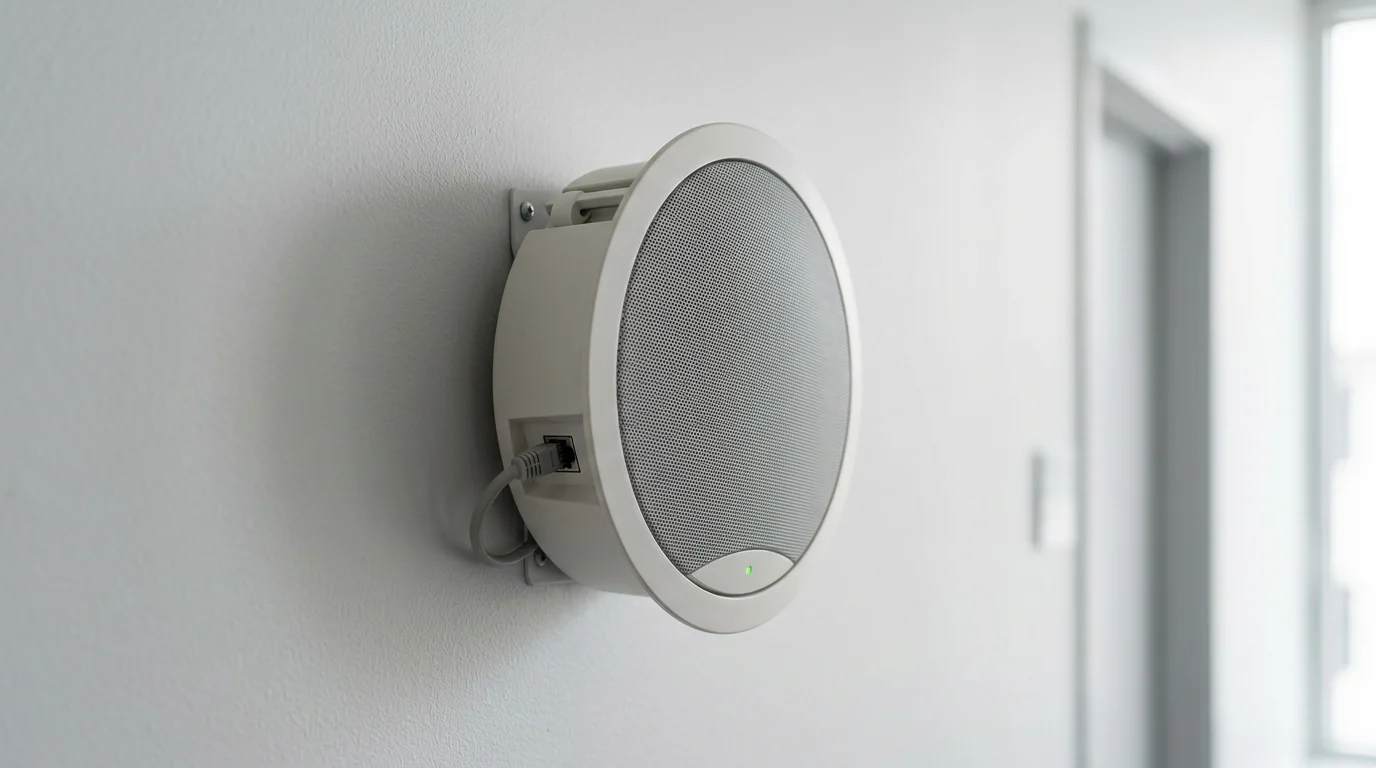
Why SIP Speaker Integration Matters for Industrial IP Systems
Industrial communication architectures have fundamentally transitioned from monolithic, single-purpose analog paging systems to distributed, IP-based networks. At the forefront of this convergence is the SIP speaker, a specialized endpoint that bridges acoustic broadcasting with enterprise telecommunications. By leveraging the Session Initiation Protocol (SIP), these devices operate directly on existing Local Area Networks (LANs) and register as standard extensions on an IP-Private Branch Exchange (IP-PBX) or unified communications platform.
Integrating SIP speakers into an industrial IP system eliminates the need for proprietary head-end audio matrixes and centralized heavy-copper 70V/100V amplifier racks. Instead, audio routing, zoning, and prioritization are handled at the software layer, yielding a highly scalable topology where adding a new notification endpoint simply requires an Ethernet drop and an available IP address.
Extending paging, alerts, and emergency communication
The primary operational advantage of SIP speaker integration is the seamless extension of enterprise telephony into the physical industrial environment. In legacy systems, deploying an emergency mass notification or routine paging announcement often required secondary interfaces or dedicated microphone consoles. With a SIP-enabled architecture, any authorized IP phone, softphone client, or automated dispatch system can instantly open a two-way or one-way audio channel to the factory floor, warehouse, or hazardous processing area.
This integration drastically reduces notification latency, ensuring that critical alerts or automated safety broadcasts reach target zones in under 150 milliseconds. Furthermore, because SIP supports complex call routing rules, emergency communications can be configured to override routine background music or low-priority operational pages automatically. Advanced SIP speakers also incorporate built-in microphones, allowing for full-duplex intercom capabilities or ambient noise monitoring, which dynamically adjusts the output volume based on the real-time acoustic conditions of the facility.
Where SIP speakers fit in VoIP and IP networks
Within the broader context of Voice over IP (VoIP) networks, SIP speakers are classified as intelligent edge devices. They register to a SIP server—whether an on-premise Cisco Unified Communications Manager, an open-source Asterisk instance, or a cloud-hosted UCaaS platform—just like a standard VoIP desk phone. This standardization ensures interoperability across disparate hardware vendors and software ecosystems.
Beyond unicast SIP calls, these speakers frequently support multicast protocols for mass notification. In a typical VoIP topology, a SIP call might be initiated to a master speaker or a dedicated SIP multicast gateway, which then translates the incoming RTP (Real-Time Transport Protocol) stream into an IP multicast broadcast. This hybrid approach prevents network bandwidth saturation, allowing hundreds of endpoints to receive synchronized audio payloads without requiring the IP-PBX to establish hundreds of simultaneous individual SIP sessions.
What Defines an Industrial SIP Speaker
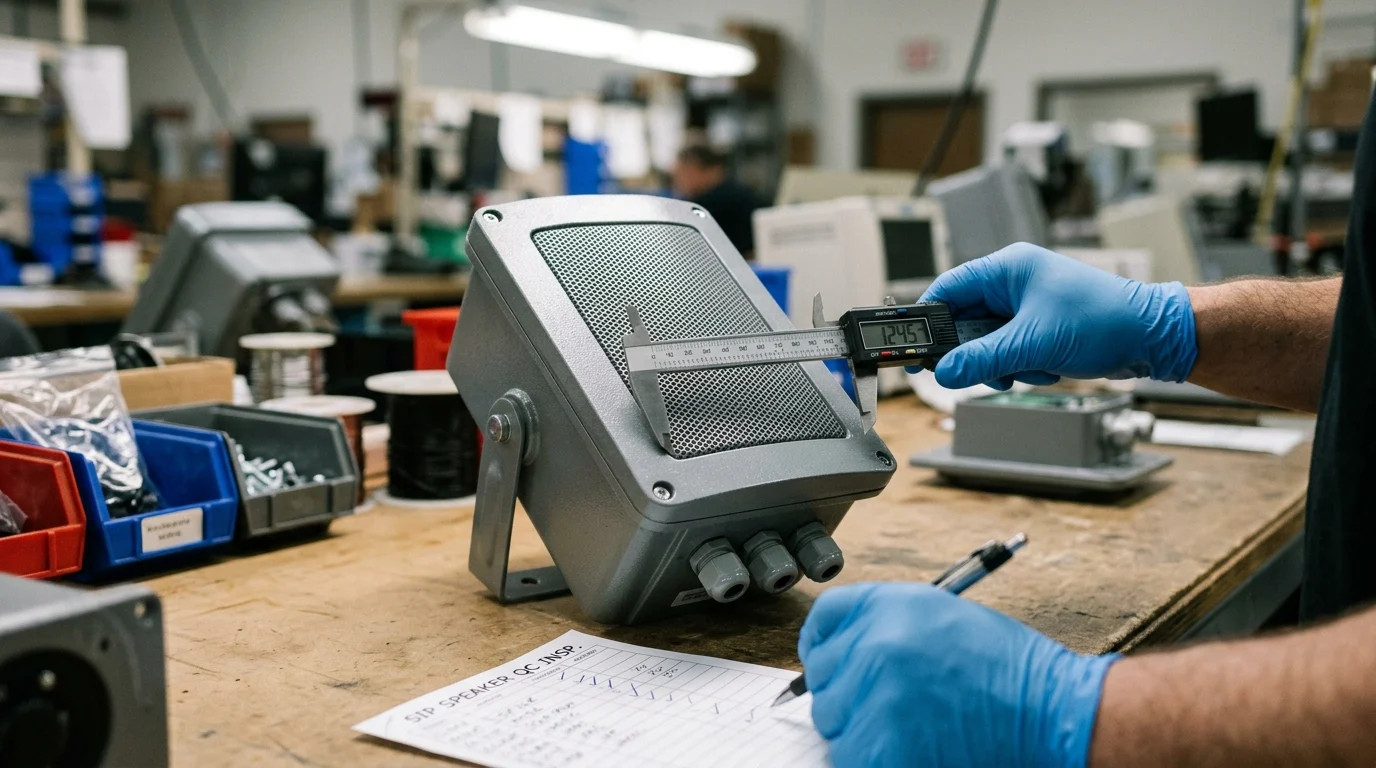
Unlike traditional analog speakers, which are passive components relying entirely on external amplification and signal processing, an industrial SIP speaker is an active, self-contained network appliance. It consolidates the roles of a network interface card, digital signal processor (DSP), Class-D audio amplifier, and electro-acoustic transducer into a single ruggedized enclosure.
Core functions beyond basic network audio
The intelligence embedded within a SIP speaker facilitates functions that extend far beyond converting electrical signals into sound waves. Modern industrial SIP endpoints feature onboard DSPs that handle acoustic echo cancellation, automated gain control, and equalization. This ensures high voice intelligibility even in acoustically challenging environments like steel mills or petrochemical plants.
Moreover, these devices perform continuous self-diagnostics and network health monitoring. An industrial SIP speaker can be configured to execute a 60-second polling interval, reporting its registration status, internal temperature, and speaker cone integrity back to a centralized SNMP (Simple Network Management Protocol) management system. If a device loses network connectivity or detects a hardware fault, the system administrator is alerted immediately, drastically reducing the mean time to repair (MTTR) compared to analog systems where dead speakers often go unnoticed until an emergency occurs.
Key protocols and interfaces: SIP, RTP, PoE, GPIO, and relays
The operational capability of a SIP speaker relies on a distinct stack of networking protocols and physical interfaces. While SIP (RFC 3261) manages the signaling, session setup, and teardown, RTP handles the actual delivery of digitized audio payloads. To power the internal amplifier and networking hardware without requiring localized AC power drops, these devices heavily utilize Power over Ethernet (PoE).
Additionally, industrial SIP speakers frequently feature General Purpose Input/Output (GPIO) pins and onboard dry contact relays. These interfaces allow the speaker to trigger external visual indicators, such as 12V or 24V strobe lights, or integrate with physical panic buttons and access control gates. This turns the audio endpoint into a comprehensive life-safety and security node.
| PoE Standard | IEEE Specification | Max Power at Port | Typical Amplifier Output | Approximate Max SPL (1m) |
|---|---|---|---|---|
| PoE | 802.3af | 15.4W | 8W – 10W | 105 dB |
| PoE+ | 802.3at | 30.0W | 15W – 25W | 115 dB |
| PoE++ (Type 3) | 802.3bt | 60.0W | 30W – 40W | 120+ dB |
How to Compare SIP and IP Industrial Speakers
Specifying the correct industrial SIP speaker requires a rigorous evaluation of both digital communication capabilities and physical acoustic performance. Engineers must balance network compatibility with the harsh realities of industrial environments, ensuring the device can cut through extreme ambient noise while surviving exposure to dust, moisture, and mechanical impact.
Key specification criteria for evaluation
The first phase of comparison involves evaluating the digital specifications. Codec support is a primary differentiator. While nearly all SIP speakers support the standard narrowband G.711 (PCMU/PCMA) codec for basic telephony compatibility, premium models support wideband codecs like G.722 or Opus. Wideband audio dramatically increases speech intelligibility by expanding the frequency response from 3.4 kHz up to 7 kHz or higher, which is critical for comprehending complex emergency instructions.
Memory capacity and local storage also vary between models. High-end SIP speakers include onboard flash memory to store pre-recorded WAV or MP3 files. This allows the device to play localized warning tones, evacuation messages, or automated shift-change bells triggered by an internal chronometer or an external HTTP API command, reducing dependency on constant WAN connectivity.
Audio output, coverage, and integration requirements
Acoustic output and coverage patterns dictate the physical quantity of speakers required for a facility. Industrial environments typically demand high Sound Pressure Levels (SPL). A standard office SIP speaker might produce 90 dB at 1 meter, whereas an industrial SIP horn speaker must consistently deliver between 115 dB and 120 dB at 1 meter to overcome heavy machinery noise.
Engineers must apply the inverse square law when comparing coverage specifications: sound pressure drops by approximately 6 dB for every doubling of distance from the source. If a factory floor has a sustained ambient noise level of 85 dB, an emergency paging system should ideally deliver 95 dB to the listener’s ear. A SIP horn speaker rated at 115 dB at 1 meter will degrade to roughly 95 dB at 10 meters, strictly dictating the spacing and placement grid during the design phase.
Environmental ratings for harsh industrial conditions
The defining characteristic of an “industrial” SIP speaker is its mechanical resilience. Devices deployed in manufacturing, mining, or marine environments must possess stringent Ingress Protection (IP) ratings. A minimum of IP66 is standard for industrial washdown areas, ensuring complete protection against dust ingress and powerful water jets, while IP67 models can withstand temporary submersion.
Temperature tolerance and impact resistance are equally critical. Standard commercial speakers often fail below 0°C or above 40°C. True industrial SIP speakers feature ruggedized aluminum or UV-stabilized polycarbonate enclosures capable of operating reliably across a temperature band of -40°C to +65°C. Furthermore, physical impact ratings, such as IK10, are essential for devices mounted in high-traffic logistics bays or areas prone to vandalism and accidental machinery strikes.
How to Implement Reliable SIP Speaker Integration
Deploying SIP speakers requires a synthesis of acoustic engineering and strict IT network management. Because these devices share infrastructure with corporate data, video surveillance, and automation control systems, a poorly implemented SIP audio deployment can suffer from jitter, dropped packets, and catastrophic failover issues during critical incidents.
Mapping call flows, paging zones, and emergency scenarios
Implementation begins with mapping the logical call flows and physical paging zones. Administrators must define which SIP extensions map to specific physical areas (e.g., Extension 5001 for the loading dock, Extension 5002 for the assembly line). For mass notification scenarios targeting multiple zones simultaneously, relying purely on SIP unicast calls to individual speakers will rapidly exhaust PBX resources.
Instead, administrators must configure IP multicast. In this flow, a SIP call is made to a designated master speaker or paging gateway, which then transmits a single multicast RTP stream to a specific IP address (e.g., 239.255.1.1). All slave speakers in that zone are programmed to subscribe to that multicast address via the Internet Group Management Protocol (IGMP), ensuring perfectly synchronized audio playback across the entire factory floor without overloading the SIP server.
Network planning: VLANs, QoS, PoE, firewalls, and SIP servers
Robust network planning is non-negotiable for real-time audio. SIP speakers should be isolated on a dedicated Voice VLAN to separate their traffic from heavy industrial data payloads. To guarantee audio quality, Quality of Service (QoS) policies must be rigorously applied across all switches and routers. The RTP audio stream should be marked with a Differentiated Services Code Point (DSCP) value of 46 (Expedited Forwarding), while the SIP signaling traffic is typically marked with DSCP 24 (CS3).
Bandwidth provisioning is also a factor, though generally minimal per device. A standard G.711 audio stream consumes approximately 87.2 kbps of network bandwidth. However, power provisioning requires careful PoE budget calculations. If a switch provides 370W of total PoE power, it can only support twelve 30W (802.3at) industrial SIP horns before requiring supplemental power sourcing equipment or midspan injectors.
Commissioning, audio testing, and failover validation
The final implementation phase is commissioning and failover validation. Audio testing must be conducted during peak operational hours to ensure the configured SPL effectively cuts through maximum ambient noise. Technicians must verify that ambient noise sensing microphones, if equipped, are accurately dynamically adjusting the amplifier gain without causing feedback loops.
Failover validation ensures system survivability. Industrial SIP speakers must be configured with primary and secondary SIP server IP addresses. Administrators should simulate a primary PBX failure to verify that the speakers successfully register to the backup server before the standard 120-second SIP registration expiry timer elapses. Furthermore, local survivability features—such as falling back to multicast-only operation or playing pre-recorded emergency tones via GPIO triggers if SIP registration is lost—must be thoroughly tested.
How to Choose the Right SIP Speaker Architecture
Selecting the right architecture for industrial communication is a strategic decision that pits decentralized, standalone SIP speakers against centralized IP-to-analog gateway architectures. The optimal choice depends on the scale of the facility, existing infrastructure, regulatory compliance requirements, and long-term lifecycle objectives.
Standalone SIP speakers versus centralized audio systems
A decentralized architecture utilizes standalone SIP speakers, where every endpoint is an intelligent, network-attached node. This topology offers unparalleled granularity, allowing administrators to adjust volume, monitor health, and reassign paging zones on a speaker-by-speaker basis without altering physical wiring. Conversely, a centralized IP audio architecture relies on a SIP paging gateway that receives the IP signal and converts it to analog audio, driving a bank of traditional 70V/100V “dumb” horn speakers via high-voltage copper cabling.
| Architecture Feature | Standalone SIP Speakers (Decentralized) | IP Gateway to Analog 70V (Centralized) |
|---|---|---|
| Granularity & Zoning | Individual endpoint control | Limited to hardwired analog loops |
| Cabling Infrastructure | Standard CAT5e/CAT6 (100m limit) | Heavy shielded copper (long distances) |
| Single Point of Failure | Low (isolated to single speaker/switch port) | High (amplifier failure drops entire zone) |
| Component Cost | Higher CAPEX per speaker | Lower CAPEX per speaker, high head-end cost |
Balancing compliance, maintainability, and lifecycle cost
When balancing these architectures, compliance with life-safety regulations is often the deciding factor. In jurisdictions enforcing stringent fire alarm and mass notification codes, such as NFPA 72 in North America or EN 54-24 in Europe, audio systems must meet specific survivability, battery backup, and continuous line-monitoring standards. Centralized 70V systems have historically dominated this space due to established certification pathways for their head-end amplifiers.
However, modern SIP speakers are rapidly achieving compliance by utilizing supervised PoE network switches backed by uninterruptible power supplies (UPS). From a lifecycle perspective, standalone SIP speakers frequently offer a lower Total Cost of Ownership (TCO). While the initial hardware cost per endpoint is higher, organizations eliminate the immense labor costs of running dedicated analog conduit, and the MTBF (Mean Time Between Failures) of decentralized solid-state SIP endpoints often exceeds 50,000 hours, significantly reducing ongoing maintenance expenditures.
Final decision framework for specifying SIP speaker systems
The final decision framework for specifying a system should be driven by the facility’s existing topology and operational needs. If a plant already possesses extensive, healthy 70V analog wiring but wishes to integrate with a modern IP-PBX, deploying a SIP-to-analog paging gateway is the most cost-effective transitional step.
If the facility is a greenfield construction, or if the requirement demands granular zone control, automated self-diagnostics, and two-way intercom capabilities, a fully decentralized standalone SIP speaker architecture is the superior choice. By aligning the acoustic requirements with network capabilities and lifecycle budgets, engineers can deploy industrial communication systems that ensure uncompromising safety, high intelligibility, and seamless enterprise integration.
Key Takeaways
- Use SIP speakers as intelligent IP endpoints to extend VoIP paging and emergency alerts across factories, warehouses, campuses, and hazardous areas.
- Plan each new SIP speaker around an Ethernet drop, power requirements, and an IP address instead of relying on centralized 70V/100V analog amplifier infrastructure.
- Configure emergency call routing so critical alerts automatically override routine paging, music, or lower-priority announcements.
- Use multicast paging for large deployments to distribute one synchronized RTP audio stream to many endpoints without overloading the IP-PBX.
- Select rugged, certified equipment for harsh sites, especially where weatherproofing, explosion protection, or industrial reliability standards are required.
Frequently Asked Questions
What is a SIP speaker in an industrial communication system?
A SIP speaker is a network-connected audio endpoint that registers to an IP-PBX or VoIP platform like a phone extension, enabling paging, alerts, and emergency broadcasts over an existing LAN.
How do SIP speakers reduce installation complexity?
They remove the need for heavy analog amplifier racks and proprietary paging matrices. In most deployments, adding a speaker requires an Ethernet connection, power, and an available IP address.
Can SIP speakers support emergency priority announcements?
Yes. SIP routing and device settings can prioritize emergency calls so safety alerts override routine paging, background music, or lower-priority operational messages.
Why is multicast useful for industrial paging?
Multicast lets one audio stream reach many speakers at the same time, preventing the IP-PBX from creating hundreds of individual SIP sessions and helping maintain synchronized mass notification.
Are SIP speakers suitable for harsh or hazardous environments?
Industrial models are built for demanding sites such as mining, oil and gas, transportation, maritime, prisons, and outdoor facilities. Siniwo also provides weatherproof, waterproof, and explosion-proof communication products.

Post time: Jun-21-2026