
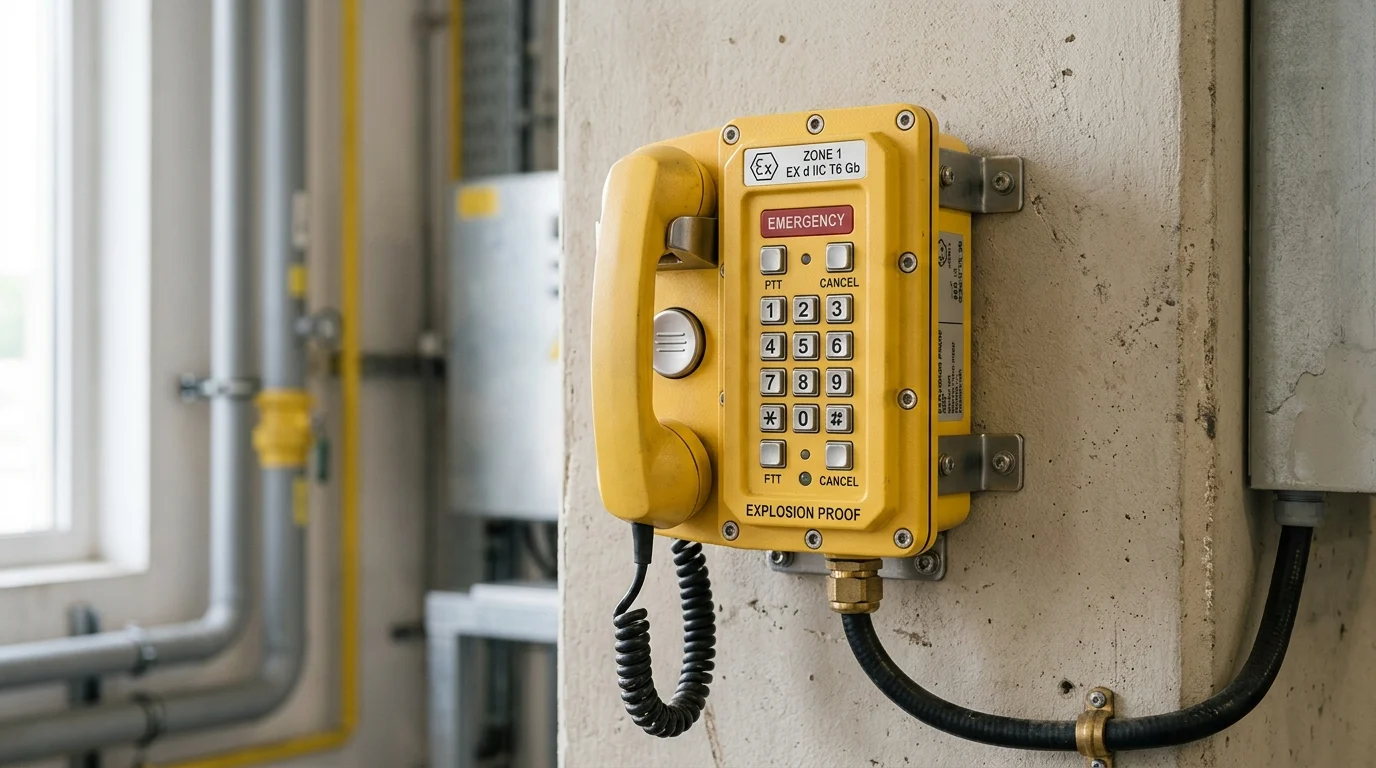
Introduction
Choosing between an explosion proof telephone and a weatherproof phone is not a simple durability decision; it determines whether a communication system is safe, compliant, and cost-effective in a given industrial area. This guide explains the core differences in hazardous-area protection, environmental resistance, certification requirements, and typical use cases, so readers can match the phone type to actual site conditions rather than assumptions. It also highlights the practical tradeoffs in price, maintenance, and deployment risk, helping engineers, specifiers, and buyers avoid both under-specifying for dangerous zones and overpaying for unnecessary protection. With that context in place, the comparison can move directly into the technical and operational factors that separate these two device categories.
Why the Explosion Proof vs Weatherproof Phone Choice Matters
Specifying the correct industrial communication hardware is a critical engineering decision that directly impacts plant safety, regulatory compliance, and capital expenditure. In harsh industrial environments, standard commercial telephones degrade rapidly, leading to communication blind spots during emergencies. The choice between an explosion proof telephone and a weatherproof phone hinges on the presence of flammable gases, combustible dust, or extreme environmental degradation.
Making an incorrect specification carries severe consequences. Deploying a standard weatherproof phone in a hazardous area introduces a catastrophic ignition risk, potentially violating international safety codes and voiding facility insurance policies. Conversely, over-specifying an explosion proof telephone for a non-hazardous, merely wet environment results in unnecessary capital expenditures, often inflating unit costs from a baseline of $300–$800 for weatherproof models to $1,500–$4,000+ for certified explosion proof units.
Safety classification, downtime risk, and site exposure
The primary driver for selecting an explosion proof telephone is the facility’s hazardous area classification. Sites designated as Zone 1 or Zone 2 (under ATEX/IECEx) or Class I, Division 1 or 2 (under NEC/CEC) mandate equipment incapable of igniting the surrounding atmosphere. This ignition can occur via electrical arcing in the handset, short circuits in the keypad, or thermal accumulation on the enclosure surface.
Beyond ignition risks, site exposure to corrosive chemicals, saline environments, and extreme mechanical impacts dictates the required ruggedness. Downtime risk also plays a quantitative role in this decision. In heavy industries like oil and gas, unplanned downtime can cost upwards of $100,000 to $500,000 per hour. Reliable communication infrastructure is required to coordinate rapid emergency shutdowns and minimize these financial losses, making the initial hardware investment a minor factor compared to operational continuity.
Typical use cases for explosion proof and weatherproof phones
Weatherproof phones are engineered primarily for environments where water ingress, dust accumulation, and temperature fluctuations are the main threats, but explosive gases are absent. Typical use cases include highway tunnel emergency systems, marine vessels, non-hazardous chemical processing areas, railway platforms, and heavy manufacturing floors. These environments demand high durability and visibility but do not require complex flame-path engineering.
Explosion proof telephones are legally mandated in volatile sectors. Common deployments include offshore drilling rigs, petroleum refineries, LNG terminals, underground coal mines, and grain handling facilities where combustible dust poses a constant threat. In these use cases, the telephone must not only survive the harsh ambient conditions but actively contain any internal electrical fault to prevent an external catastrophic event.
Key Differences Between Explosion Proof and Weatherproof Phones
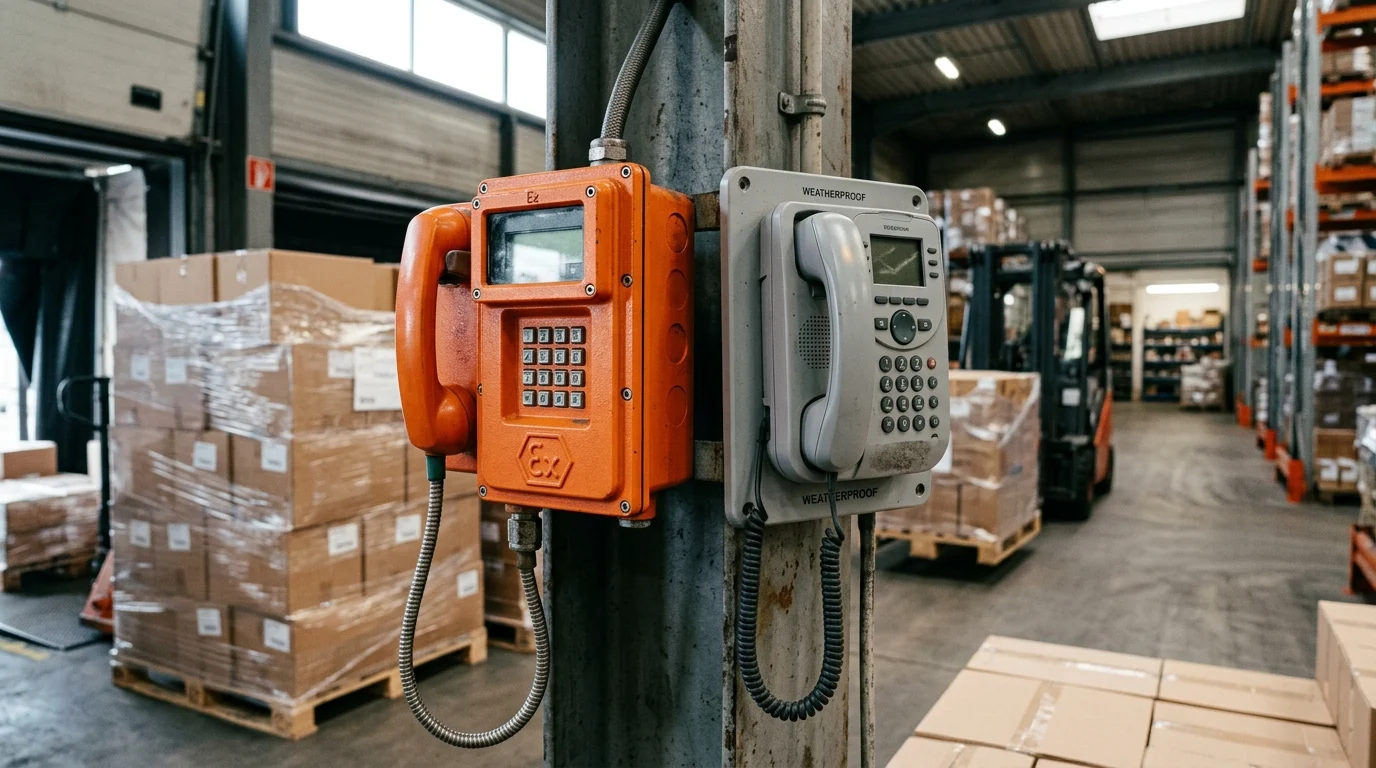
While both device categories are built to withstand severe industrial abuse, their underlying engineering philosophies are fundamentally different. A weatherproof phone is designed to keep the external environment out, whereas an explosion proof phone is designed to keep internal electrical faults contained.
Hazardous area ratings, ingress protection, and enclosure design
Ingress protection is the core metric for weatherproof phones, typically achieving an IP66 or IP67 rating (or NEMA 4X equivalent). These enclosures are generally manufactured from Glass Reinforced Polyester (GRP) or standard die-cast aluminum, featuring a wall thickness of 3mm to 5mm. They rely on heavy-duty silicone or polyurethane gaskets to block high-pressure water jets and fine dust.
Explosion proof enclosures require vastly different structural engineering. Rather than simply blocking water, they must withstand the immense internal pressure of a gas explosion without rupturing. These enclosures are cast from copper-free aluminum, 316L stainless steel, or specialized cast iron, with wall thicknesses routinely exceeding 10mm to 15mm. Furthermore, they incorporate precision-machined flame paths. If an internal explosion occurs, these microscopic gaps (often machined to tolerances tighter than 0.15mm) allow the expanding gases to cool below the auto-ignition temperature of the external atmosphere before escaping.
Definitions, certifications, and environmental resistance
Certifications dictate the legal deployment of these devices. Weatherproof phones are tested against standard environmental benchmarks, such as EN 60529 for IP ratings or MIL-STD-810 for shock and vibration. Explosion proof phones must undergo rigorous third-party testing to achieve ATEX, IECEx, or UL/CSA certifications, which verify their ability to operate safely in specific gas groups (e.g., IIA, IIB, IIC) and temperature classes (e.g., T4, which ensures the device surface never exceeds 135°C).
| Feature | Weatherproof Phone | Explosion Proof Telephone |
|---|---|---|
| Primary Function | Prevents water/dust ingress | Contains internal explosions |
| Typical Enclosure | GRP, Aluminum (3-5mm thick) | Copper-free Aluminum, 316L SS (10-15mm thick) |
| Key Certifications | IP66, IP67, NEMA 4X | ATEX, IECEx, UL Class I Div 1/2 |
| Temperature Class | Not applicable | T3 (200°C), T4 (135°C), T5, T6 |
| Impact Resistance | Standard industrial (IK08-IK09) | Extreme heavy duty (often > 100 Joules) |
How to Compare Explosion Proof and Weatherproof Phones
Comparing these two classes of industrial telephones requires a holistic evaluation of the facility’s specific operational needs. Engineers must balance strict regulatory compliance against budget constraints, maintenance capabilities, and the physical realities of the installation environment.
Core comparison criteria for application fit
The foremost comparison criterion is the hazardous area zone map of the facility. If a mounting location falls within a Zone 1 or Zone 2 boundary, an explosion proof telephone is a non-negotiable requirement. For safe areas (unclassified zones), a weatherproof phone is the logical choice.
Secondary criteria include acoustic performance and visibility. Both phone types are typically equipped with noise-canceling microphones designed to filter out background noise exceeding 85 dB(A), and many feature integrated heavy-duty ringers or external beacons capable of outputting 100 dB(A) to 110 dB(A) at 1 meter. However, the exact acoustic requirements will dictate whether standard handset models or specialized headset-compatible units are necessary.
Lifecycle cost, certification, and maintenance factors
Lifecycle costs differ significantly between the two technologies. The initial CAPEX for an explosion proof telephone is typically 300% to 500% higher than a comparable weatherproof model. OPEX must also be factored in; explosion proof equipment requires specialized, documented maintenance routines. Technicians must strictly adhere to hazardous area protocols, such as verifying flame path integrity and ensuring barrier glands are properly torqued.
Weatherproof phones offer a lower total cost of ownership (TCO) due to simpler installation and maintenance. Routine maintenance generally involves visual inspections of the enclosure seals and functional testing of the keypad and handset cord, without the need for specialized hazardous area work permits or specialized diagnostic tools.
Performance trade-offs in real operating conditions
Real-world operating conditions introduce distinct performance trade-offs. Weight is a major factor: a heavy-duty explosion proof telephone can weigh between 15 kg and 25 kg, requiring robust structural mounting points and specialized lifting procedures during installation. In contrast, a GRP weatherproof phone typically weighs between 3 kg and 6 kg, allowing for rapid installation by a single technician.
Ergonomics can also be impacted by the ruggedization level. The handsets on explosion proof models are often heavier and feature armored cords with a pull strength exceeding 200 kg to prevent severance. While this guarantees survivability in extreme conditions, it can cause user fatigue during prolonged troubleshooting calls compared to the slightly lighter handsets used on standard weatherproof models.
Compliance, Installation, and Supplier Evaluation
Procuring and installing industrial communication equipment is heavily regulated. Utilizing non-compliant hardware or employing improper installation techniques can instantly invalidate a multi-million dollar facility’s safety certification and insurance coverage.
Relevant standards and approval requirements
Compliance is governed by strict international frameworks. For explosion proof telephones, the IEC 60079 series of standards defines the testing and certification parameters globally, with regional variations such as the ATEX Directive (2014/34/EU) in Europe and the National Electrical Code (NEC) Articles 500-505 in the United States. Equipment must carry the appropriate markings (e.g., Ex db eb IIC T4 Gb) matching the site’s exact gas and dust hazards.
Weatherproof phones, while not subject to explosive atmosphere regulations, must still comply with rigorous electrical safety and telecommunications standards. They must meet EN 60529 for their stated IP rating and often require FCC, CE, or ICASA approvals for their internal electronic components, ensuring electromagnetic compatibility (EMC) in environments with heavy machinery.
Installation practices that reduce operational risk
Installation practices directly influence the operational risk and longevity of the devices. Explosion proof telephones require specialized cable entry systems. Installers must use certified barrier glands filled with a sealing compound to prevent explosive gases from migrating through the cable core. Enclosure bolts must be torqued to exact manufacturer specifications—often between 15 Nm and 25 Nm—to maintain the precise gap of the flame path.
For weatherproof phones, installation focuses on maintaining the IP rating. Cable entries must be fitted with correctly sized nylon or brass IP68 compression glands. A common point of failure is improper gland sizing or failing to utilize drip loops in the cabling, which allows water to track down the cable and bypass the enclosure seals over time.
How to assess manufacturers and suppliers
Evaluating suppliers for industrial telephones requires scrutinizing their quality management systems and supply chain reliability. For explosion proof equipment, the manufacturer must hold an ATEX Quality Assurance Notification (QAN) or IECEx Quality Assessment Report (QAR), proving their manufacturing process maintains the exact tolerances tested during certification.
| Evaluation Metric | Weatherproof Phone Suppliers | Explosion Proof Phone Suppliers |
|---|---|---|
| Quality Certification | ISO 9001 | ISO 9001, ATEX QAN, IECEx QAR |
| Typical Lead Times | 2 to 4 weeks | 8 to 12 weeks (due to testing) |
| Defect Rate Tolerance | < 1.0% | < 0.1% (Zero critical safety defects) |
| Documentation Provided | IP Test Reports, CE/FCC | Ex Certificates, Specific Test Reports |
Procurement teams should also assess the supplier’s Mean Time Between Failures (MTBF) data. Top-tier manufacturers will provide verifiable MTBF figures exceeding 50,000 hours for both weatherproof and explosion proof electronics, ensuring long-term reliability in unattended locations.
How to Choose the Right Phone for Your Site
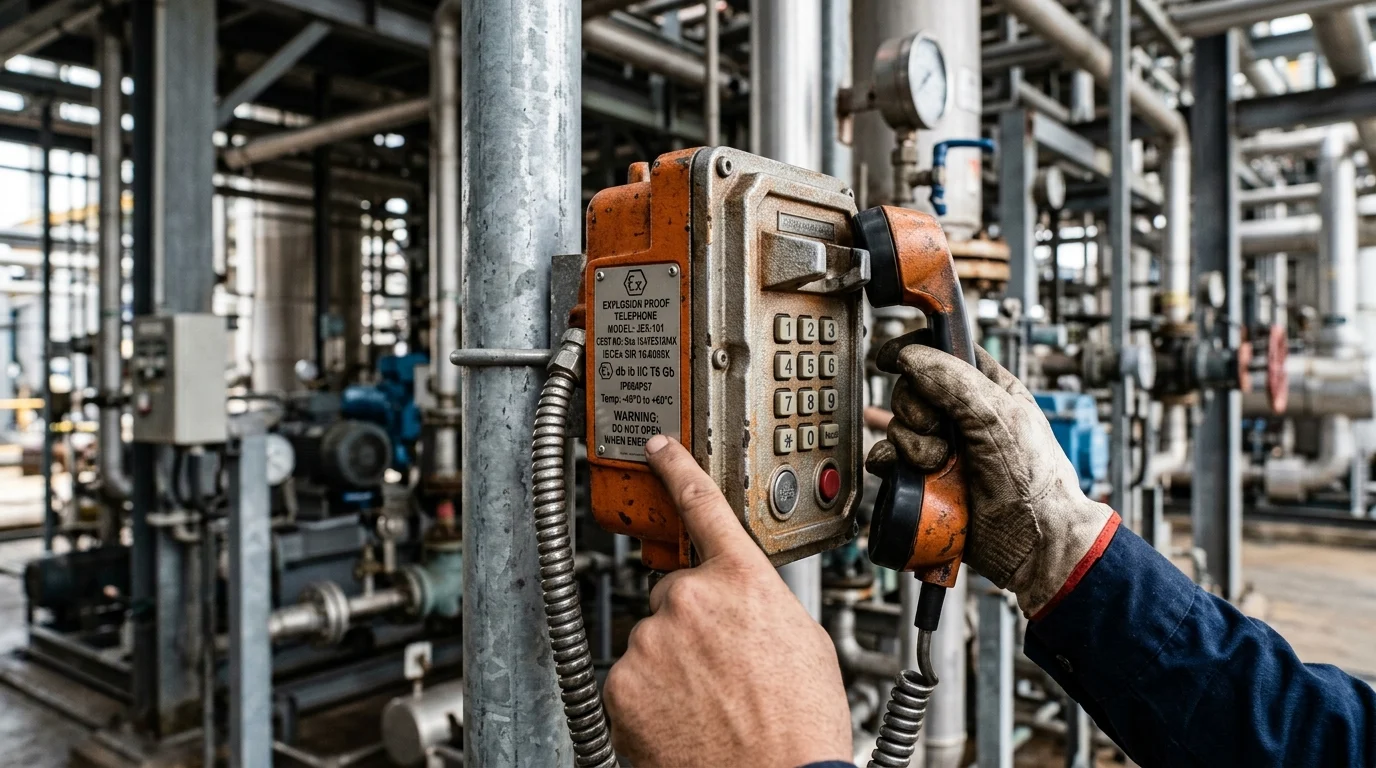
Selecting the right industrial telephone requires bridging the gap between stringent engineering requirements and practical procurement realities. A systematic approach ensures that safety is prioritized without incurring unnecessary costs or deployment delays.
A decision path for selecting the correct phone type
The decision path begins with a definitive hazardous area classification review. If the installation point is mapped as Zone 1, Zone 2, or Class I Div 1/2, the path strictly routes to an explosion proof telephone. Once classified, the engineer must match the device’s gas group (e.g., IIC for hydrogen) and T-Class (e.g., T4 for temperatures up to 135°C) to the site’s specific chemical hazards.
If the area is unclassified, the path routes to a weatherproof phone. The subsequent decisions revolve around environmental extremes. Determine the required operating temperature range; standard industrial phones handle -20°C to +60°C, but extreme environments may require components rated for -40°C to +75°C. Finally, select the communication protocol, choosing between standard analog, SIP/VoIP for modern IP PBX integration, or specialized intrinsically safe systems.
A final engineering and procurement checklist
Before issuing a purchase order, finalize the specification using a comprehensive engineering checklist. Verify that the selected enclosure material resists the specific corrosive agents present on site (e.g., specifying 316L stainless steel rather than aluminum for offshore saline environments). Confirm that the IP rating is a minimum of IP66 for outdoor, unsheltered installations.
Ensure that the acoustic output of the integrated ringer or external beacon exceeds the ambient noise level by at least 10 dB(A) to 15 dB(A). Finally, validate that the supplier provides full documentation, including hazardous area certificates, installation manuals, and warranty terms, ensuring the facility remains fully compliant and operational for the 10 to 15-year expected lifespan of the hardware.
Key Takeaways
- The most important conclusions and rationale for Explosion Proof Telephone
- Specs, compliance, and risk checks worth validating before you commit
- Practical next steps and caveats readers can apply immediately
Frequently Asked Questions
When should I choose an explosion proof telephone instead of a weatherproof phone?
Choose explosion proof models for Zone 1/2 or Class I Div 1/2 areas with flammable gas or combustible dust. Use weatherproof phones only in non-hazardous wet, dusty, or outdoor locations.
Are weatherproof phones safe to install in hazardous oil and gas areas?
No. A weatherproof phone resists water and dust, but it is not designed to contain ignition sources. Hazardous areas require certified explosion proof telephones.
What certifications should I check before buying an explosion proof telephone?
Verify the required hazardous-area approval, such as ATEX or IECEx, plus matching gas group and temperature class. For general quality, Siniwo also offers products aligned with CE, FCC, ROHS, and ISO9001 standards.
Why are explosion proof telephones more expensive than weatherproof phones?
They use thicker metal enclosures, precision flame paths, and certified designs to contain internal faults. That extra engineering and testing raises cost but is essential for legal compliance and plant safety.
Can Siniwo help match the right industrial phone to my site conditions?
Yes. Siniwo provides one-stop support from design and integration to installation and maintenance, helping customers select explosion-proof or weatherproof communication systems for harsh and hazardous environments.
Post time: May-12-2026