
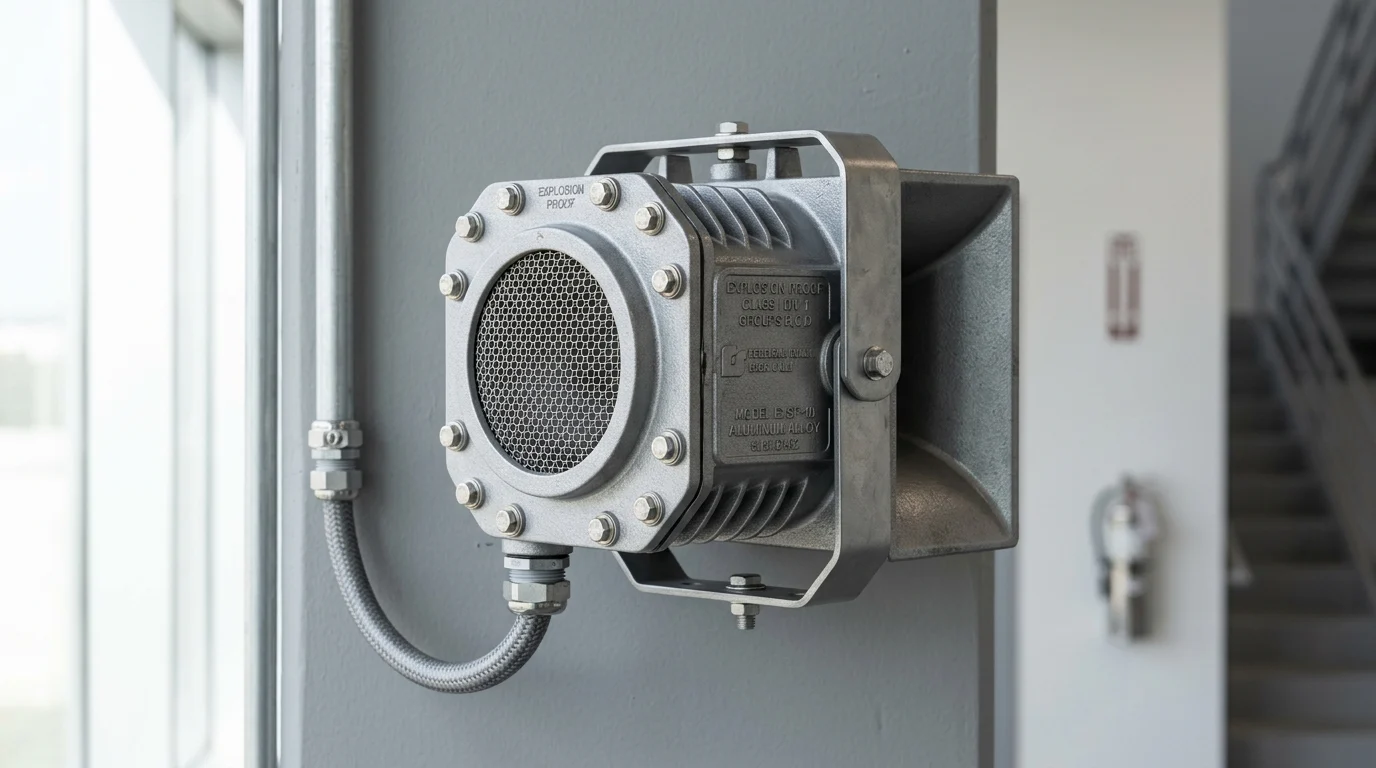
Why Explosion-Proof Speakers Matter in Hazardous Areas
Industrial facilities operating in volatile environments require robust Public Address and General Alarm (PA/GA) systems to ensure personnel safety and operational continuity. In areas where flammable gases, vapors, or combustible dusts are present, standard electronic equipment poses a severe ignition risk. Explosion-proof speakers are engineered specifically to neutralize this threat while delivering critical audio alerts and voice communications across expansive, high-noise industrial footprints.
The deployment of these specialized acoustic devices is not merely a best practice; it is a strict regulatory mandate governed by international safety frameworks. Understanding the engineering principles, certification requirements, and acoustic performance metrics of explosion-proof speakers is essential for electrical engineers, facility managers, and procurement specialists tasked with safeguarding hazardous locations.
How to Frame the Need for Explosion-Proof Speakers
To contextualize the necessity of explosion-proof audio equipment, one must examine the fire triangle: fuel, oxygen, and an ignition source. In a hazardous industrial location, fuel (such as methane, hydrogen, or grain dust) and oxygen are frequently present in the ambient atmosphere. The only controllable variable is the ignition source. Standard loudspeakers utilize voice coils, transformers, and wiring that can generate electrical sparks or surface temperatures exceeding the auto-ignition threshold of surrounding volatile substances. For instance, the minimum ignition energy (MIE) for a hydrogen-air mixture is exceptionally low, measured at approximately 0.017 mJ. A standard commercial speaker can easily generate energy discharges far exceeding this threshold during normal operation or a fault condition.
Explosion-proof speakers are designed to eliminate the speaker as a viable ignition source. This is achieved not by preventing the volatile atmosphere from entering the device, but by ensuring that any internal ignition is contained and extinguished before it can propagate to the external environment. This fundamental shift in engineering philosophy dictates the stringent material choices, structural tolerances, and thermal management strategies employed in these devices.
Key Operational Risks in Hazardous Area Communication
Communication in hazardous areas is fraught with unique operational challenges that extend beyond the immediate threat of explosion. Industrial environments such as refineries, offshore drilling platforms, and chemical processing plants are characterized by extreme ambient noise levels. Background noise from compressors, turbines, and heavy machinery frequently operates in the 85 dB(A) to 110 dB(A) range. In such conditions, the primary operational risk is acoustic masking, where critical evacuation alarms or emergency voice instructions are rendered inaudible.
Mitigating this risk requires explosion-proof speakers capable of generating high Sound Pressure Levels (SPL) without compromising their hazardous area certification. A standard operational requirement dictates that alarm tones must exceed ambient background noise by a minimum of 10 to 15 dB(A) to ensure recognition. Consequently, an area with 95 dB(A) ambient noise necessitates an acoustic output of at least 105 dB(A) to 110 dB(A) at the listener’s position. Failing to achieve this differential results in localized “dead zones” or acoustic shadows, severely compromising site-wide safety protocols and increasing evacuation response times during critical incidents.
What Defines an Explosion-Proof Speaker
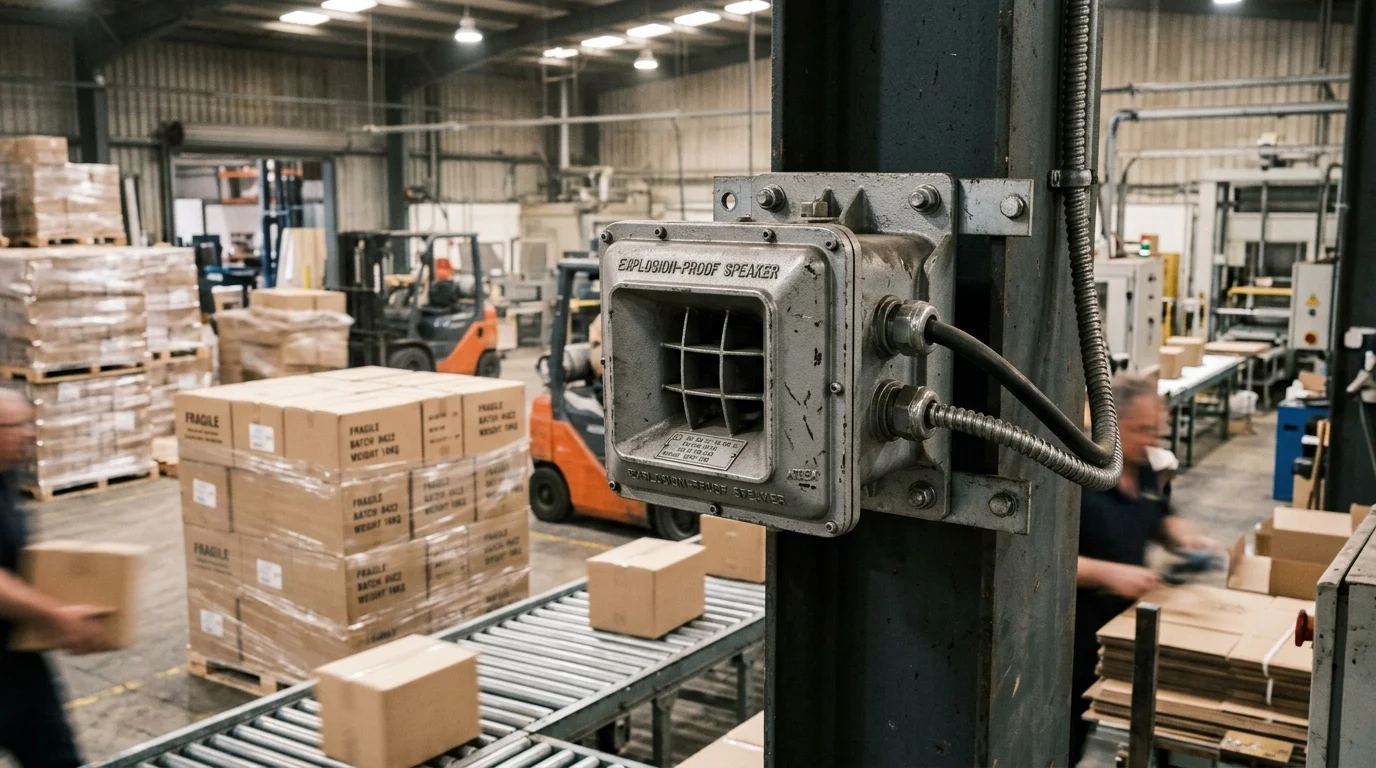
The terminology “explosion-proof” is frequently misunderstood in industrial contexts. It does not imply that the speaker is indestructible or capable of surviving an external catastrophic explosion. Rather, it signifies that the device’s enclosure is engineered to contain an internal explosion of a specified flammable gas or vapor mixture, preventing the ignition of the surrounding hazardous atmosphere.
This containment capability relies on precise mechanical engineering, rigorous material science, and specialized acoustic components that differentiate explosion-proof speakers from heavy-duty or weather-resistant commercial alternatives.
Enclosure Design, Flame Paths, and Sealing
The core mechanism of an explosion-proof (Ex d) speaker is its enclosure design and the implementation of flame paths. When a volatile gas enters the speaker housing and is ignited by an internal electrical fault, the resulting explosion generates immense internal pressure. The enclosure must possess sufficient mechanical strength to withstand this pressure without rupturing. More critically, the expanding, superheated gases must be safely vented to the external environment to prevent catastrophic enclosure failure.
This venting occurs through precisely machined flame paths—gaps between the mating surfaces of the enclosure. These paths are designed with specific lengths and highly controlled clearances, often machined to tolerances tighter than 0.15 mm. As the ignited gas is forced through these narrow, labyrinthine channels, it rapidly loses thermal energy. By the time the gas exits the enclosure, its temperature has dropped below the auto-ignition temperature of the external atmosphere, effectively quenching the flame and preventing external propagation. Furthermore, specialized sintered metal meshes are frequently utilized over the acoustic horn or driver opening to allow sound waves to pass while acting as a thermal mass to cool escaping gases.
Explosion-Proof Speaker Comparison Criteria
When evaluating explosion-proof speakers, the choice of enclosure material is a primary comparison criterion, directly impacting durability, weight, and suitability for specific environments. The three dominant materials utilized in the industry are Copper-Free Aluminum, Glass-Reinforced Polyester (GRP), and Stainless Steel 316L.
Aluminum offers excellent thermal dissipation and structural integrity at a moderate cost, making it ubiquitous in standard onshore applications. GRP provides a lightweight, highly corrosion-resistant alternative, ideal for harsh chemical environments where metals might degrade. Stainless Steel 316L represents the premium tier, delivering unparalleled resistance to salt spray and corrosive agents, making it the definitive choice for offshore marine and heavy industrial sectors.
| Enclosure Material | Relative Weight | Corrosion Resistance | Typical Application Environment | Estimated Cost Multiplier |
|---|---|---|---|---|
| Copper-Free Cast Aluminum | Medium (4-6 kg) | Moderate | Onshore Oil & Gas, General Industrial | 1.0x (Baseline) |
| Glass-Reinforced Polyester (GRP) | Light (2-4 kg) | High | Chemical Plants, Highly Corrosive Areas | 1.2x – 1.5x |
| Stainless Steel 316L | Heavy (7-12 kg) | Exceptional | Offshore Platforms, Marine Environments | 2.5x – 4.0x |
Output Power, SPL, Impedance, and Frequency Response
Beyond mechanical containment, the acoustic performance of an explosion-proof speaker must meet rigorous industrial standards. The output power of these devices typically ranges from 15W to 30W, driven by specialized compression drivers. Despite this seemingly modest wattage compared to commercial audio systems, the high-efficiency horn designs enable these speakers to produce exceptional Sound Pressure Levels (SPL), frequently achieving 110 dB to 125 dB at 1 meter.
Impedance matching is critical for large-scale PA/GA systems. Most explosion-proof speakers feature integrated multi-tap transformers, allowing them to operate on 100V or 70V distributed audio lines. This configuration minimizes signal loss over the long cable runs typical in expansive industrial facilities. Frequency response is deliberately optimized for human speech intelligibility and alarm tone penetration, generally spanning from 300 Hz to 8 kHz. This restricted frequency band intentionally rolls off low frequencies that consume excessive power without contributing to voice clarity in high-noise environments.
Certifications and Standards to Check
Specifying an explosion-proof speaker requires navigating a complex landscape of global certifications and localized safety standards. A device deemed safe in one jurisdiction may be strictly prohibited in another if it lacks the appropriate regional markings.
Regulatory compliance is non-negotiable; installing non-certified or improperly rated equipment in a hazardous location violates occupational safety laws, voids insurance policies, and introduces catastrophic risk to personnel and infrastructure.
Class, Division, Zone, Gas Group, and Dust Group Ratings
Hazardous locations are classified using two primary systems: the Class/Division system (predominantly used in North America under the NEC/CEC) and the Zone system (used globally under IEC standards). The Class/Division system categorizes hazards by type (Class I for gases, Class II for dusts) and probability of presence (Division 1 for normal operations, Division 2 for abnormal conditions). Conversely, the Zone system categorizes gas hazards into Zone 0 (continuous presence), Zone 1 (occasional presence), and Zone 2 (rare presence), with corresponding Zones 20, 21, and 22 for combustible dusts.
Furthermore, speakers must be rated for specific Gas Groups and Dust Groups. Gas Group IIC represents the most volatile gases, such as hydrogen and acetylene, requiring the most stringent enclosure designs. Dust Group IIIC encompasses conductive dusts like metal powders. Temperature classification (T-Rating) is equally critical; a speaker with a T4 rating guarantees that its maximum external surface temperature will never exceed 135°C under maximum fault conditions, ensuring it will not ignite gases with auto-ignition temperatures above that threshold.
ATEX, IECEx, and UL Certification Differences
The certification body approving the device dictates its legal deployability in specific global markets. ATEX (Atmosphères Explosibles) is a mandatory directive for equipment intended for use within the European Union. IECEx is an international certification scheme designed to facilitate global trade, widely accepted in regions like Australia, the Middle East, and Asia. In North America, equipment must typically bear marks from Nationally Recognized Testing Laboratories (NRTLs) such as UL, FM, or CSA.
| Certification Scheme | Primary Region of Authority | Governing Framework | Typical Marking Example |
|---|---|---|---|
| ATEX | European Union | EU Directive 2014/34/EU | CE 0518 II 2G Ex db IIC T4 Gb |
| IECEx | International (Global) | IEC Standards (e.g., IEC 60079 series) | Ex db IIC T4 Gb |
| UL / CSA | North America | NEC (NFPA 70) / CEC | Class I, Div 1, Groups A, B, C, D T4 |
Documentation, Labeling, and Installation Drawings
Procurement and engineering teams must verify comprehensive documentation before accepting an explosion-proof speaker. A valid Declaration of Conformity (DoC) and an official certificate from a Notified Body (such as Sira, Baseefa, or PTB) must accompany the product. The speaker’s physical nameplate must permanently display the Ex markings, ambient temperature limits (e.g., Ta = -40°C to +60°C), electrical ratings, and the IP code.
Installation drawings and manuals provided by the manufacturer are legally binding documents under Ex regulations. These documents specify critical installation parameters, such as the required type of Ex-certified cable glands (e.g., Ex d barrier glands for specific internal volumes) and the exact torque specifications for enclosure bolts. Deviation from these manufacturer-specified installation procedures instantly invalidates the explosion-proof certification of the entire assembly.
How to Specify an Explosion-Proof Speaker
Translating technical specifications into a functional PA/GA deployment requires a methodical approach to system design. Selecting the correct explosion-proof speaker is highly contextual, depending entirely on the specific industrial process, the physical environment, and the site’s acoustic topology.
Engineers must balance acoustic coverage requirements with harsh environmental realities, ensuring the equipment survives the operational lifespan of the facility while maintaining its critical safety certifications.
Industrial Applications That Require Explosion-Proof Speakers
The demand for explosion-proof speakers spans a diverse array of heavy industries. In the upstream and downstream oil and gas sectors—ranging from offshore drilling rigs to onshore petrochemical refineries—the constant threat of hydrocarbon leaks necessitates ubiquitous Ex-rated communication infrastructure. Similarly, chemical manufacturing plants dealing with volatile solvents require extensive Zone 1 and Zone 2 acoustic coverage.
However, hazardous areas are not limited to gases and vapors. The agricultural and food processing industries face severe risks from combustible dusts. Grain elevators, flour mills, and sugar processing facilities operate in environments where suspended particulate matter can create highly explosive atmospheres. For example, the minimum explosible concentration (MEC) for grain dust typically ranges between 40 to 50 grams per cubic meter. In these applications, speakers must carry specific Dust Group (e.g., IIIB or IIIC) and Zone 21/22 certifications, featuring enclosures that prevent the ingress of fine particulates that could ignite on internal electrical components.
Environmental Factors: Corrosion, Washdown, and Temperature
Explosion-proof ratings address ignition risks, but environmental ingress ratings determine the operational longevity of the speaker. Industrial environments subjected to driving rain, high-pressure washdowns, or heavy particulate settling require speakers with robust Ingress Protection (IP) ratings, typically IP66 or IP67. In North America, an equivalent NEMA 4X rating is often specified, which also denotes a high level of corrosion resistance.
Temperature extremes dictate material and component selection. Facilities located in the Arctic Circle or the Middle East require speakers certified for extended ambient temperature ranges, often spanning from -50°C to +70°C. Furthermore, environments with high salinity, such as coastal LNG terminals or offshore platforms, subject equipment to relentless accelerated corrosion. In these scenarios, specifying 316L stainless steel enclosures and marine-grade mounting brackets is imperative to prevent structural degradation that could compromise the integrity of the flame paths.
Step-by-Step Selection Process
Selecting the optimal explosion-proof speaker follows a strict engineering progression. First, identify the exact hazardous area classification (Class/Division or Zone, Gas/Dust Group, and T-Rating) required for the specific installation point. This immediately filters out non-compliant hardware. Second, analyze the environmental stressors to determine the necessary enclosure material (Aluminum, GRP, or Stainless Steel) and IP rating.
Third, perform acoustic calculations. Measure or model the ambient noise level of the area. Apply the standard rule of requiring the alarm tone to be 10 to 15 dB(A) above the ambient noise floor. Using the inverse square law of sound attenuation (which dictates a 6 dB drop in SPL for every doubling of distance), calculate the required speaker wattage, dispersion angle, and placement density to achieve the target SPL across the designated coverage zone. Finally, verify the electrical compatibility, ensuring the speaker’s impedance or transformer tappings align with the facility’s central PA/GA amplifier architecture.
How to Compare Suppliers and Make a Buying Decision
The procurement of explosion-proof speakers represents a significant capital expenditure for any industrial project. The highly specialized nature of these devices, combined with the rigorous testing and certification processes they undergo, results in a pricing structure vastly different from standard commercial audio equipment.
Making an informed buying decision requires moving beyond the initial unit purchase price and evaluating the total cost of ownership, the manufacturer’s quality assurance processes, and the long-term support infrastructure available for the life of the facility.
Total Cost Drivers to Assess
When assessing total cost drivers, buyers must recognize the steep premium attached to hazardous area equipment. While a heavy-duty industrial speaker might cost $200 to $400, a certified Ex d speaker typically ranges from $800 to over $2,500 per unit, depending on the material and certification tier. Stainless steel 316L variants sit at the top of this pricing spectrum due to high raw material costs and the difficulty of machining tight-tolerance flame paths into hard alloys.
However, the unit price is only one component of the total expenditure. Installation costs in hazardous areas are exceptionally high due to the requirement for specialized labor, explosion-proof conduit systems, barrier glands, and certified junction boxes. Furthermore, OPEX (Operational Expenditure) must be factored into the equation. A cheaper aluminum speaker installed in a highly corrosive marine environment may require replacement within three years, whereas a premium stainless steel or GRP unit could provide a 15-year operational lifespan, ultimately delivering a significantly lower Total Cost of Ownership (TCO).
Manufacturer Quality, Traceability, and Support
The integrity of an explosion-proof speaker is entirely dependent on the manufacturer’s quality control processes. Buyers must verify that the supplier operates under a stringent quality management system specifically tailored for Ex equipment, such as ISO/IEC 80079-34. This standard ensures that the manufacturer maintains strict traceability of materials and adheres to the precise machining tolerances required by the certification bodies.
Reputable manufacturers conduct 100% routine pressure testing on cast enclosures to identify microscopic porosity or structural flaws before assembly. Traceability is critical; the manufacturer should be able to provide material certificates and batch records for every unit shipped. Additionally, buyers must assess supply chain reliability and lead times. Specialized explosion-proof equipment is rarely held in massive stock quantities. Standard configurations may require 4 to 6 weeks for delivery, while custom-painted or specific tapped variants can extend lead times to 10 or 12 weeks, which must be factored into project schedules.
Final Decision Framework
The final decision framework for selecting an explosion-proof speaker supplier should weigh technical compliance, acoustic performance, and vendor support. Prioritize manufacturers who offer comprehensive acoustic modeling services, such as EASE data files, enabling engineers to simulate sound propagation and guarantee coverage before installation.
Evaluate the vendor’s global footprint and long-term support capabilities. Given that industrial facilities often operate for decades, the ability to source replacement drivers, certified spare parts, or localized technical support 10 years post-installation is a crucial differentiator. Ultimately, selecting the right explosion-proof speaker is an exercise in risk mitigation. By rigorously comparing certifications, materials, acoustic data, and manufacturer pedigree, industrial operators can ensure their critical safety communication systems perform flawlessly when they are needed most.
Key Takeaways
- Select explosion-proof speakers according to the site’s hazardous area classification, including zone, gas or dust group, and temperature class.
- Ensure alarm output exceeds ambient background noise by at least 10 to 15 dB(A) to maintain intelligibility in high-noise industrial areas.
- Use certified explosion-proof audio equipment in facilities where gases, vapors, or combustible dust can create an ignition risk.
- Plan speaker placement carefully to eliminate acoustic shadows and ensure emergency messages reach all occupied areas.
- Integrate explosion-proof speakers with PA/GA, paging, intercom, VoIP, and emergency communication systems for coordinated response across the site.
- Prioritize rugged, certified industrial communication products for outdoor, corrosive, dusty, or hazardous environments where reliability affects personnel safety.
Frequently Asked Questions
What makes an explosion-proof speaker different from a standard industrial speaker?
An explosion-proof speaker is built to contain internal sparks, arcs, or ignition events so they cannot ignite surrounding gases, vapors, or dust. It also uses certified enclosures, controlled surface temperatures, and rugged materials suitable for hazardous industrial areas.
Where are explosion-proof speakers commonly used?
They are used in oil and gas facilities, chemical plants, mines, offshore platforms, refineries, grain processing sites, maritime environments, and other hazardous locations where flammable gases or combustible dust may be present.
Why is high sound pressure level important in hazardous areas?
Industrial background noise can reach 85 to 110 dB(A). Alarm tones should typically exceed ambient noise by 10 to 15 dB(A), so explosion-proof speakers must deliver enough output to avoid acoustic dead zones during emergencies.
What certifications should buyers look for?
Buyers should check hazardous-area certifications such as ATEX, along with relevant quality and compliance marks like CE, FCC, ROHS, and ISO9001 where applicable. Certification must match the site’s zone, gas or dust group, and temperature class.
Can explosion-proof speakers be integrated into PA/GA or VoIP systems?
Yes. Explosion-proof speakers are commonly used in Public Address and General Alarm systems and may be integrated with paging, dispatch, IP PBX/VoIP, emergency phones, and intercom systems for coordinated site-wide communication.

Post time: Jun-19-2026