
Introduction
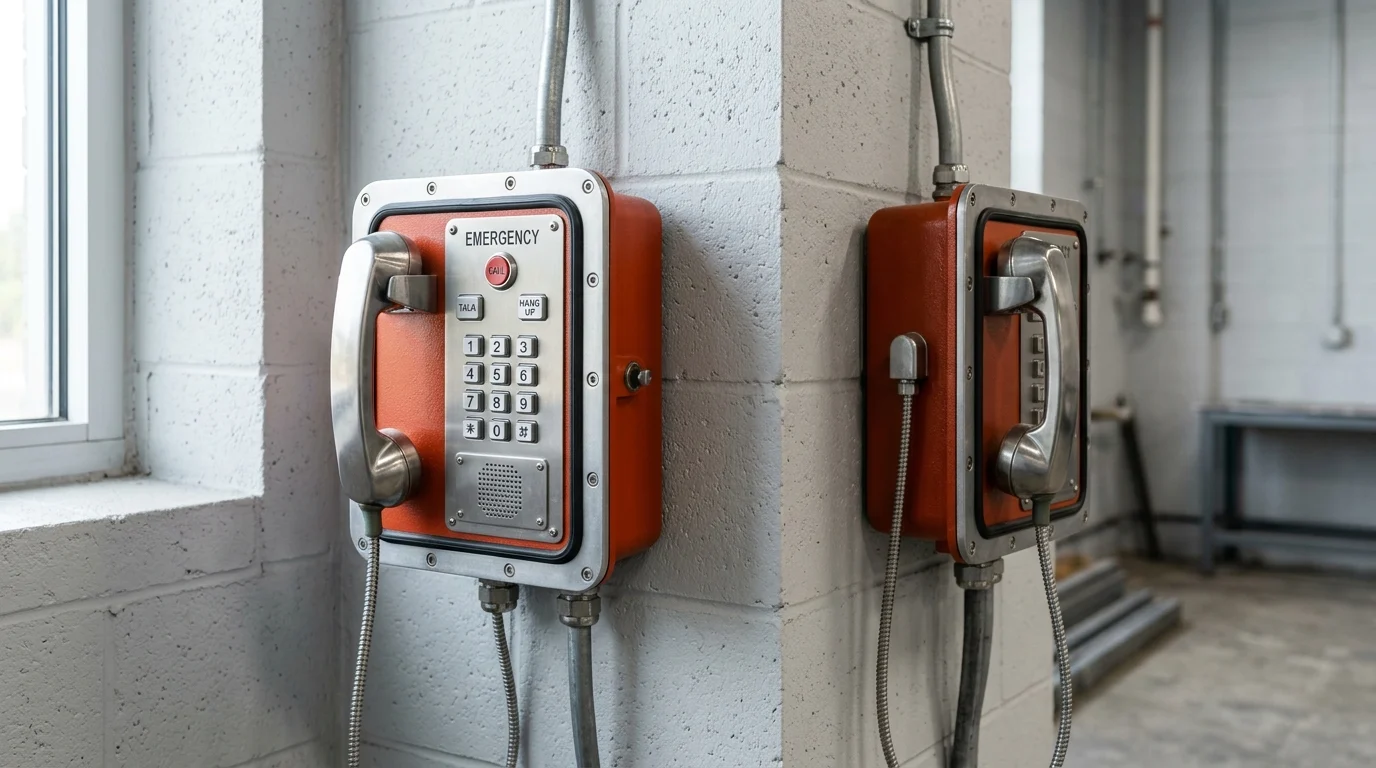
In facilities where water, dust, vibration, and corrosive exposure are routine, communication equipment has to remain reliable under conditions that would disable standard devices. Waterproof industrial telephones are built for exactly that role, supporting emergency response, daily coordination, and regulatory compliance in places such as refineries, tunnels, ports, and offshore platforms. This article outlines ten practical applications for these phones in harsh environments, showing where they deliver the most value, how they reduce downtime and safety risk, and why their design matters when uninterrupted voice communication is part of critical operations.
Why Waterproof Industrial Telephones Matter
Waterproof industrial telephones represent a critical infrastructure component in facilities where standard commercial communication equipment would immediately fail. In environments characterized by extreme moisture, dust, and temperature fluctuations, maintaining continuous voice communication is not merely a matter of convenience but a strict regulatory and safety requirement. These specialized terminals bridge the gap between human operators and central control systems, ensuring that emergency protocols can be executed without technological delay.
The engineering behind these devices focuses on isolating sensitive acoustic and electronic components from aggressive external elements. By utilizing hermetically sealed enclosures, conformal-coated printed circuit boards (PCBs), and specialized acoustic membranes, manufacturers produce endpoints capable of sustaining operational integrity in the world’s most unforgiving industrial landscapes.
How they reduce operational risk
The deployment of ruggedized communication endpoints directly correlates with a reduction in catastrophic operational risks. In sectors like offshore drilling or petrochemical refining, the cost of unplanned downtime can easily exceed $10,000 to $50,000 per hour. When an anomaly occurs, the ability to instantly communicate with the control room can prevent a minor mechanical fault from escalating into a full-scale facility shutdown.
Furthermore, these devices boast a Mean Time Between Failures (MTBF) frequently exceeding 50,000 hours, compared to the 10,000-hour average of standard commercial office phones. This reliability ensures that emergency response times remain consistently low, mitigating the risk of personnel injury and environmental damage during critical incidents.
Key performance standards and IP ratings
The baseline performance of a waterproof industrial telephone is dictated by its Ingress Protection (IP) rating. To be classified as truly industrial and waterproof, devices must meet a minimum standard of IP66, which guarantees total protection against dust ingress and resistance to heavy seas or powerful jets of water. Many top-tier models achieve an IP67 rating, allowing for temporary submersion in up to 1 meter of water for 30 minutes without functional degradation.
Beyond moisture and dust, thermal resilience is a vital performance metric. Industrial telephones are engineered to operate continuously in extreme temperature bands, typically ranging from -40°C to +70°C (-40°F to 158°F). This broad thermal tolerance, often paired with NEMA 4X certifications in North American markets, ensures that the internal electronics do not succumb to condensation, freezing, or thermal runaway.
Technical Criteria for Comparing Models
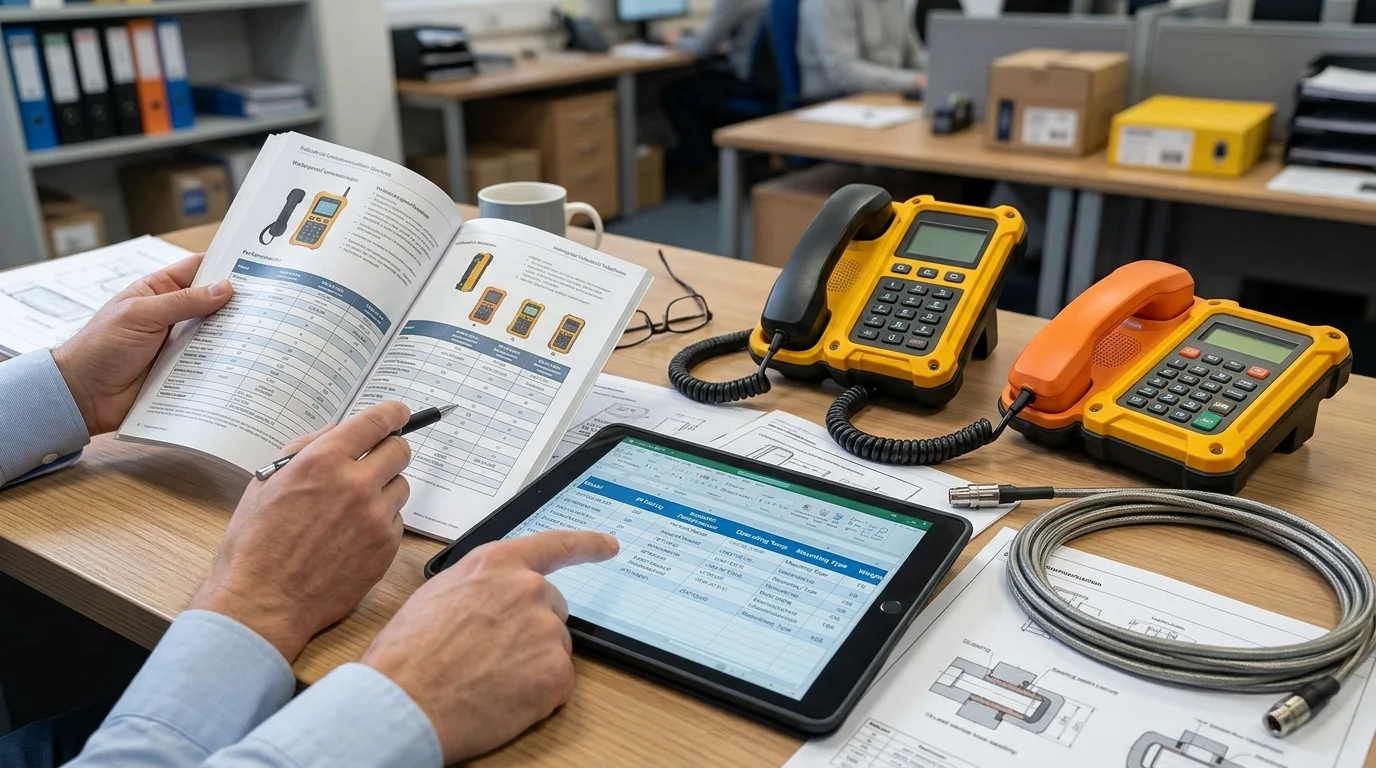
Evaluating waterproof industrial telephones requires a rigorous analysis of both their mechanical durability and their underlying communication architecture. Procurement engineers must weigh the physical resilience of the enclosure against the technical capabilities of the internal circuitry to ensure seamless integration with existing plant infrastructure.
IP ratings, corrosion resistance, and impact protection
While IP ratings govern moisture and dust resistance, impact protection is measured by the IK scale. A high-quality industrial telephone typically carries an IK09 or IK10 rating, meaning the enclosure can withstand a kinetic impact of 10 to 20 Joules—equivalent to a 5 kg mass dropped from 400 mm. This is critical in environments where dropped tools or moving machinery pose a constant threat.
Corrosion resistance is primarily dictated by material selection. Glass Reinforced Polyester (GRP) offers total immunity to chemical corrosion and is highly prevalent in acidic environments. Conversely, Stainless Steel 316L provides superior mechanical strength and is the gold standard for marine environments where salt spray accelerates oxidation. Aluminum alloy enclosures offer a middle ground, providing high impact resistance at a lower weight, provided they are treated with outdoor-grade epoxy powder coating.
Analog, VoIP, and SIP comparison
The choice of communication protocol dictates the cabling infrastructure, power requirements, and integration capabilities of the telephone network.
| Protocol | Max Distance | Power Source | Ideal Application |
|---|---|---|---|
| Analog | Up to 5 km | Line powered (48V DC) | Legacy infrastructure, long-distance remote sites |
| VoIP / SIP | 100 meters (Cat5e/6) | PoE (IEEE 802.3af/at) | Modern facilities, smart grid integration |
| Fiber Optic | Up to 20 km+ | Local AC/DC or Solar | Extreme distance, high EMI environments |
Analog systems remain highly relevant for massive facilities where cable runs exceed the 100-meter limitation of standard Ethernet, utilizing twisted-pair copper to achieve distances up to 5,000 meters. However, VoIP and SIP models are rapidly dominating new installations. By leveraging Power over Ethernet (PoE) standards like IEEE 802.3af, these devices require only a single cable for both data and power, simplifying deployment and enabling advanced features like automated health monitoring.
Installation, maintenance, and integration factors
The total cost of ownership is heavily influenced by installation and maintenance factors. Devices designed with a low Mean Time To Repair (MTTR)—often featuring modular faceplates and captive screws—allow technicians to replace internal components in under 15 minutes without removing the entire enclosure from the wall or pillar.
Integration factors also include network management capabilities. Modern SIP-based waterproof telephones support Simple Network Management Protocol (SNMP v2/v3), allowing IT departments to ping the device, monitor handset integrity, and verify microphone functionality remotely. This eliminates the need for manual, physical testing rounds across sprawling industrial complexes.
Common Applications in Harsh Environments
Waterproof industrial telephones are deployed in sectors where standard commercial endpoints would face immediate catastrophic failure. The specific environmental stressors of each industry dictate the necessary features, from acoustic enhancements to intrinsic safety certifications.
Use cases in offshore, mining, and heavy industry
In offshore oil and gas platforms, telecommunication equipment faces a relentless assault from 95% ambient humidity, corrosive salt fog, and extreme UV exposure. Here, high-visibility yellow or red enclosures made of GRP or Stainless Steel 316L are mandatory. In the mining sector, devices must survive heavy particulate matter and the potential presence of explosive methane gas, necessitating ATEX Zone 1 or Zone 2 certifications.
Heavy industry and manufacturing facilities present a different challenge: acoustic interference. In steel mills or stamping plants where ambient noise routinely exceeds 110 dB, waterproof telephones must be equipped with noise-canceling microphones and integrated amplifiers (typically 15W to 30W) capable of driving external PA horns. This ensures that incoming calls are heard and outgoing voice transmission remains intelligible despite the surrounding machinery.
Where they deliver the most value
These specialized endpoints deliver the highest return on investment in linear infrastructure projects, such as railway networks, highway tunnels, and hydroelectric dams. In a highway tunnel, standard emergency phones often succumb to a combination of vehicle exhaust particulates and high-pressure washdowns within 3 to 6 months.
By deploying IP67-rated industrial units, transit authorities can extend the hardware lifecycle to 10 or even 15 years. The value is realized not just in the reduced capital expenditure of replacement units, but in the drastic reduction of labor costs associated with closing highway lanes or railway tracks to perform maintenance.
Compliance and enclosure trade-offs
Selecting the optimal waterproof telephone often involves navigating trade-offs between regulatory compliance, physical footprint, and enclosure weight. For instance, achieving ATEX certification for hazardous areas requires intrinsically safe circuitry and heavily reinforced enclosures that prevent internal sparks from igniting external gases.
This level of protection adds significant bulk. A standard aluminum waterproof phone might weigh approximately 4 kg, making it easy to mount on standard drywall or light structural framing. In contrast, an ATEX-certified, explosion-proof equivalent cast in heavy-duty GRP or stainless steel can easily exceed 8 to 10 kg, necessitating heavy-duty mounting brackets and structural reinforcement at the installation site.
How to Select the Right Waterproof Industrial Telephone
Procuring the correct waterproof industrial telephone involves more than selecting a device with a high IP rating. Buyers must align their technical specifications with regional regulatory requirements, existing network architecture, and supply chain realities to ensure a successful and compliant deployment.
Certifications and regional compliance requirements
Industrial communication equipment must adhere to a strict matrix of regional and industry-specific certifications. In the European Union, CE marking and RoHS compliance are baseline requirements. For hazardous environments, ATEX (Europe) or IECEx (Global) certifications dictate the equipment’s suitability for explosive atmospheres. In North America, UL listings and NEMA enclosure ratings (such as NEMA 4 or 4X) serve as the standard.
For marine and offshore applications, buyers should look for type approvals from maritime classification societies such as DNV/GL or ABS. Deploying non-certified equipment in these regulated zones not only voids insurance policies but can result in severe legal penalties and facility shutdowns during safety audits.
Step-by-step selection process
The selection process should follow a systematic, step-by-step methodology to prevent costly specification errors. First, conduct an acoustic analysis of the installation site. If ambient noise exceeds 85 dB, the specification must include an external flashing beacon and a secondary ringer horn to ensure call visibility.
Second, evaluate the cabling infrastructure. Determine whether the site requires legacy 2-wire analog connections or if Cat5e/Cat6 ethernet is available for SIP deployment. Third, assess power availability. If PoE is not viable due to distance constraints, the device must support local AC (110V/220V) or DC (12V/24V/48V) power inputs, which may require separate weatherproof conduits.
How to assess suppliers and lead times
When assessing manufacturers, buyers must scrutinize production capacity, quality control, and logistical lead times. A reputable supplier should demonstrate a hardware defect rate of less than 0.5% and provide comprehensive warranty terms extending a minimum of 24 to 36 months.
Lead times vary significantly based on customization and certification requirements. Standard VoIP/SIP models with standard IP67 ratings typically carry a lead time of 2 to 4 weeks. However, intrinsically safe ATEX models or units requiring custom RAL colors and bespoke firmware configurations can push lead times to 8 to 12 weeks. Additionally, buyers should verify Minimum Order Quantities (MOQs); while standard units often have no MOQ, custom-colored enclosures may require an MOQ of 25 to 50 units.
Decision Framework and Final Recommendations
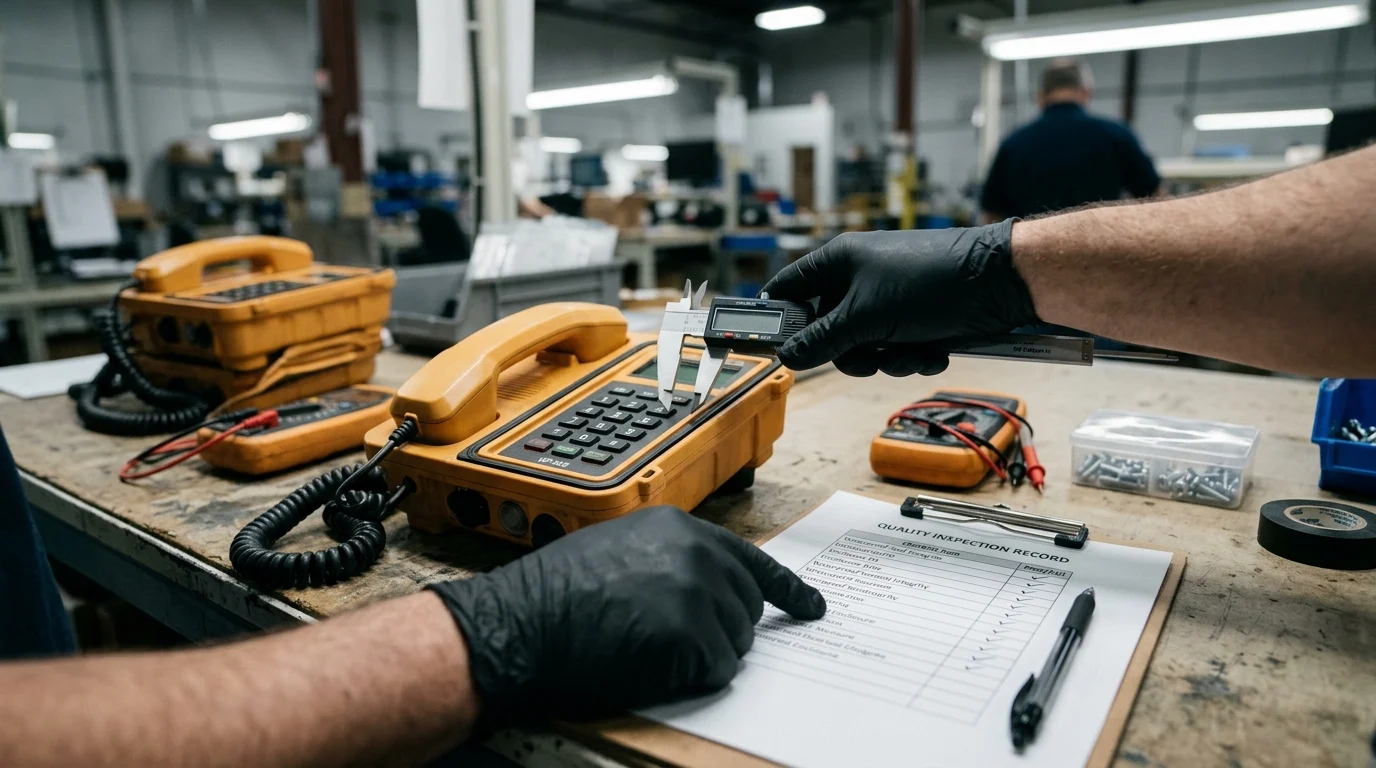
Finalizing the procurement of waterproof industrial telephones requires balancing upfront capital expenditure against long-term operational resilience. By utilizing a structured decision framework, facility managers and network engineers can ensure that the selected hardware aligns precisely with the environmental demands and communication protocols of their specific site.
Decision matrix for prioritizing requirements
To streamline the specification process, buyers can utilize the following decision matrix to align the deployment environment with the appropriate enclosure material and protection ratings.
| Deployment Environment | Recommended Enclosure | Protection Ratings | Primary Cost Driver |
|---|---|---|---|
| Marine / Offshore | Stainless Steel 316L | IP67 / IK10 | High-grade materials & anti-corrosion treatments |
| Heavy Manufacturing | Aluminum Alloy | IP66 / IK09 | Acoustic enhancements (horns, beacons) |
| Chemical / Mining | Glass Reinforced Polyester | IP67 / ATEX Zone 1 | Intrinsically safe certifications & testing |
By prioritizing requirements based on this matrix, organizations can avoid over-specifying equipment for benign environments while ensuring absolute reliability in high-risk zones. For example, investing in expensive ATEX-certified GRP units is an unnecessary capital drain for a standard automated warehouse, where an IP66 aluminum unit would suffice.
Final recommendations for buyers
For future-proofing industrial communication networks, buyers should strongly prioritize open-standard SIP protocols over proprietary IP systems. Standardizing on SIP ensures interoperability with modern PBX systems like Cisco, Avaya, or Asterisk, effectively eliminating vendor lock-in and reducing long-term software licensing fees.
Furthermore, for any deployment scaling beyond 20 units, it is highly recommended to specify models equipped with robust self-diagnostic capabilities and SNMP support. The upfront premium paid for these smart diagnostics is rapidly offset by the elimination of manual maintenance patrols, driving down the total cost of ownership while maximizing facility safety.
Key Takeaways
- The most important conclusions and rationale for Waterproof Industrial Telephones
- Specs, compliance, and risk checks worth validating before you commit
- Practical next steps and caveats readers can apply immediately
Frequently Asked Questions
Where are waterproof industrial telephones most commonly used?
They are widely used in mining, oil and gas, marine docks, tunnels, construction sites, rail platforms, and outdoor emergency points where water, dust, and impact can disable standard phones.
What IP rating should I choose for a waterproof industrial telephone?
Choose at least IP66 for heavy dust and water jets. If temporary immersion is possible, select IP67 for added protection in washdown or flood-prone areas.
Should I use analog or VoIP waterproof industrial telephones?
Use analog for long cable runs and legacy systems, often up to 5 km. Choose VoIP/SIP for modern networks, PoE power, and easier integration with IP PBX and control platforms.
How do Siniwo waterproof industrial telephones handle harsh environments?
Siniwo designs rugged phones for harsh and hazardous sites, with weatherproof and explosion-proof options, durable enclosures, and support for design, integration, installation, and maintenance.
What certifications matter when buying a waterproof industrial telephone?
Look for ATEX if the site has explosive gas or dust risks, plus CE, FCC, ROHS, and ISO9001 for compliance and quality assurance. Also verify the required IP and impact ratings.
Post time: Apr-23-2026