
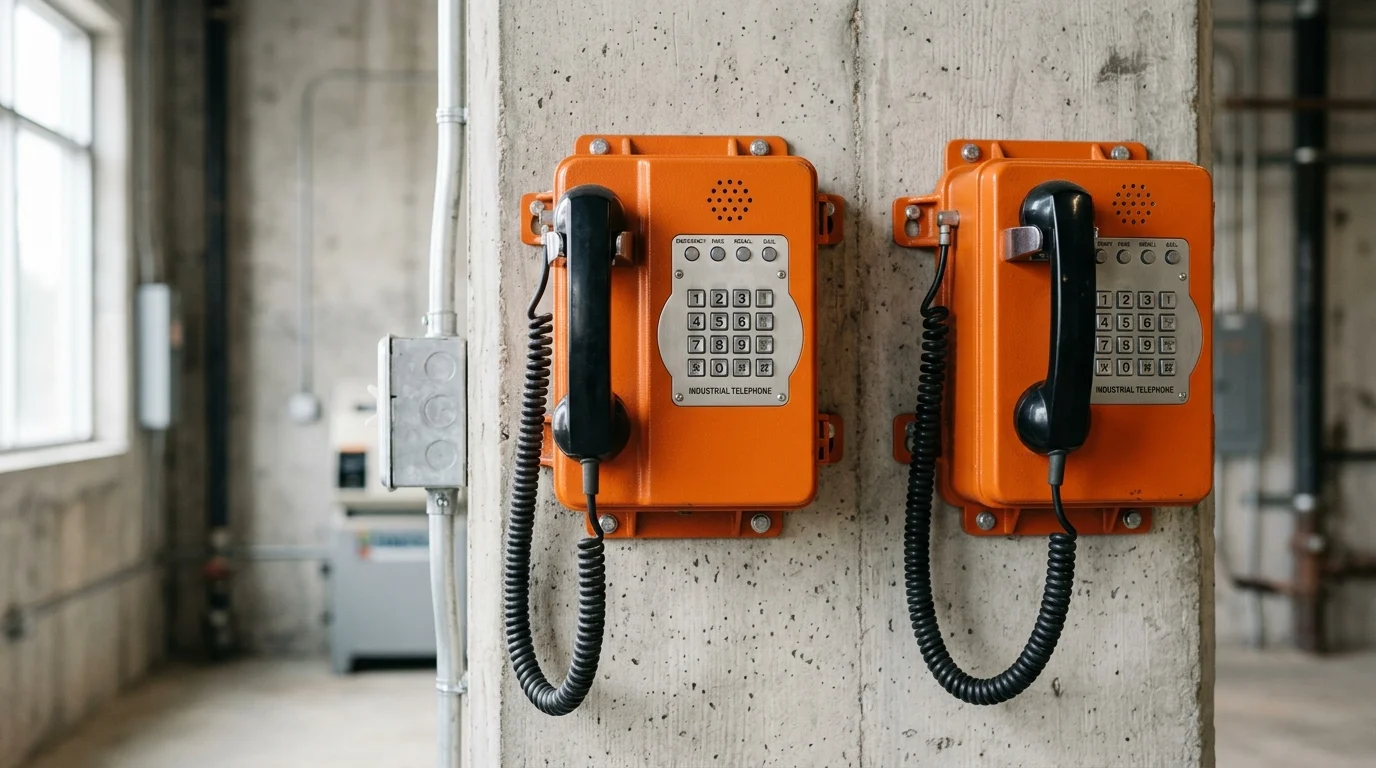
Introduction
Selecting industrial telephones for hazardous areas means balancing communication performance with strict safety compliance. In environments where flammable gases, vapors, or combustible dust may be present, the wrong device can introduce serious operational and ignition risks. This article explains the key factors that should guide purchasing decisions, including hazardous-area classifications, explosion-proof and intrinsically safe protection methods, durability in harsh conditions, network and power reliability, and emergency-use requirements. By the end, readers will have a practical framework for comparing industrial telephones and matching each option to the site’s safety standards, environmental demands, and communication needs.
Why hazardous-area industrial telephones require stricter selection
Procuring industrial telephones for hazardous areas demands rigorous technical scrutiny extending far beyond standard telecommunications purchasing. In facilities processing volatile hydrocarbons, combustible dusts, or reactive chemicals, electronic communication devices represent potential ignition sources. The selection process must therefore reconcile strict explosion-proof or intrinsically safe methodologies with the need for uninterrupted, clear communication in high-decibel, structurally complex environments.
Operational risk, downtime, and emergency communication needs
Operational risk in hazardous environments dictates that communication infrastructure serves as a critical lifeline rather than a mere operational convenience. When an abnormal event occurs, the ability to coordinate an emergency shutdown or evacuation can prevent catastrophic asset loss and fatalities. Downtime in these sectors is exceptionally costly; for instance, unexpected production halts on an offshore drilling platform or petrochemical refinery can incur financial losses exceeding $500,000 per day.
Industrial telephones must function flawlessly during these critical windows. This requires redundant network topologies and fail-safe power mechanisms to ensure the communication link remains active even during localized power failures. The speed and clarity of emergency response operations are directly proportional to the reliability of the site’s telecommunication hardware.
Hazardous area classifications and protection concepts
Navigating hazardous area classifications is the foundational step in equipment selection. Global regulatory frameworks classify these environments based on the frequency and duration of explosive atmosphere occurrences. The ATEX directive and IECEx system utilize a Zone-based approach, whereas the North American National Electrical Code (NEC) relies on a Class and Division system. Specifying a telephone requires aligning the device’s protection concept—such as intrinsically safe (Ex i), flameproof (Ex d), or increased safety (Ex e)—with specific zone requirements.
A device rated for Zone 1 must withstand environments where explosive gas mixtures are likely to occur during normal operation, whereas a Zone 2 device is designed for areas where such mixtures are unlikely and persist for fewer than 10 hours per year. Selecting a telephone with an incorrect protection concept invalidates facility safety protocols and risks catastrophic ignition.
| IECEx / ATEX | NEC / CEC (North America) | Atmosphere Presence | Typical Protection Concept |
|---|---|---|---|
| Zone 0 / 20 | Class I/II, Div 1 | Continuous / Long periods | Ex ia (Intrinsic Safety) |
| Zone 1 / 21 | Class I/II, Div 1 | Likely in normal operation | Ex d (Flameproof), Ex ib |
| Zone 2 / 22 | Class I/II, Div 2 | Unlikely / Short periods | Ex nA (Non-sparking), Ex ic |
Technical and compliance criteria for hazardous-area industrial telephon
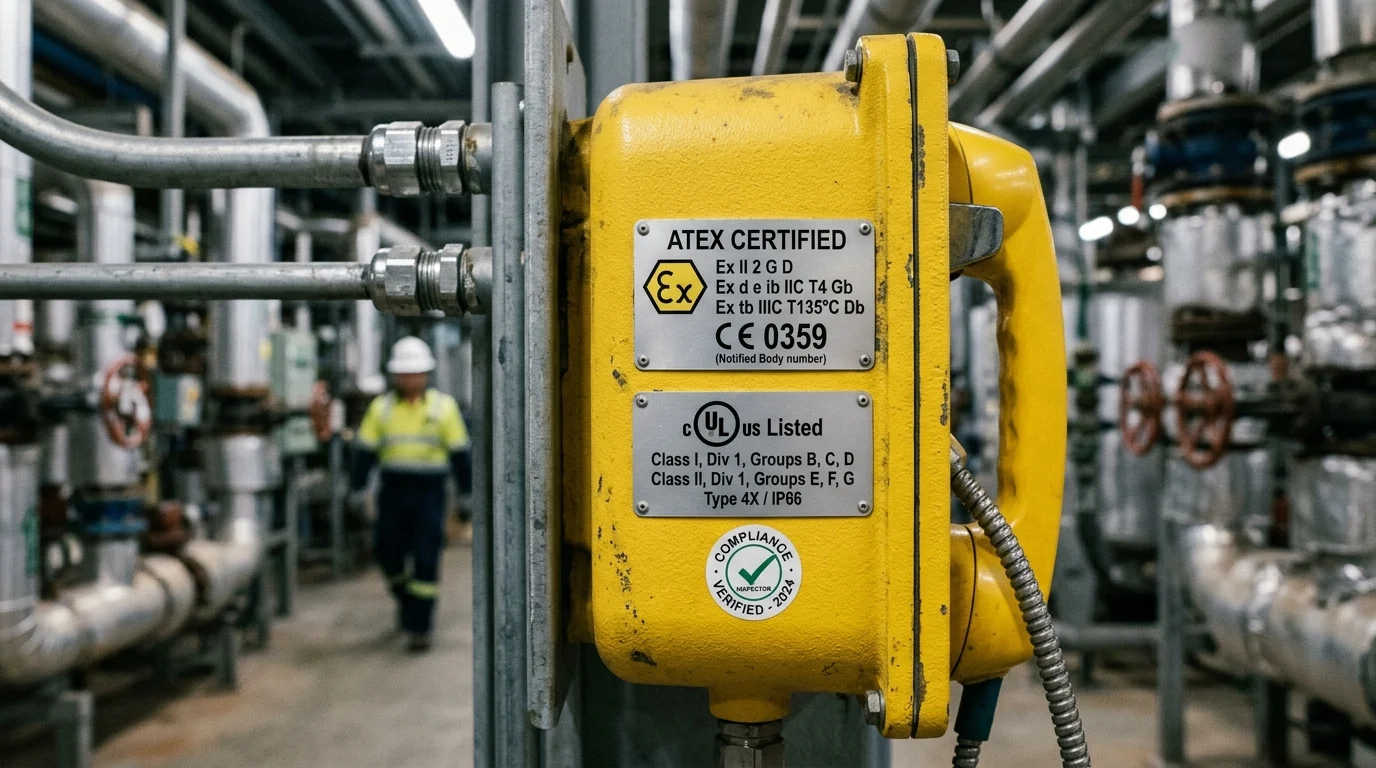
Beyond baseline explosion protection, industrial telephones must meet exacting technical specifications to survive corrosive, high-impact, and extreme-temperature environments while delivering enterprise-grade telecommunications functionality to the facility’s edge.
Certifications, ingress protection, and environmental ratings
While certifications validate protection concepts, environmental ratings determine the hardware’s operational lifespan. Hazardous-area industrial telephones typically require an ingress protection rating of at least IP66 or IP67 to prevent dust penetration and withstand high-pressure water jets during routine facility washdowns.
Temperature resilience is equally critical. Devices deployed in Arctic oil fields or Middle Eastern refineries must maintain certification and functionality across an ambient temperature range extending from -40°C to +70°C. Furthermore, humidity tolerances must accommodate up to 95% non-condensing environments to prevent internal short circuits that could compromise intrinsic safety barriers.
Communication, power, and system integration requirements
Communication architecture heavily influences the selection of industrial telephones. Modern facilities increasingly favor Voice over Internet Protocol (VoIP) using Session Initiation Protocol (SIP) over legacy analog lines. VoIP integration allows for advanced diagnostics, centralized management, and seamless Private Branch Exchange (PBX) integration.
However, power delivery in hazardous areas complicates VoIP deployments. Standard Power over Ethernet (PoE) under IEEE 802.3af delivers up to 15.4W, which must be carefully managed or isolated using certified barriers to ensure energy levels remain below the ignition threshold of the surrounding atmosphere. For analog systems, intrinsically safe telephone lines require specialized Zener barriers to limit voltage and current to safe parameters.
Mechanical durability, audio performance, and usability
Mechanical durability and audio performance directly impact usability in harsh industrial environments. Enclosures are typically manufactured from Glass-Reinforced Polyester (GRP), cast aluminum, or 316L stainless steel, each offering distinct resistance to mechanical impact and chemical corrosion.
Audio performance is paramount; ambient noise in a compressor room or stamping plant frequently exceeds 85 dB(A). To compensate, industrial telephones must feature ringing volumes of at least 90 to 95 dB(A) at a 1-meter distance. This should be coupled with noise-canceling microphones capable of achieving a 15 to 20 dB Signal-to-Noise Ratio (SNR) improvement to transmit clear voice data over background machinery.
| Enclosure Material | Impact Resistance | Chemical Resistance | Relative Cost | Weight |
|---|---|---|---|---|
| Glass-Reinforced Polyester (GRP) | High (IK09) | Excellent | Medium | Light |
| Cast Aluminum Alloy | High (IK10) | Moderate (Requires coating) | Low | Medium |
| 316L Stainless Steel | Very High (IK10+) | Exceptional | High | Heavy |
How to evaluate suppliers and lifecycle costs
Evaluating suppliers for hazardous-area industrial telephones requires a shift from initial capital expenditure (CapEx) calculations to comprehensive Total Cost of Ownership (TCO) models, factoring in long-term reliability, vendor support, and parts availability.
Comparing certified products across suppliers
When comparing certified products across suppliers, procurement teams must rigorously verify the authenticity and scope of the certifications. A Notified Body certificate must cover the exact model and configuration being purchased, not just the raw enclosure material.
Beyond compliance, evaluating manufacturing quality is essential. Top-tier suppliers demonstrate stringent quality control, targeting a hardware defect rate of less than 0.5% for mission-critical communication devices. Buyers should also review the supplier’s track record in similar industrial sectors, seeking reference architectures that validate the equipment’s performance in comparable operational profiles.
Spare parts, serviceability, lead times, and total cost
The lifecycle cost of an industrial telephone extends far beyond its initial purchase price, which typically ranges from $800 to $2,500 depending on the certification level, material, and embedded technology. Maintenance, spare parts availability, and serviceability drive the long-term TCO over an expected 10-to-15-year operational lifespan.
Buyers must assess the supplier’s lead times for both complete units and replacement components. Due to the specialized manufacturing and individual pressure testing required for flameproof (Ex d) enclosures, standard production lead times can stretch from 6 to 12 weeks. Additionally, evaluating the Mean Time Between Failures (MTBF) is critical; high-quality industrial telephones should offer an MTBF exceeding 50,000 hours to minimize maintenance interventions in hazardous zones, which demand costly work permits and specialized labor.
Practical process for choosing the right industrial telephone
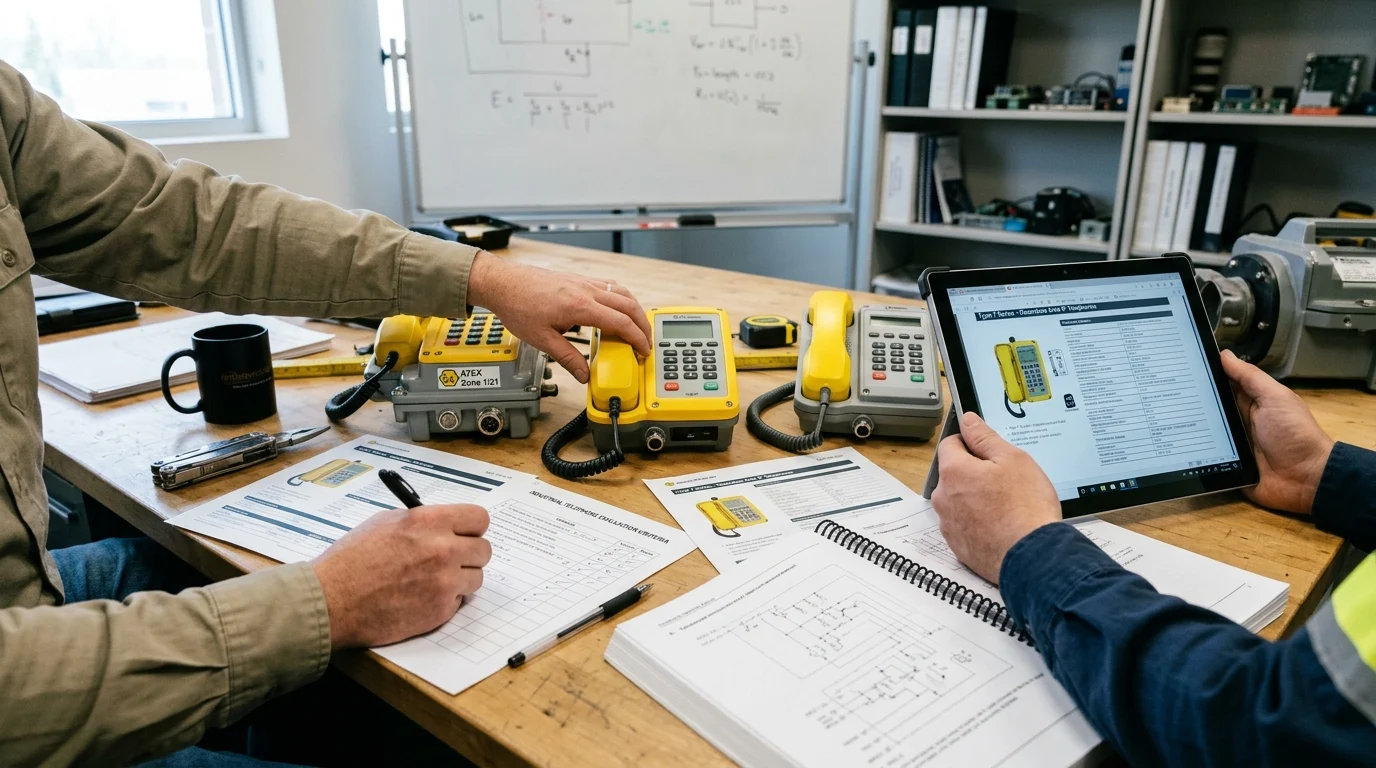
Executing a successful procurement strategy for hazardous-area industrial telephones requires a structured, cross-functional approach that balances safety compliance with operational usability and fiscal responsibility.
Aligning engineering, EHS, operations, and procurement
The selection process must integrate the distinct priorities of multiple departments. Environmental, Health, and Safety (EHS) teams must validate that the device’s ATEX or IECEx certifications precisely match the facility’s localized risk assessments and hazardous area drawings.
Engineering and IT departments must ensure network compatibility, allocating sufficient bandwidth—typically around 80 to 100 kbps per active VoIP call—and verifying PBX interoperability. Operations teams represent the end-users and must confirm that the physical design, such as oversized keypads or magnetic hook switches, accommodates personnel wearing heavy personal protective equipment (PPE). Procurement acts as the orchestrator, ensuring these technical demands are met within targeted budgetary constraints.
Step-by-step validation and selection process
A systematic validation process mitigates deployment risks. The first step involves a comprehensive site audit to map exact hazardous zone boundaries and measure baseline ambient noise levels, which dictate the required acoustic specifications.
Next, engineers must evaluate the existing infrastructure to determine whether the facility can support modern PoE networks or if legacy copper lines with intrinsic safety barriers must be utilized. Finally, conducting a pilot test with a small batch of telephones in a representative operational area allows teams to validate audio clarity, network stability, and mechanical resilience before committing to a facility-wide rollout.
Common buying mistakes and final decision framework
A frequent purchasing error is over-specifying equipment, such as deploying a Zone 1 certified telephone in a Zone 2 area. While ensuring safety, this can unnecessarily inflate unit costs by 30% to 50% and needlessly complicate maintenance procedures due to heavier, bolted enclosures.
Conversely, under-specifying environmental protections—like selecting an IP54 rating for an outdoor coastal installation—guarantees premature hardware failure from saline corrosion and moisture ingress. The final decision framework must therefore rest on a precise alignment of the telephone’s certification, environmental durability, and acoustic performance with the specific micro-environment of its intended installation location. By adhering to this rigorous methodology, industrial operators secure a resilient communication infrastructure that safeguards personnel and ensures continuous operational oversight.
Key Takeaways
- The most important conclusions and rationale for industrial telephones
- Specs, compliance, and risk checks worth validating before you commit
- Practical next steps and caveats readers can apply immediately
Frequently Asked Questions
What certification should an industrial telephone have for hazardous areas?
Match the phone to your site classification first. For many global projects, look for ATEX or IECEx certification, then verify the exact Zone and protection concept such as Ex d or Ex i on the nameplate.
Is IP66 enough for hazardous-area industrial telephones?
IP66 is often the minimum practical choice for dust and washdown protection. If the phone faces heavy rain, offshore spray, or frequent cleaning, IP67 can provide extra sealing margin.
Should I choose VoIP or analog for a hazardous area?
Choose SIP/VoIP if you need PBX integration, remote diagnostics, and centralized management. Choose analog when the existing system is legacy-based or when simple point-to-point reliability is the priority.
Which audio features matter most in noisy industrial environments?
Prioritize high-volume ringers, noise-canceling handsets or microphones, and clear full-duplex audio. For mines, refineries, and transport sites, also check hearing-aid compatibility and glove-friendly buttons.
Why source hazardous-area industrial telephones from Siniwo?
Siniwo focuses on industrial communication for harsh environments, offers explosion-proof and weatherproof phones, and supports design, integration, installation, and maintenance with in-house manufacturing and certified products.
Post time: May-18-2026