
Introduction
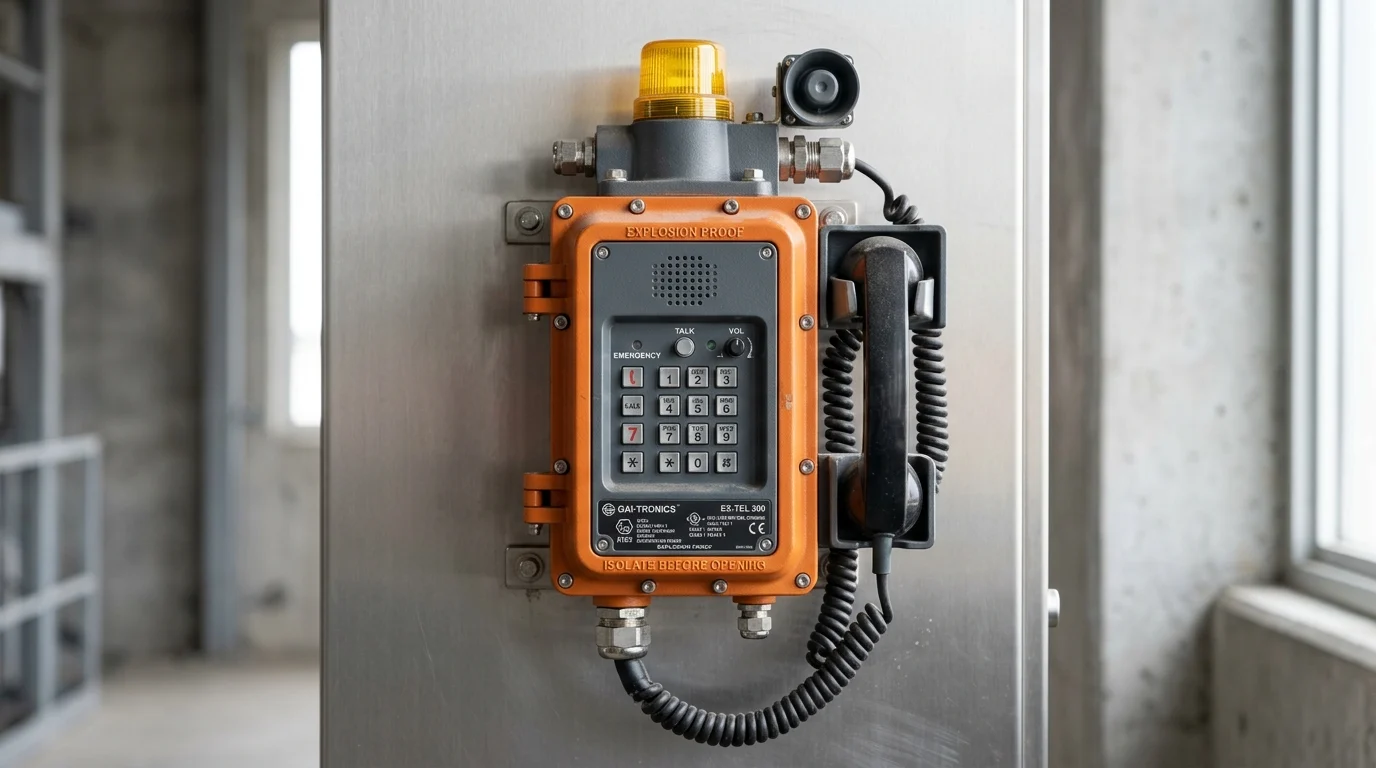
Selecting communication equipment for hazardous locations involves more than matching features and price. In industrial projects, an explosion proof telephone must satisfy area classification rules, withstand harsh operating conditions, and remain reliable during emergencies when communication is most critical. This guide explains the key standards, technical specifications, and environmental factors that should shape a purchasing decision. Readers will learn how to compare certification requirements, enclosure durability, audio performance, power and installation needs, and lifecycle maintenance considerations, making it easier to choose equipment that supports compliance, operational continuity, and personnel safety.
Why an Explosion Proof Telephone Buying Guide Matters
Procuring communication equipment for hazardous industrial environments requires navigating a complex matrix of safety standards, technical specifications, and operational demands. An explosion proof telephone is not merely a communication device; it is a critical life-safety asset engineered to prevent the ignition of volatile gases, vapors, or combustible dusts. Selecting the wrong equipment can result in catastrophic failures, regulatory fines, and severe personnel risks.
This guide provides engineering, procurement, and operations professionals with a structured approach to evaluating, selecting, and deploying explosion proof telephones. By understanding the rigorous requirements of hazardous area classifications, organizations can optimize their capital expenditures while ensuring uninterrupted communication during critical operational windows.
How hazardous-area communication failures increase project risk
In high-risk sectors such as petrochemical refining, offshore drilling, and underground mining, communication infrastructure forms the backbone of emergency response. When a standard industrial telephone fails in a volatile atmosphere, it can act as an ignition source. Beyond the immediate explosion risk, the secondary consequence of communication failure is delayed emergency response. In critical scenarios, a delay beyond the standard 3-minute emergency response window can escalate localized incidents into facility-wide disasters.
Furthermore, communication downtime carries severe financial implications. In the oil and gas sector, unplanned downtime can exceed $250,000 per hour. If an operations center cannot communicate with field technicians in a Zone 1 area due to telephone malfunction, production must often be halted until the communication link is re-established. Investing in certified explosion proof equipment mitigates these costly operational interruptions while maintaining strict compliance with occupational safety regulations.
Which industrial environments require explosion proof telephones
The necessity for an explosion proof telephone is dictated by the presence and frequency of explosive atmospheres, categorized globally by Zone or Division systems. Facilities handling volatile hydrocarbons, such as LNG terminals, chemical processing plants, and aviation fuel depots, inherently require certified communication nodes at strategic intervals.
Different environments dictate different levels of equipment protection. For instance, a grain handling facility dealing with combustible dust requires ATEX Zone 21 or 22 certification, whereas an offshore oil rig requires Zone 1 or Zone 2 gas certifications. Understanding the specific classification of the installation site is the mandatory first step in the procurement process.
| Area Classification (IEC/ATEX) | North American Standard (NEC) | Hazard Frequency | Required Equipment Protection Level (EPL) |
|---|---|---|---|
| Zone 0 | Class I, Div 1 | Continuous / Long periods | Ga (Intrinsically Safe only) |
| Zone 1 | Class I, Div 1 | Occasional in normal operation | Gb (Flameproof Ex d, Increased Safety Ex e) |
| Zone 2 | Class I, Div 2 | Unlikely / Short periods | Gc (Non-sparking, Restricted Breathing) |
Technical and Compliance Requirements
Evaluating an explosion proof telephone requires a granular understanding of its technical specifications and regulatory compliance. Industrial buyers must look beyond basic functionality to assess how the device’s engineering aligns with the specific hazards of the deployment site.
Which hazardous-area ratings and certifications matter
The foundation of any hazardous area equipment is its certification. Globally recognized frameworks include ATEX (Europe), IECEx (International), and UL/CSA (North America). A telephone deployed in a hazardous area must bear the appropriate markings, such as ‘Ex d’ for flameproof enclosures, which are designed to contain an internal explosion without igniting the external atmosphere. Alternatively, ‘Ex i’ denotes intrinsic safety, where the electrical energy is restricted below the ignition threshold of the specific gas mixture.
Buyers must verify the gas group (e.g., IIA, IIB, or IIC for highly volatile gases like hydrogen) and the temperature class (T1 through T6). For example, a T6 rating guarantees that the equipment’s maximum surface temperature will not exceed 85°C (185°F), making it safe for environments with low auto-ignition temperature chemicals like carbon disulfide.
How to compare enclosure, ingress protection, and durability
Industrial environments expose equipment to extreme weather, corrosive chemicals, and physical impact. Consequently, the enclosure material and ingress protection (IP) ratings are critical comparative metrics. Most premium explosion proof telephones offer an IP66 or IP67 rating, ensuring total protection against dust ingress and resistance to high-pressure water jets or temporary submersion.
Material selection dictates long-term durability. Glass Reinforced Polyester (GRP) offers excellent chemical and UV resistance, making it ideal for onshore chemical plants. Marine-grade aluminum alloy is common for general industrial use, while 316L stainless steel is the gold standard for offshore platforms due to its unmatched resistance to salt-spray corrosion. Additionally, buyers should mandate an IK10 impact resistance rating, guaranteeing the enclosure can withstand a 20-joule impact without compromising its explosion proof integrity.
What audio, signaling, and power features are essential
In facilities where ambient noise routinely exceeds 80 dB to 90 dB, standard audio capabilities are insufficient. An explosion proof telephone must feature advanced noise-canceling microphones and integrated amplifiers. Integrated external ringers or beacons are often necessary, requiring sound output levels between 90 dB and 110 dB to be audible over heavy machinery.
Power architecture is equally important. Modern VoIP/SIP models often utilize Power over Ethernet (PoE) adhering to IEEE 802.3af (15.4W) or 802.3at (30W) standards, which simplifies installation by combining power and data in a single cable. Analog systems typically rely on line power from the PBX (ranging from 24VDC to 48VDC) or require local AC mains power (110-230VAC) to drive high-decibel external sounders and visual beacons.
How to Compare Explosion Proof Telephone Options
Once technical requirements are established, procurement teams must navigate the vendor landscape. Comparing options involves analyzing both vendor reliability and the underlying communication technology to ensure seamless integration with existing site infrastructure.
Which criteria to use in a vendor comparison
When auditing potential suppliers, industrial buyers should prioritize proven reliability metrics and supply chain stability. A key indicator of quality is the Mean Time Between Failures (MTBF). Industrial-grade explosion proof telephones should demonstrate an MTBF exceeding 50,000 hours under continuous operation. Warranty terms also serve as a proxy for quality; reputable manufacturers typically offer 2 to 3 years of comprehensive warranty coverage.
Logistical criteria are equally vital. Specialized hazardous area equipment often carries extended production timelines. Buyers should expect standard lead times of 4 to 8 weeks, though custom configurations involving specialized relays or fiber-optic terminations can extend to 12 weeks. Additionally, Minimum Order Quantities (MOQs) should be evaluated; while massive projects easily meet high MOQs, maintenance or pilot deployments may require vendors willing to supply 1 to 5 units without exorbitant surcharges.
What trade-offs exist between analog, VoIP, and SIP models
The choice between analog, VoIP, and SIP architectures fundamentally impacts installation complexity and system capabilities. Analog telephones are highly reliable, utilize legacy 2-wire copper infrastructure, and can transmit signals over vast distances exceeding 5,000 meters without amplification. However, they lack advanced diagnostics and require separate power lines for heavy-duty signaling accessories.
Conversely, VoIP and SIP telephones integrate directly into modern IP-PBX networks, offering remote management, SNMP monitoring, and self-diagnostic fault reporting. The primary trade-off is distance constraint; standard Ethernet limits transmission to 100 meters, necessitating fiber-optic media converters or intrinsically safe network switches for widespread field deployments.
| Feature Specification | Analog Explosion Proof Telephone | VoIP / SIP Explosion Proof Telephone |
|---|---|---|
| Cabling Infrastructure | Standard 2-wire copper | Cat5e / Cat6 / Fiber Optic |
| Maximum Transmission Distance | > 5,000 meters | 100 meters (copper without active switch) |
| Power Delivery | PBX Line powered / 24VDC local | PoE (IEEE 802.3af/at) or 110-230VAC local |
| Remote Diagnostics | Limited (line voltage check only) | Advanced (SNMP, web-interface monitoring) |
| Typical Hardware Cost Band | $800 – $1,500 per unit | $1,200 – $2,800+ per unit |
Procurement, Installation, and Maintenance Steps
Acquiring the hardware is only a fraction of the deployment lifecycle. Rigorous supplier qualification, stringent testing protocols, and meticulous installation procedures are required to maintain the explosion proof integrity of the final system.
How to qualify suppliers and review documentation
Qualifying a supplier for hazardous area equipment extends beyond standard ISO 9001 certification. Vendors must possess an ATEX Quality Assurance Notification (QAN) or an IECEx Quality Assessment Report (QAR). These certifications mandate that the manufacturer maintains strict traceability of all critical components, ensuring that the unit delivered matches the exact prototype tested by the notified body.
Procurement teams must demand a comprehensive documentation package prior to shipment. This dossier must include the Declaration of Conformity (DoC), hazardous area certificates, user manuals, and specific conditions of use (often denoted by an ‘X’ at the end of the certificate number). Missing documentation can result in immediate failure during a site safety audit.
What to check during factory acceptance testing
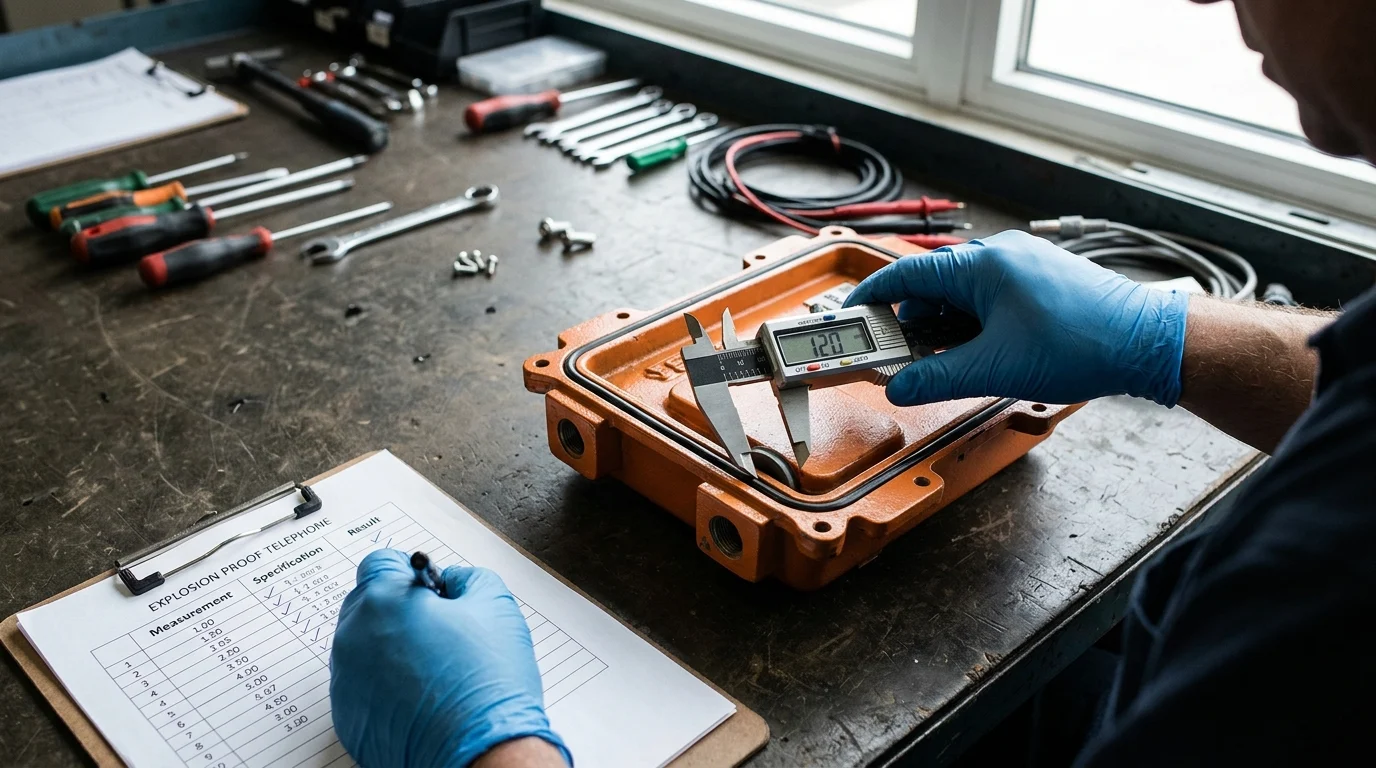
Factory Acceptance Testing (FAT) is a critical gateway before equipment leaves the manufacturer. Buyers should request FAT protocols that verify both communication clarity and safety thresholds. Acoustic testing must confirm that microphone noise cancellation functions effectively against simulated background noise of at least 85 dB.
Electrical safety tests are paramount. For mains-powered units, dielectric strength testing (often applying 1.5kV AC for 1 minute) ensures insulation integrity. Reputable manufacturers maintain a defect rate of less than 0.5% during FAT. Any unit failing these thresholds must be quarantined and reworked before dispatch.
How to plan site survey, installation, and commissioning
Preparation for installation begins with a detailed site survey to identify cable routing, ambient noise profiles, and structural mounting points. Installers must pay strict attention to cable entries; explosion proof telephones typically feature M20 or 1/2-inch NPT threaded entries. Utilizing certified Ex d or Ex e cable glands is mandatory, as a standard gland will void the entire enclosure’s safety rating.
Ergonomics and accessibility dictate that telephones should be mounted at a height of 1.2m to 1.5m (47 to 59 inches) from the finished floor level (FFL), compliant with ADA or local accessibility standards where applicable. Post-installation, a strict maintenance schedule must be established, featuring visual inspections every 6 to 12 months to check for seal degradation, corrosion on the flamepaths, and the integrity of the armored cabling.
How to Make the Final Purchase Decision
The final procurement decision requires balancing technical necessities with financial realities. By aligning the specific application scenario with a structured decision framework, organizations can select equipment that provides maximum safety and operational efficiency.
Which application scenarios help narrow the choice
Defining the exact application scenario drastically narrows the field of viable products. For example, an offshore drilling rig exposed to saline environments and extreme weather necessitates a 316L stainless steel, IP67-rated SIP telephone with an integrated 110 dB beacon. This configuration typically falls into the higher cost band of $1,800 to $2,800+ per unit.
In contrast, an indoor pharmaceutical or chemical processing facility operating in a Zone 1 area may only require a GRP-housed, IP66-rated analog telephone. Without the need for extreme weatherproofing or complex IP networking, this scenario allows for a more economical procurement strategy, with reliable units available in the $800 to $1,500 range. Identifying these scenario-specific thresholds prevents over-engineering and wasteful capital expenditure.
What decision framework aligns engineering, procurement, and ope
rations
A successful purchase decision relies on a Total Cost of Ownership (TCO) framework evaluated over a standard 10-year industrial lifecycle. Engineering teams prioritize compliance, MTBF, and system integration. Procurement focuses on the initial Capital Expenditure (CAPEX), lead times, and vendor terms. Operations and maintenance teams are concerned with Operating Expenditure (OPEX), focusing on ease of repair, availability of spare parts, and diagnostic capabilities.
By utilizing SIP/VoIP models, organizations may face a 20% to 40% higher initial CAPEX compared to analog systems. However, the OPEX drastically decreases due to remote monitoring capabilities, which eliminate the need for physical field inspections simply to verify device status. Ultimately, aligning these three departmental priorities ensures the selected explosion proof telephone delivers robust safety compliance, financial efficiency, and seamless day-to-day operational support.
Key Takeaways
- The most important conclusions and rationale for Explosion Proof Telephone
- Specs, compliance, and risk checks worth validating before you commit
- Practical next steps and caveats readers can apply immediately
Frequently Asked Questions
What certification should an explosion proof telephone have for my site?
Match the phone to your hazardous area: ATEX/IECEx for many global projects, plus the correct Zone, gas group, and temperature class such as Zone 1, IIC, T6.
Is an IP66 or IP67 rating enough for hazardous industrial projects?
It helps, but it is not enough alone. Use IP66/IP67 for dust and water protection, then confirm the telephone also has the required explosion-proof certification for the area.
Which industries typically need explosion proof telephones?
They are commonly used in oil and gas, chemical plants, offshore platforms, mining, fuel depots, and dust-risk facilities such as grain processing sites.
How can I verify product quality and delivery reliability from Siniwo?
Check certifications like ATEX, CE, FCC, ROHS, and ISO9001, and ask about lead times. Siniwo also states it manufactures over 90% of core components in-house for stable quality.
Can Siniwo support the full project, not just supply the telephone?
Yes. According to siniwo.com, Siniwo provides one-stop industrial communication services including design, integration, installation, maintenance, and related systems such as PA, paging, and VoIP.
Post time: May-20-2026