
Introduction
Buying communication equipment for hazardous areas is less about picking a rugged phone and more about matching a device to the exact ignition risks, certifications, and operating demands of the site. Many purchasing mistakes happen before vendors are even compared, when hazard classifications are vague, required standards are misunderstood, or practical needs such as noise levels, power supply, and maintenance access are overlooked. This article outlines the most common errors organizations make when selecting explosion proof telephones, explains why those errors create safety, compliance, or cost problems, and gives readers a clearer basis for evaluating specifications before moving into detailed procurement decisions.
Why Explosion Proof Telephones Get Misbought
Procuring explosion-proof communication equipment is a high-stakes endeavor where engineering precision, regulatory compliance, and budget constraints collide. When organizations misbuy explosion-proof telephones, the consequences extend beyond operational inconvenience; they introduce severe ignition risks into volatile environments or result in massive, unnecessary capital expenditures. Despite the critical nature of these devices in oil refineries, chemical plants, and offshore platforms, procurement teams frequently make critical errors during the specification and sourcing phases.
The root of most misaligned purchases lies in a disconnect between the engineering realities of a hazardous environment and the commercial assumptions driving the procurement cycle. By isolating exactly where the purchasing process fails, technical buyers and facility managers can eliminate structural vulnerabilities in their communication networks.
How weak hazard assessments lead to wrong purchases
A fundamental error in purchasing explosion-proof telephones is relying on outdated, overly broad, or poorly documented hazardous area classifications. Procurement teams often receive vague directives to purchase “intrinsically safe” or “explosion-proof” hardware without specifying the exact Zone or Division. For example, defaulting to Zone 1 (ATEX) or Class I, Division 1 (NEC) certified telephones for a facility that only requires Zone 2 or Division 2 compliance is a costly mistake. This over-specification typically inflates capital expenditures by 40% to 60% per unit, as Zone 1 devices require significantly more robust cast enclosures and complex flame paths.
Conversely, under-specifying equipment due to a weak hazard assessment creates catastrophic risks. If a facility processes hydrogen but the assessment fails to identify the need for Gas Group IIC certification, buyers might inadvertently purchase Group IIA or IIB telephones. In the event of a fault, these inadequately rated devices lack the tight gap tolerances required to cool a hydrogen-based internal ignition, turning the telephone itself into a primary ignition source.
Why lifecycle cost assumptions distort decisions
Beyond the initial capital expenditure (CapEx), flawed lifecycle cost assumptions routinely distort procurement decisions. Buyers frequently evaluate competing explosion-proof telephones based solely on the upfront unit price, ignoring the long-term operational expenditure (OpEx) required to maintain compliance in harsh industrial environments. A telephone acquired for a seemingly competitive $800 can easily generate over $2,500 in maintenance costs over a five-year lifecycle if it requires proprietary spare parts or specialized, labor-intensive servicing.
Furthermore, buyers often fail to account for the Mean Time Between Failures (MTBF) and the cost of production downtime. In an offshore drilling environment, the failure of a critical safety communication node due to premature corrosion or moisture ingress not only halts localized operations but incurs exorbitant logistical costs to dispatch certified technicians. Factoring in a minimum 50,000-hour MTBF requirement and assessing the availability of standardized, easily replaceable components are non-negotiable steps for accurate lifecycle cost modeling.
Technical Specification Mistakes That Matter Most
Technical specifications dictate both the safety and the operational efficacy of industrial communication devices. When buyers misunderstand or overlook granular technical requirements, they risk deploying equipment that fails to withstand environmental realities or facilitate clear communication during an emergency. Precision in specification is the only safeguard against these operational failures.
How to match telephones to the actual hazardous area
Hazardous areas demand exact matching between the environmental threat and the telephone’s certification parameters. Beyond the basic Zone or Division, buyers must rigorously assess the Temperature Class (T-Class). A frequent mistake is unnecessarily demanding a T6 rating (maximum surface temperature of 85°C) when a T4 rating (135°C) is entirely sufficient for the specific gases present. Over-specifying the T-Class severely restricts vendor options and drives up costs without delivering any tangible safety benefit.
Additionally, the specific communication protocol must match the facility’s infrastructure. Buyers often attempt to integrate legacy analog explosion-proof telephones into modern IP-based networks using localized, non-certified analog-to-digital converters, which immediately voids the hazardous area compliance of the assembly. Direct specification of native SIP/VoIP telephones certified for the specific area is required for modern deployments.
Which enclosure, IP rating, acoustic output, and handset features matter
The physical construction of the telephone dictates its survivability. Buyers frequently misunderstand Ingress Protection (IP) ratings, assuming IP66 (protection against heavy seas/powerful water jets) is inferior to IP67 (temporary submersion). In many petrochemical wash-down areas, the high-pressure resistance of IP66 is actually more critical than the submersion resistance of IP67. The enclosure material also heavily influences longevity; specifying standard aluminum in a highly corrosive marine environment instead of Glass Reinforced Polyester (GRP) or Stainless Steel 316L will lead to rapid degradation.
Acoustic performance is another frequently misjudged specification. In high-noise environments like compressor rooms, ambient noise can easily exceed 100 dB. Buying an explosion-proof telephone with a standard 80 dB(A) ringer guarantees missed calls during critical operations. Specifications must demand an integrated acoustic or visual alerting system, typically requiring a built-in relay to trigger an external 110 dB(A) sounder or a certified Xenon strobe beacon. Handset cords must also be evaluated; standard coiled cords snap under industrial use, necessitating armored stainless-steel cords with a minimum 200kg tensile strength.
How to compare models effectively
Evaluating competing models requires moving beyond marketing brochures and directly comparing the core engineering specifications. Buyers must align the material, certification, and acoustic capabilities against an objective baseline to prevent systemic procurement failures.
| Feature / Specification | Standard Aluminum Model | GRP (Glass Reinforced Polyester) Model | Stainless Steel 316L Model |
|---|---|---|---|
| Relative Cost Index | 1.0x (Baseline) | 1.2x – 1.4x | 2.0x – 2.5x |
| Corrosion Resistance | Moderate (requires epoxy coating) | High (immune to most chemicals) | Extreme (ideal for marine/offshore) |
| Impact Resistance | High (IK09 typically) | High (IK09/IK10) | Maximum (IK10+) |
| Weight Profile | Heavy (~5-7 kg) | Lightweight (~3-5 kg) | Very Heavy (~8-12 kg) |
| Typical IP Rating | IP66 / IP67 | IP66 / IP67 | IP66 / IP67 / IP68 |
Compliance and Certification Errors With the Highest Risk
Regulatory compliance serves as the absolute baseline for hazardous area equipment. However, the global regulatory landscape is highly fragmented, and misinterpreting certification standards is one of the most legally and financially dangerous mistakes a buyer can make. Non-compliant equipment installation not only voids facility insurance policies but exposes the organization to severe regulatory penalties.
Why confusing ATEX, IECEx, NEC, and local rules causes problems
The global landscape of explosion protection is governed by distinct, geographically bound frameworks. A critical error occurs when procurement teams assume certifications are universally interchangeable. For instance, purchasing a telephone with a European ATEX Directive 2014/34/EU certificate and installing it in a North American facility governed by the NEC 500/505 (OSHA) standards is a direct compliance violation, even if the engineering tolerances of the device are technically sufficient.
Similarly, confusing the international IECEx scheme with local mandates causes significant project delays. While IECEx serves as a baseline for many national standards, countries like China (CCC Ex), Brazil (INMETRO), and Russia (EAC Ex) require localized testing and certification marks. Buyers who fail to specify the exact regional certification required in their Request for Quotation (RFQ) often face customs impoundments or forced retrofitting, delaying project commissioning by months.
How to verify certificates, labels, and technical files
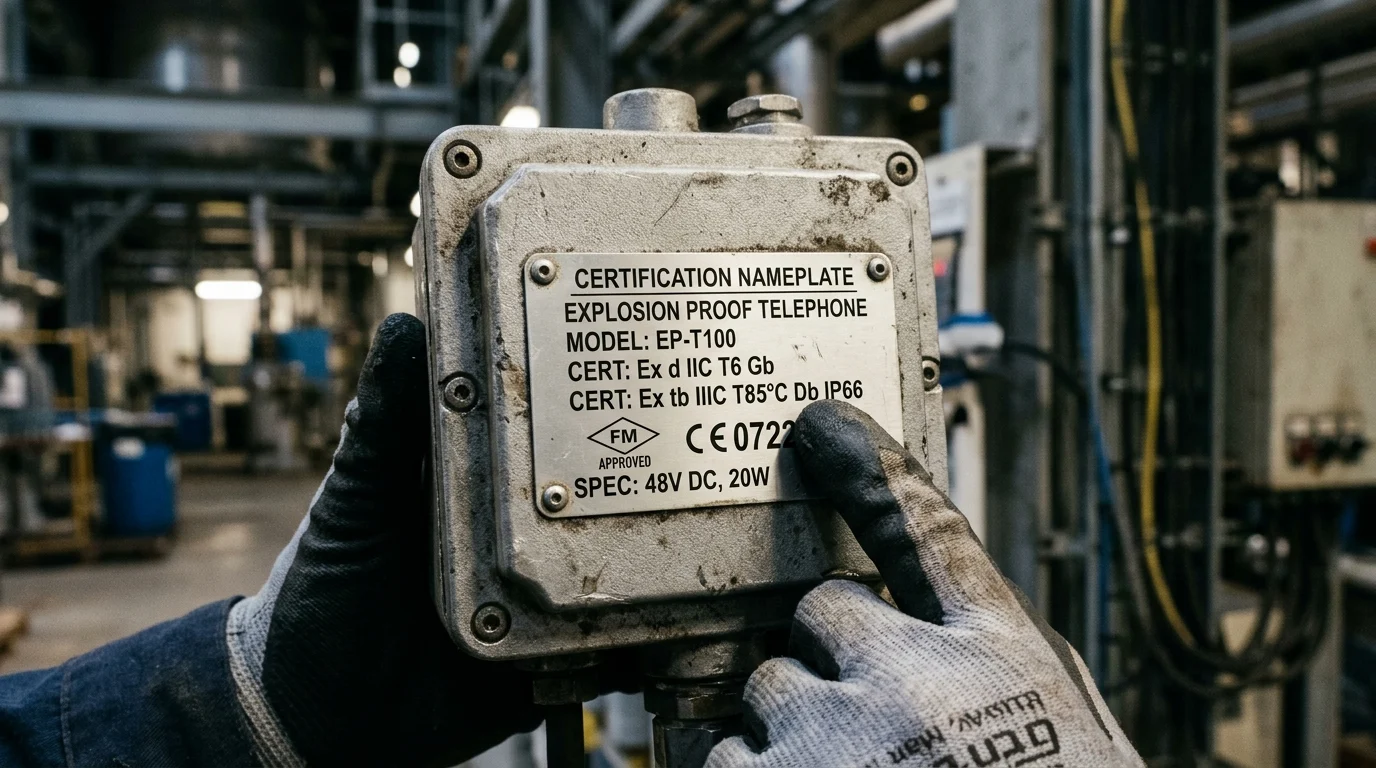
Relying solely on a vendor’s claim of “explosion-proof” without verifying the underlying documentation is a systemic failure in due diligence. Buyers must meticulously verify the EU-Type Examination Certificate or the equivalent local document. This involves checking the Notified Body (NB) number and cross-referencing the certificate’s validity on the issuing agency’s database to ensure it has not been suspended or withdrawn.
Furthermore, the device’s data plate (label) must strictly match the technical files and the facility’s exact hazard classification. Procurement teams should audit the manufacturer’s quality assurance notifications (e.g., ATEX QAN or IECEx QAR) to ensure consistent manufacturing standards. Rejecting vendors that exhibit field defect rates higher than 1.5% or those who cannot produce comprehensive, serialized test reports for each unit is a necessary risk mitigation strategy.
How Sourcing, Installation, and Maintenance Raise Total Cost
The total cost of ownership for explosion-proof telephones extends far beyond the initial purchase order. Errors in sourcing logistics, improper installation practices, and neglected maintenance protocols routinely compound, turning a seemingly economical purchase into a persistent financial drain. Controlling these downstream variables requires aggressive vendor management and strict adherence to certified installation procedures.
How vendor selection, lead times, and spare parts affect outcomes
Supply chain dynamics heavily influence the success of industrial telecom deployments. Explosion-proof equipment is rarely an off-the-shelf commodity; specialized casting and rigorous batch testing mean that lead times frequently stretch from 8 to 16 weeks. Buyers who fail to account for these extended manufacturing cycles often resort to expedited air freight, which can add 15% to 20% to the total project cost due to the heavy weight of the enclosures.
Vendor selection must also prioritize the guaranteed availability of certified spare parts. If a vendor phases out a specific proprietary mainboard or Ex-certified keypad without a backward-compatible replacement, the entire telephone must be discarded upon a minor component failure. Securing a contractual guarantee for spare parts availability for a minimum of 10 years post-purchase is a critical safeguard against forced obsolescence.
Which installation and maintenance mistakes create avoidable risk
Even the most rigorously certified explosion-proof telephone becomes a severe hazard if installed incorrectly. A pervasive mistake is the use of standard, non-certified cable glands during installation. If an Ex d (flameproof) telephone is fitted with an uncertified gland, the integrity of the flame path is instantly compromised, legally voiding the entire assembly’s certification and allowing explosive gases to migrate through the conduit.
Maintenance errors also create avoidable risks. The heavy bolts securing a flameproof enclosure must be tightened to exact manufacturer specifications. Failing to apply the required torque—for instance, under-tightening to 10 Nm when the specification demands 15 Nm—leaves microscopic gaps in the machined flanges, rendering the flamepath ineffective during an internal explosion. Routine maintenance must be performed exclusively by CompEx-certified (or equivalent) technicians to ensure these critical tolerances are maintained.
What procurement steps improve supplier comparison
To neutralize these risks, procurement teams must implement structured evaluation matrices that weigh logistical and operational metrics alongside unit pricing. This ensures a holistic view of supplier capabilities.
| Evaluation Criteria | Vendor A (Low Initial Cost) | Vendor B (Optimized TCO) | Procurement Impact |
|---|---|---|---|
| Unit CapEx | $850 | $1,100 | Initial budget variance of $250 per unit. |
| Standard Lead Time | 14 – 16 Weeks | 6 – 8 Weeks | Faster deployment reduces project holding costs. |
| Spares Guarantee | 3 Years | 10 Years | Prevents premature forced replacement. |
| Cable Gland Inclusion | Not Included | Included (Certified Ex d/e) | Saves ~$50-$80 per unit and prevents installation errors. |
| MTBF Rating | 35,000 Hours | 65,000 Hours | Directly reduces localized downtime and maintenance OpEx. |
How Buyers Should Make the Final Decision
The culmination of the procurement process requires synthesizing engineering requirements, regulatory mandates, and financial constraints into a single, cohesive purchasing decision. Buyers must abandon siloed decision-making, where procurement chases the lowest price while engineering demands the highest possible specifications regardless of actual need.
What decision framework aligns engineering, procurement, and operations
A robust decision framework aligns the distinct priorities of engineering, procurement, and operations. Engineering must define the hard boundaries: the exact Zone/Division, the Gas Group, the Temperature Class, and the required network protocol (e.g., SIP over IEEE 802.3af PoE). Operations dictates the ergonomic and functional requirements, such as the necessity of a full keypad versus an auto-dial hotline, or the integration of a 90 dB(A) visual-acoustic alerting system.
Procurement’s role within this framework is to source equipment that meets these non-negotiable boundaries while optimizing the total cost of ownership.
Key Takeaways
- The most important conclusions and rationale for Explosion Proof Telephones
- Specs, compliance, and risk checks worth validating before you commit
- Practical next steps and caveats readers can apply immediately
Frequently Asked Questions
What is the most common mistake when buying explosion proof telephones?
Using a vague hazard rating. Always confirm the exact Zone/Division, gas group, and temperature class before ordering to avoid unsafe under-specification or costly over-specification.
Do I always need the highest ATEX or T6 rating?
No. Buying beyond the actual site requirement can raise costs significantly. Match the telephone certification to your documented hazardous area assessment.
Why is protocol choice important for explosion proof telephones?
A mismatch can break compliance or complicate installation. If your site uses IP PBX or VoIP, choose a native certified SIP phone instead of adding uncertified converters.
What environmental features should I check before purchase?
Verify IP rating, corrosion resistance, acoustic output, and handset durability. For offshore, mining, or outdoor sites, these details often matter as much as the explosion-proof certificate.
How can Siniwo help reduce buying mistakes?
Siniwo provides one-stop support from design and integration to installation and maintenance, helping buyers match certified explosion-proof telephones to real industrial site conditions.
Post time: Apr-30-2026